
Field Notes Journal Entry
A Year in the Life of a Woodpigeon (Abingdon)
A familiar resident species whose numbers fluctuate through the year, despite being present in every month
Following on from the Starling, it is interesting to consider a species that is equally familiar, but whose seasonal pattern is more subtle.
The Woodpigeon (Columba palumbus) is a widespread and abundant resident, present throughout the year in the Abingdon area.
Monthly Sightings
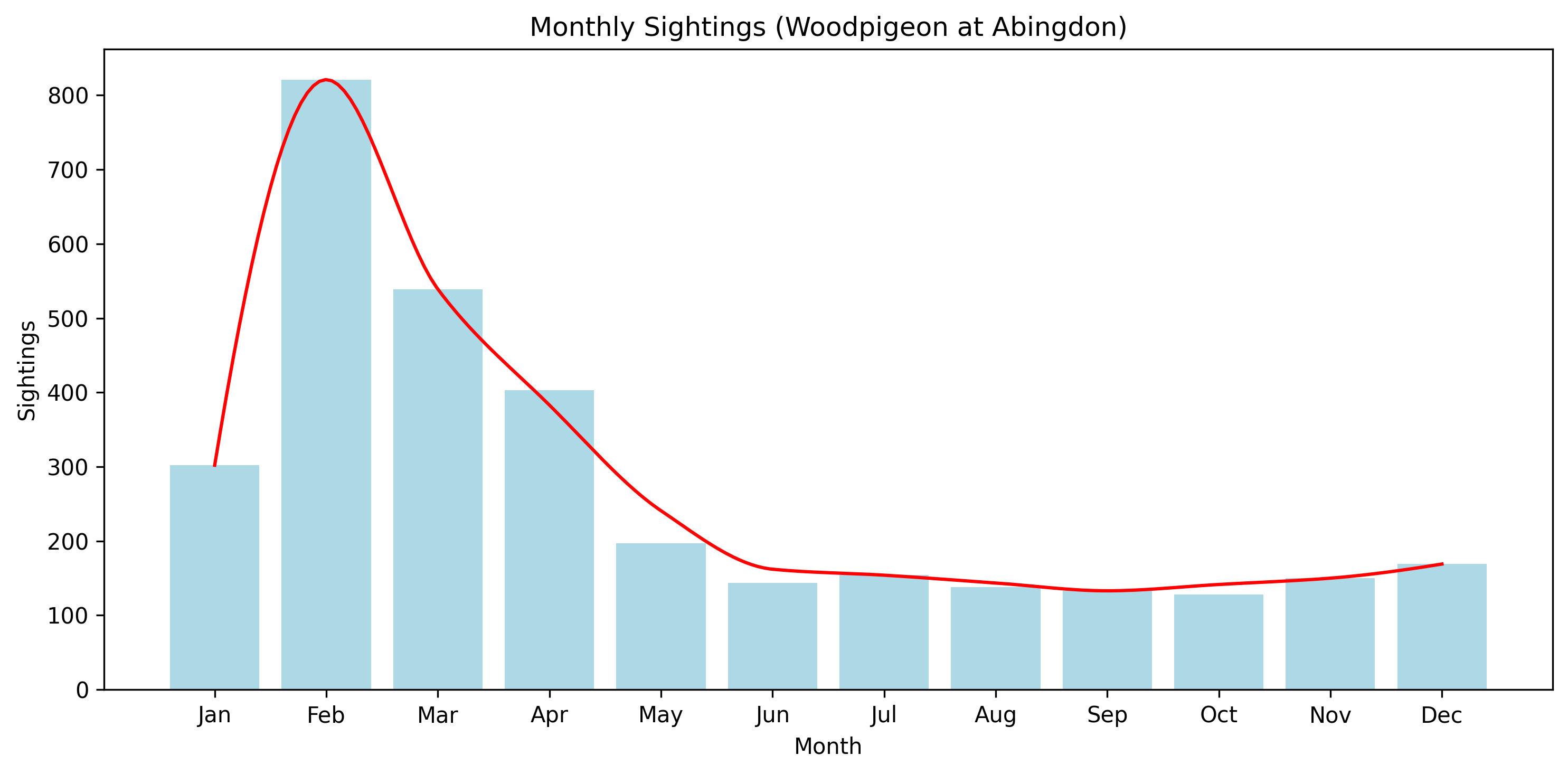
At first glance, the pattern appears less dramatic than some of the migratory species. However, a clear structure emerges:
- A pronounced peak in late winter, particularly February
- A steady decline through spring
- Lower, relatively stable counts through summer
- A gradual increase through autumn into winter
Unlike the Swallow or Chiffchaff, there is no sharp boundary to the curve. Instead, the changes are gradual and continuous.
Presence — How Often Are They Seen?
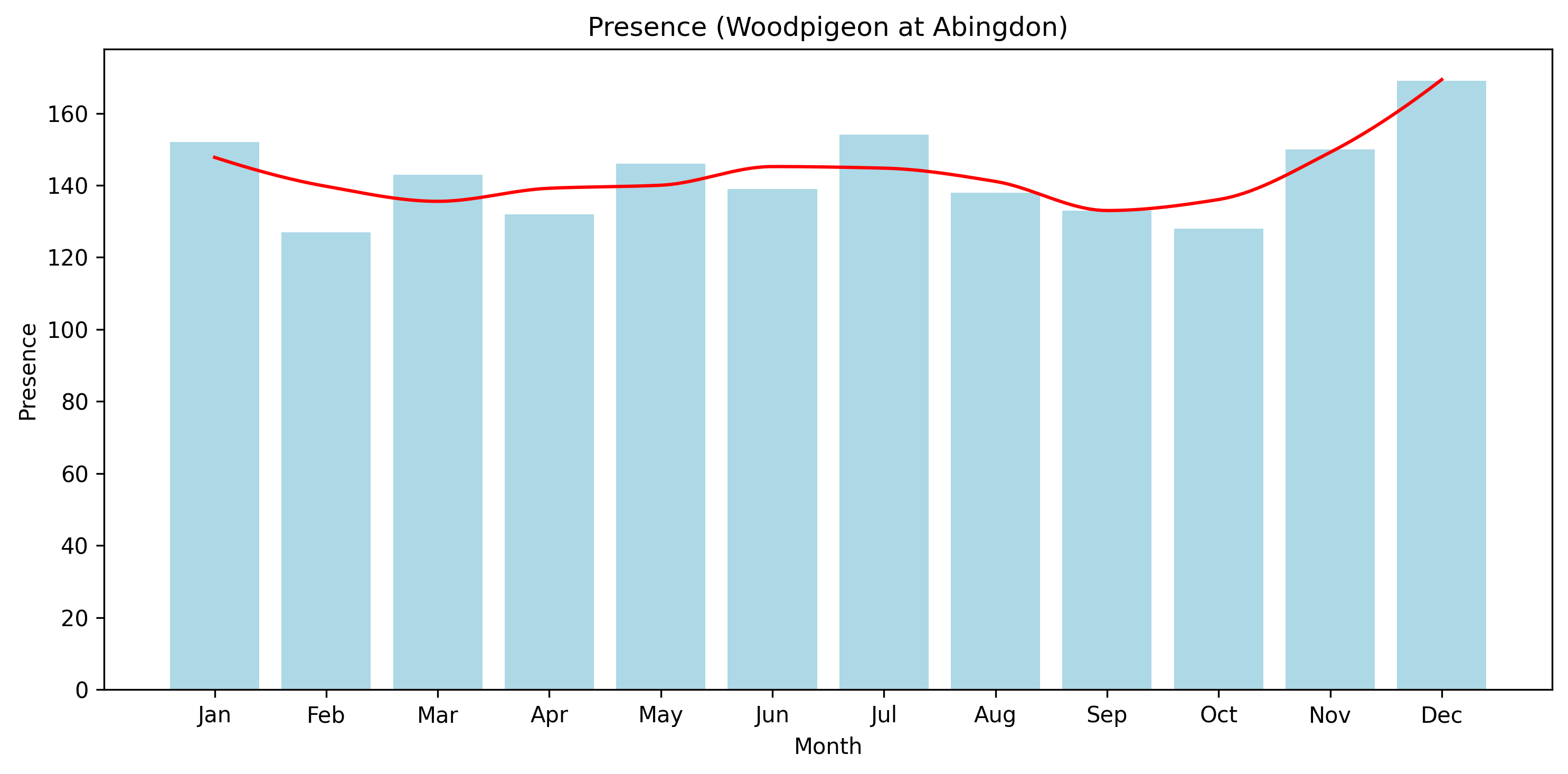
The presence data tells a different story.
Woodpigeons are recorded consistently throughout the year, with only modest variation between months. There is no period of absence, and no clearly defined seasonal window.
This suggests that the species is a constant feature of the local landscape.
Interpreting the pattern
The contrast between the two charts is particularly instructive.
While Woodpigeons are present year-round, the number of individuals encountered varies considerably.
The late winter peak is likely to reflect the formation of larger feeding groups, when birds congregate in open areas and are more readily counted in higher numbers.
As spring approaches, these groups disperse as birds establish breeding territories. Individuals remain present, but are encountered singly or in pairs, leading to a reduction in recorded counts.
Through the summer months, this dispersed pattern continues, with relatively stable but lower counts.
The gradual rise through autumn and into winter suggests a return to more communal behaviour, as birds begin to regroup outside the breeding season.
A Note On The Data
As with the other analyses, these observations are drawn from informal records rather than structured surveys. Recording effort varies through the year, and counts should be interpreted as indicative rather than absolute.
Even so, the contrast between presence and total sightings provides a consistent and informative pattern.
Placing This Alongside Other Species
The Woodpigeon adds an important dimension to the series.
| Species | Primary driver of pattern | Key feature |
|---|---|---|
| Robin | Detectability | Late-summer dip |
| Chiffchaff | Migration | Clear seasonal window |
| Blackcap | Migration with winter presence | Residual winter records |
| Swallow | Migration | Late arrival and autumn departure |
| Starling | Aggregation | Strong winter flocking peak |
| Woodpigeon | Aggregation (diffuse) | Year-round presence, variable counts |
Unlike the Starling, where large flocks dominate the winter pattern, the Woodpigeon shows a more gradual shift between dispersed and aggregated states.
Closing Thoughts
What makes the Woodpigeon particularly interesting is not the presence of a strong seasonal signal, but the way in which that signal is expressed.
The species is always there, but not always in the same numbers.
This distinction — between presence and abundance — turns out to be a useful lens through which to view several of the patterns in this series.
As with the other examples, a simple monthly summary is enough to bring this into focus.