
Field Notes Journal Entry
A Year in the Life of a Swallow (Abingdon)
A clear seasonal visitor whose pattern reflects arrival, breeding, and departure, with a subtle late-summer peak
Following on from the Chiffchaff and Blackcap, it’s useful to look at a species that shows a particularly clear seasonal presence.
The Swallow (Hirundo rustica) is a familiar summer visitor, closely associated with open farmland and buildings, and well represented in the Abingdon records.
Monthly Sightings
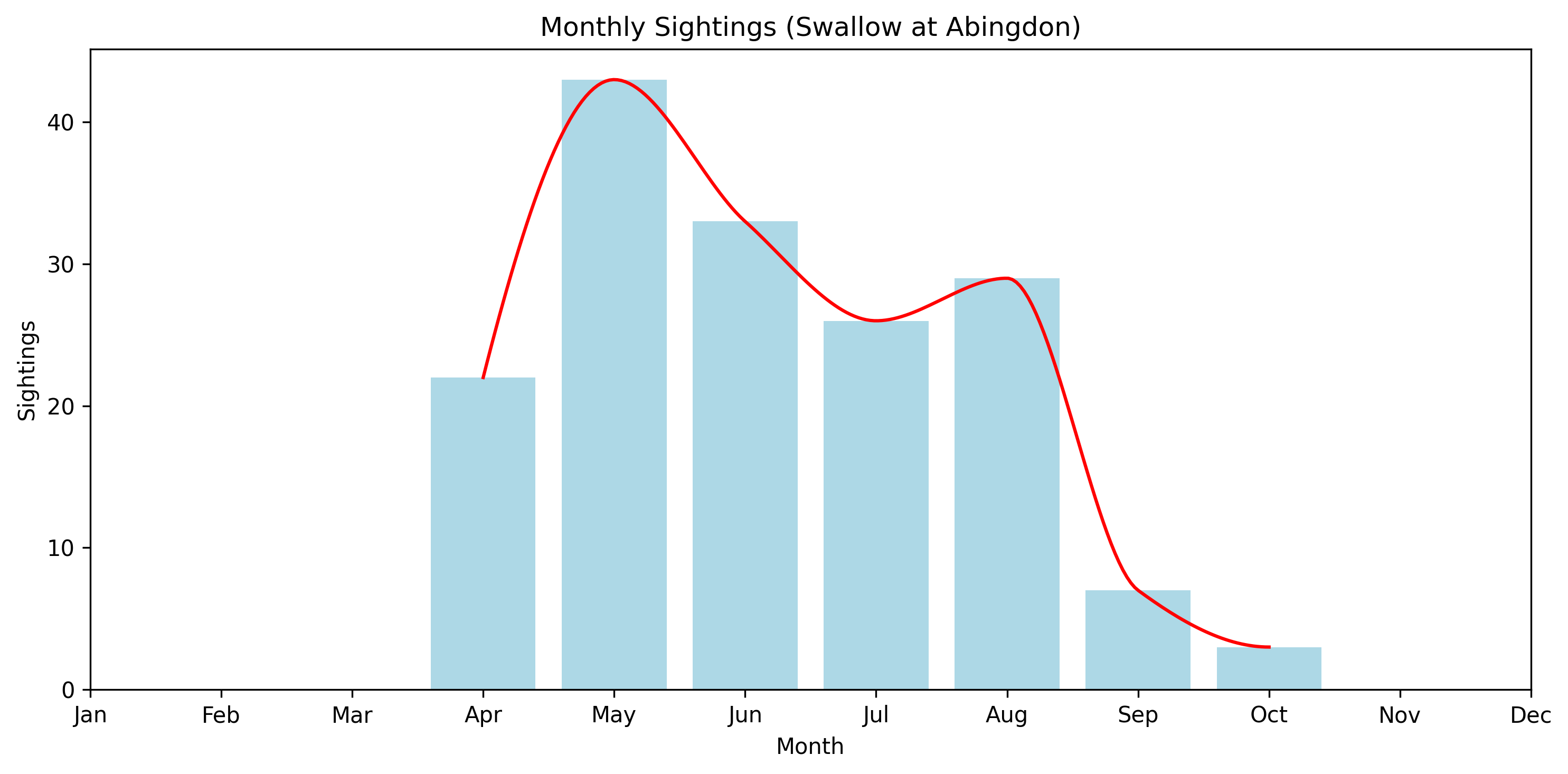
The overall pattern is strikingly well defined:
- No records through winter and early spring
- A sudden appearance in April
- A strong peak in May
- A gradual decline through June and July
- A smaller rise in August
- A rapid fall through September, with very few records by October
Compared with the earlier species, this is a notably clean seasonal window.
Presence — How Often Are They Seen?
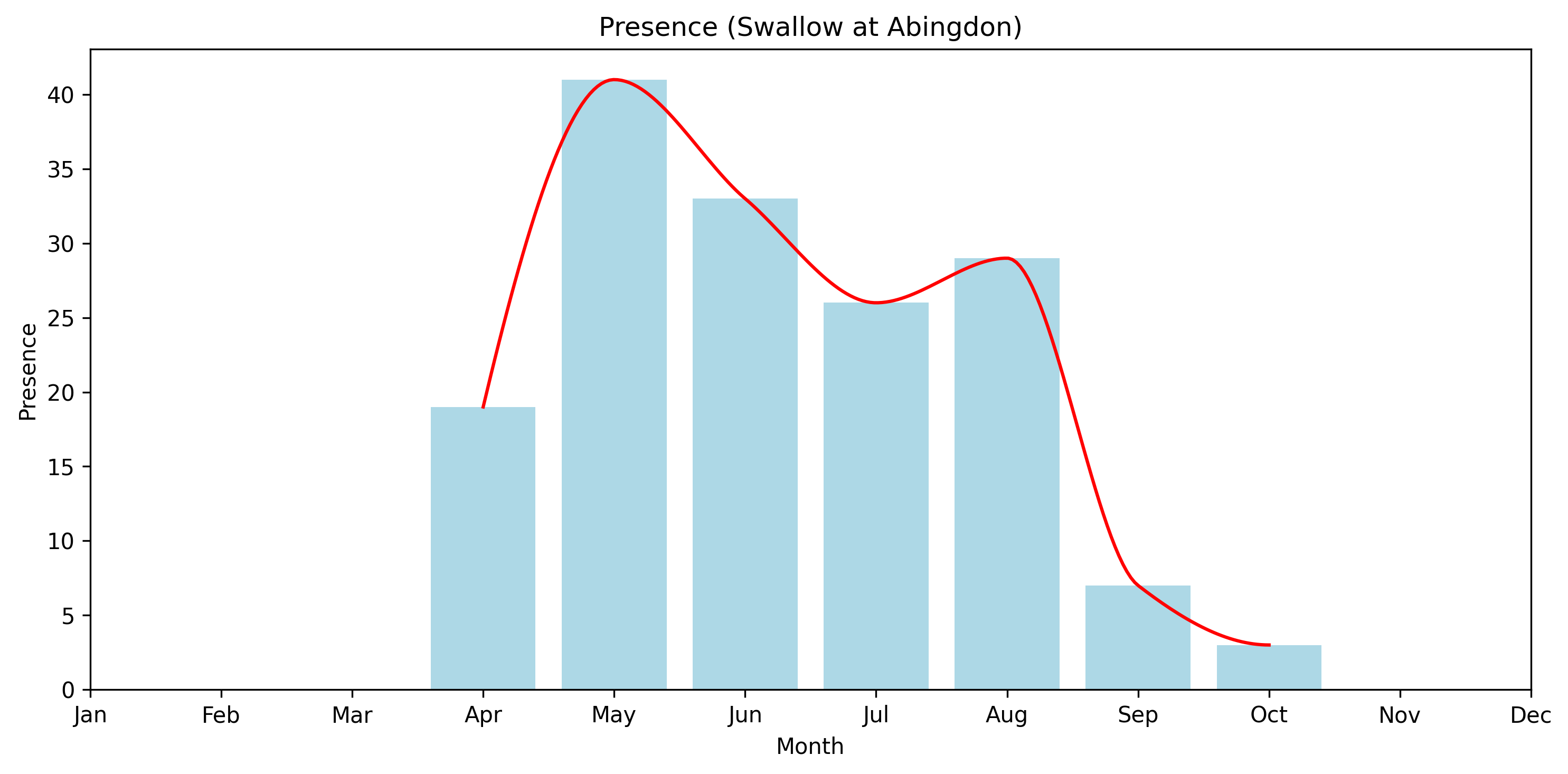
The pattern of encounter frequency closely mirrors the total sightings.
The rise, peak, and decline are all clearly visible, suggesting that both measures are capturing the same underlying process: the presence of the species in the local area.
Interpreting the pattern
As with the Chiffchaff, the Swallow curve is best understood as reflecting seasonal presence rather than changes in detectability alone.
The species is absent through the winter, arrives in spring, and departs again in early autumn.
The April rise corresponds to arrival, while the strong peak in May likely reflects a period of high activity associated with territory establishment and breeding.
The gradual decline through June and July suggests a transition into a more settled phase of the breeding season, when birds are still present but perhaps less conspicuous.
One feature stands out, however: a secondary rise in August.
This is likely to reflect the presence of newly fledged birds and increased movement in the period leading up to migration. At this stage, birds may be more frequently encountered as they gather and feed in preparation for departure.
The sharp decline through September marks the onset of migration, with very few records remaining by October.
A Note On The Data
As with the other analyses, these records come from informal observations rather than structured surveys. Counts are typically low, and recording effort varies through the year.
The charts are therefore best read as indicative patterns. The clarity of the seasonal signal, however, makes the interpretation relatively robust.
Placing This Alongside Other Species
Seen alongside the Chiffchaff and Blackcap, the Swallow provides a useful point of comparison.
| Species | Primary driver of pattern | Key feature |
|---|---|---|
| Chiffchaff | Migration (arrival and departure) | Early, compact seasonal window |
| Blackcap | Migration with winter presence | Residual winter records |
| Swallow | Migration (clear seasonal presence) | Late arrival and autumn departure |
All three are migratory, but their patterns differ in timing and structure.
Closing Thoughts
What stands out here is the clarity of the seasonal signal, combined with a small amount of internal structure.
Even within a relatively simple “present or absent” pattern, it is possible to see traces of different phases: arrival, breeding, and departure.
As with the other examples, a simple monthly summary is enough to bring these phases into view.