
Field Notes Journal Entry
A Year in the Life of a Blackcap (Abingdon)
A seasonal visitor with a more complex pattern, reflecting both migration and a small but persistent winter presence
Following on from the Chiffchaff, it’s interesting to look at a species that, at first glance, might be expected to show a similar pattern.
The Blackcap (Sylvia atricapilla) is also a familiar summer visitor in the UK, and well represented in the Abingdon records.
Monthly Sightings
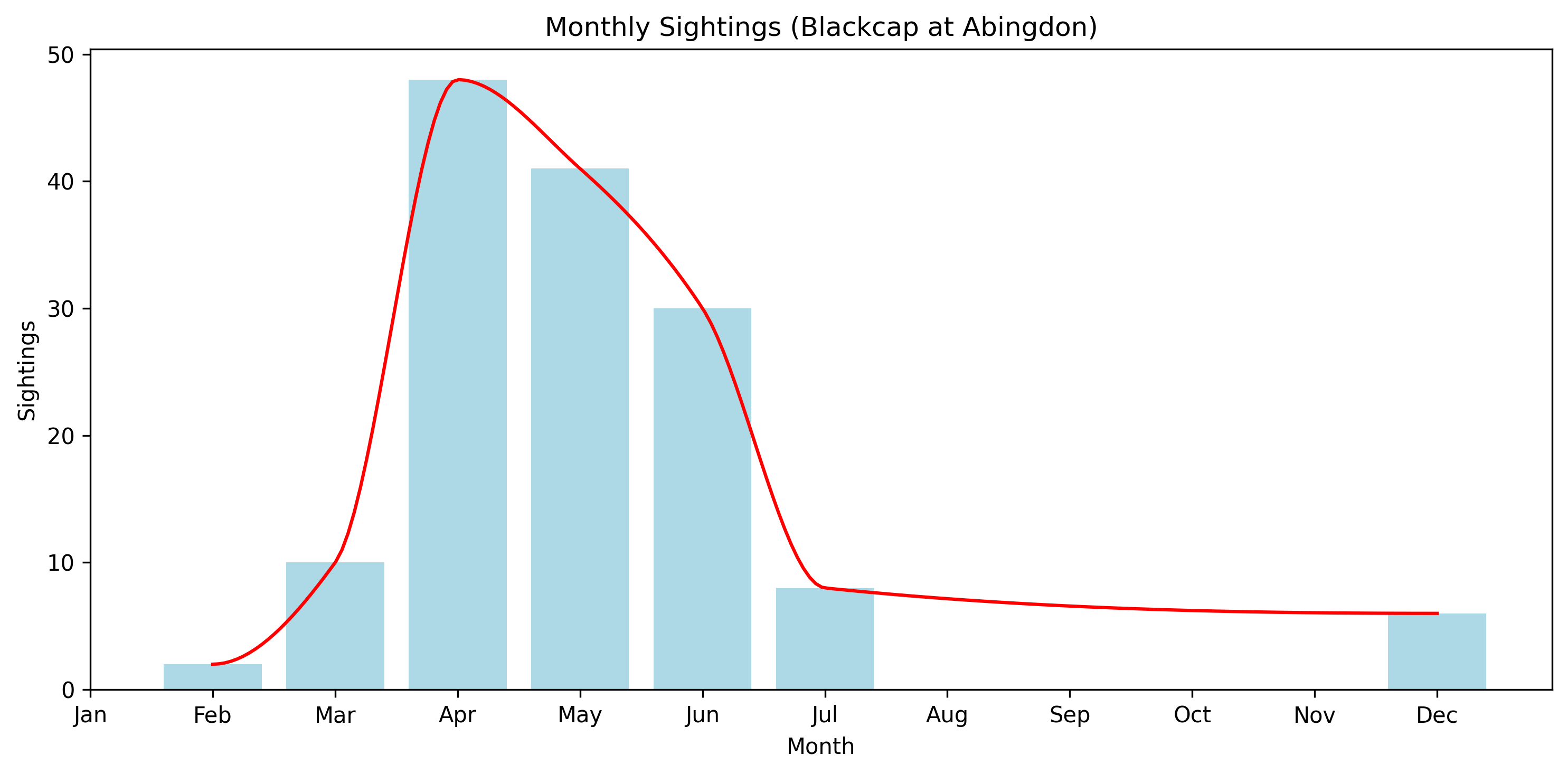
The overall shape is recognisably seasonal:
- Very few records in winter
- A sharp rise through March
- A peak in April
- A gradual decline through May and June
- Very low numbers by July
This closely mirrors the pattern seen in Chiffchaff, suggesting a similar underlying process of spring arrival and summer presence.
Presence — How Often Are They Seen?
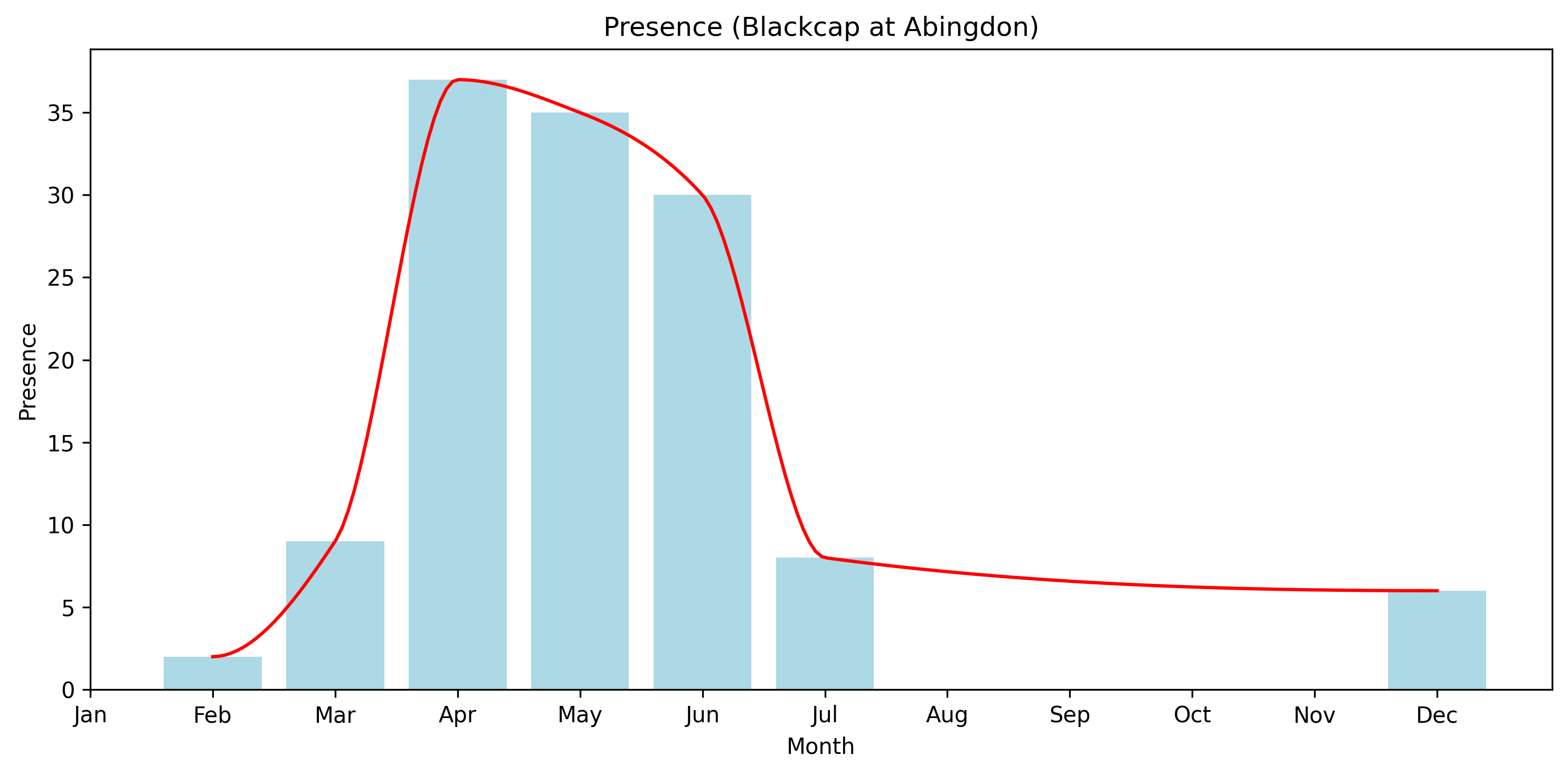
Looking at encounter frequency reinforces the same general structure.
The rise, peak, and decline are all clearly visible, with the species recorded on many days during the spring and early summer.
However, one feature stands out on closer inspection.
Interpreting the pattern
Unlike the Chiffchaff, the Blackcap does not drop cleanly to zero outside the breeding season.
A small but consistent level of winter records is present in the data.
This suggests that, while the species remains primarily a migratory visitor, a proportion of individuals are now present throughout the year.
The main spring peak can be interpreted in the same way as for other migratory species:
- Arrival in March
- Peak detectability during territorial song in April
- Gradual decline through the breeding season
But the presence of winter records points to a more complex pattern.
In recent decades, Blackcaps have increasingly been recorded overwintering in the UK. These birds are often thought to originate from populations that would previously have migrated further south, but now remain in or move to milder western areas.
From a field perspective, this produces a hybrid signal:
- A strong seasonal curve driven by migration
- Overlaid with a low-level, year-round presence
Both charts reflect this combination:
- A pronounced spring peak
- A rapid decline into summer
- A persistent, if minimal, winter signal
A Note On The Data
As with the other analyses, these records come from informal observations rather than structured surveys. Counts are typically low, and recording effort varies through the year.
The charts are therefore best read as indicative patterns. The consistency of the seasonal shape, and the repeated appearance of winter records, is what makes the signal of interest.
Placing This Alongside Other Species
Seen alongside the Chiffchaff, the Blackcap highlights how migration patterns are not always cleanly defined.
| Species | Primary driver of pattern | Key feature |
|---|---|---|
| Chiffchaff | Migration (arrival and departure) | Clear seasonal window |
| Blackcap | Migration with winter presence | Residual winter records |
Although both species are traditionally regarded as summer visitors, their patterns in the data differ in subtle but important ways.
Closing Thoughts
What stands out here is not just the seasonal peak, but the departure from a simple on–off pattern.
The Blackcap suggests that even within a single category — migratory species — there can be variation in how clearly that migration is expressed in local records.
As with the other examples, a simple monthly summary is enough to bring out this difference, provided the results are read with a little care.