
Field Notes Entry
A Year in the Life of a Starling (Abingdon)
A year-round species whose seasonal pattern reflects changes in group size rather than simple presence or detectability
Following on from the earlier examples, it’s interesting to look at a species that is present throughout the year, but whose pattern is shaped less by detectability or seasonality alone, and more by changes in how individuals are distributed.
The Starling (Sturnus vulgaris) is a familiar and widespread bird locally, often encountered in groups, particularly in the colder months.
Monthly Sightings
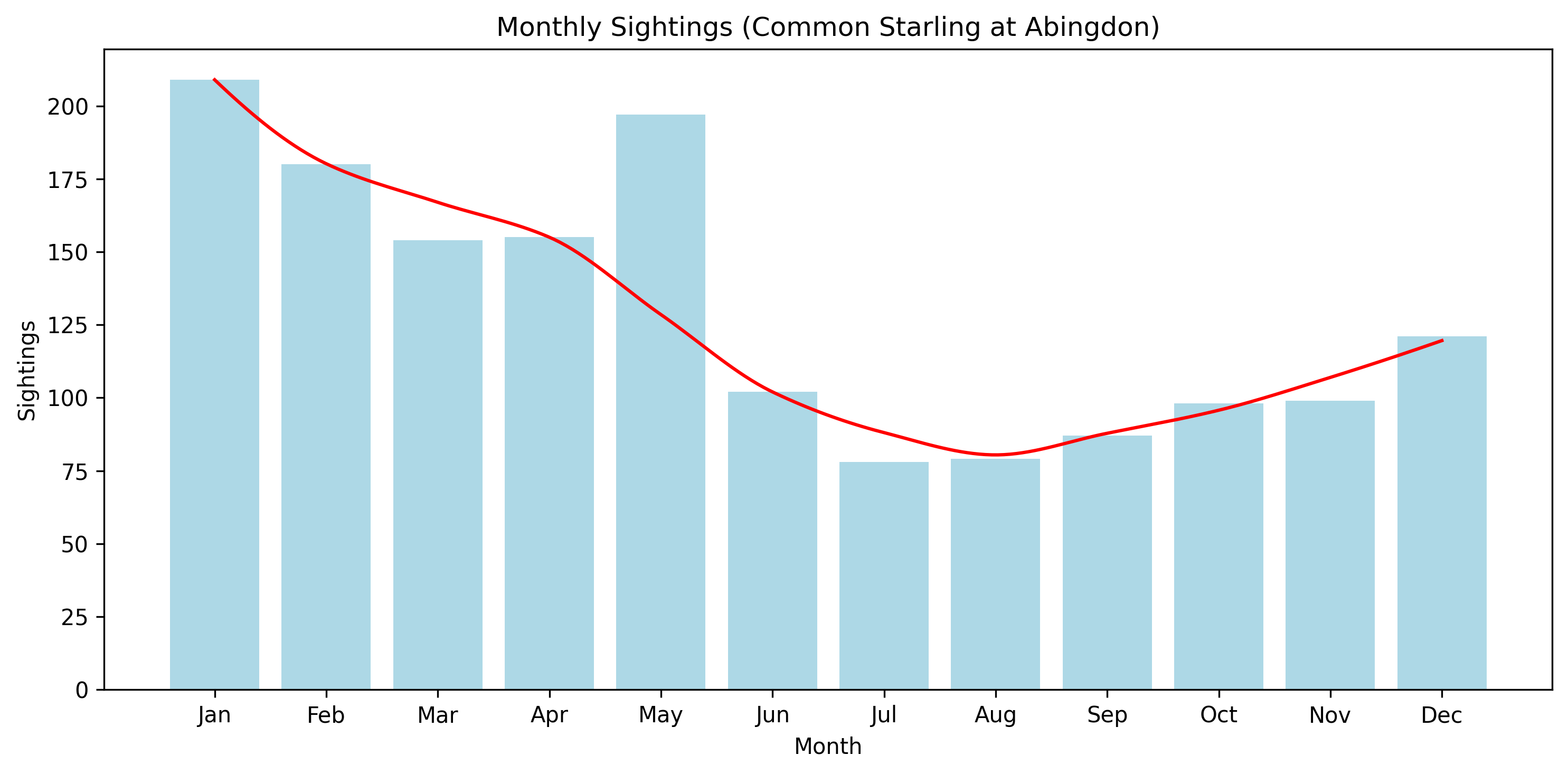
The overall pattern differs noticeably from the other birds considered so far:
- High counts through winter, particularly in December and January
- A gradual decline into spring
- A small rise around May
- A clear low point in mid to late summer
- A steady recovery into autumn
Unlike the Chiffchaff, the species is present throughout the year, but the number of individuals recorded varies considerably.
Presence — How Often Are They Seen?
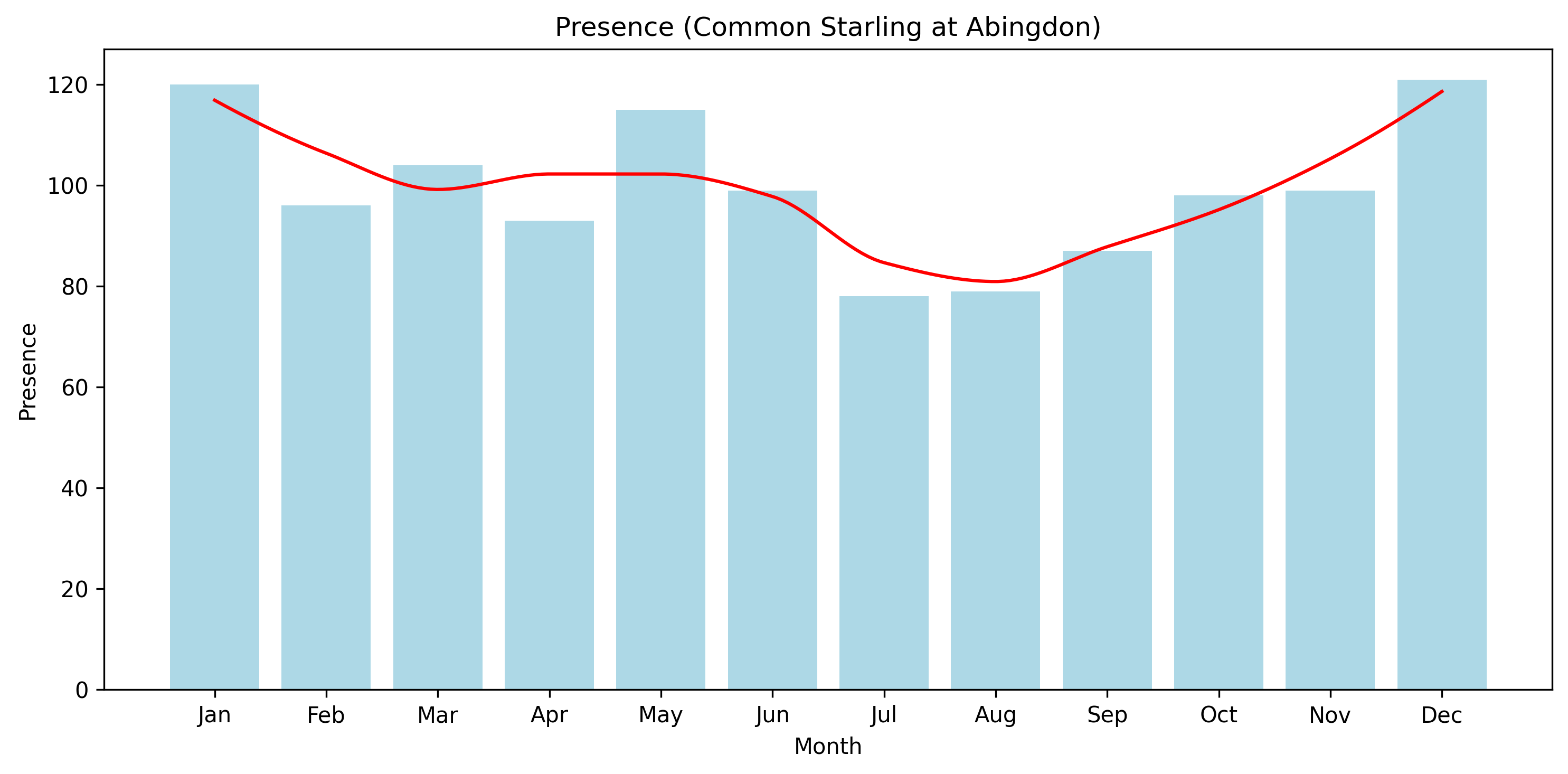
Looking at encounter frequency reveals a more even pattern.
Starlings are recorded on a large number of days throughout the year, with only a modest dip in mid-summer and a gradual increase into winter.
The contrast between the two charts is more pronounced here than in the previous examples.
Interpreting the pattern
In this case, the difference between total sightings and presence is itself informative.
The Starling pattern reflects changes in group size, rather than simple presence or absence.
During winter, Starlings tend to form large flocks, often feeding together in open areas. This leads to higher counts when they are encountered, even if the number of days on which they are seen does not increase proportionally.
Through spring, these flocks begin to break up as birds move into breeding pairs and smaller groups. The number of individuals recorded per sighting falls, even though the species remains commonly encountered.
The small rise in May may reflect increased activity associated with feeding young, when adults make frequent trips between feeding areas and nest sites.
By mid to late summer, numbers are at their lowest. Birds are more dispersed, less conspicuous, and undergoing moult, all of which reduce both counts and encounter frequency.
From autumn onwards, flocks begin to reform, and the number of individuals seen per encounter increases once again, leading into the winter peak.
A Note On The Data
As with the other analyses, these records come from informal observations rather than structured surveys. Counts vary widely, particularly for a species that is often seen in groups.
The charts are therefore best read as indicative patterns. The difference between the two measures, however, provides a useful additional dimension in this case.
Placing This Alongside Other Species
Seen alongside the earlier examples, the Starling highlights a further way in which seasonal patterns can arise.
| Species | Primary driver of pattern | Key feature |
|---|---|---|
| Blackbird | Behaviour (moult, concealment) | Mid-summer dip |
| Robin | Behaviour, with earlier timing | Earlier seasonal dip |
| Daisy | Flowering and environmental factors | Spring peak |
| Dandelion | Extended flowering and persistence | Broad seasonal presence |
| Chiffchaff | Migration (arrival and departure) | Sharp seasonal window |
| Starling | Social behaviour (flocking) | Winter-weighted counts |
Although the same method is used throughout, the meaning of the curves continues to vary by species.
Closing Thoughts
What stands out here is that not all variation is about whether a species is present, or even how easily it can be detected.
In the case of the Starling, the key factor is how birds are grouped: whether they are dispersed or gathered into flocks.
This adds another layer to the interpretation of these simple monthly summaries, suggesting that even informal records can begin to reflect not just seasonal timing, but aspects of social behaviour as well.
Data for this chart is available to download here: