
Field Notes Entry
A Year in the Life of a Blackbird (Abingdon)
Exploring seasonal patterns in Blackbird sightings around Abingdon, using long-term field notes to reveal a late-summer dip in visibility
Up to now, most of the wildlife-related charts and tables on this site have been about what has been recorded — summaries of sightings, distributions, trends and totals over time.
For some time, I’ve wanted to look at the data slightly differently: not just as a record of observations, but as a way of teasing out patterns in behaviour — asking whether long-term, everyday notes might reveal something about how individual species change through the year.
This is a first small attempt at that, using one of the most familiar birds locally, and one of my personal favourites: the Blackbird (Turdus merula), recorded around Abingdon over a number of years.
Monthly Sightings
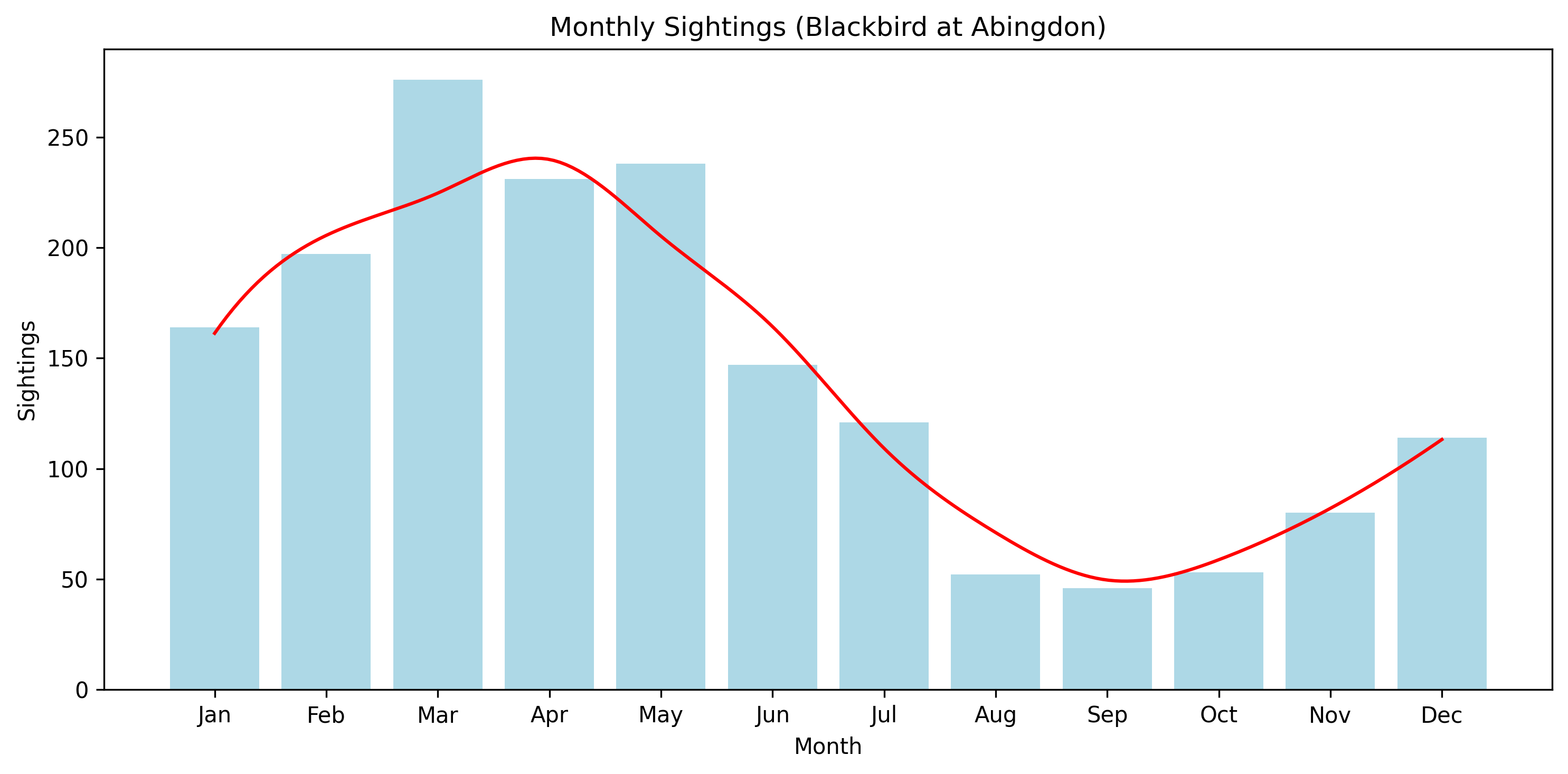
This chart shows the total number of Blackbird sightings by month, aggregated across all years in the dataset.
There’s an immediate and fairly intuitive shape:
- A rise through late winter into spring
- A peak around March–May
- A noticeable decline through mid to late summer
- A recovery into autumn and early winter
On its own, that already suggests a seasonal pattern — but total counts can be influenced by how often I was out recording.
Presence — How Often Are They Seen?
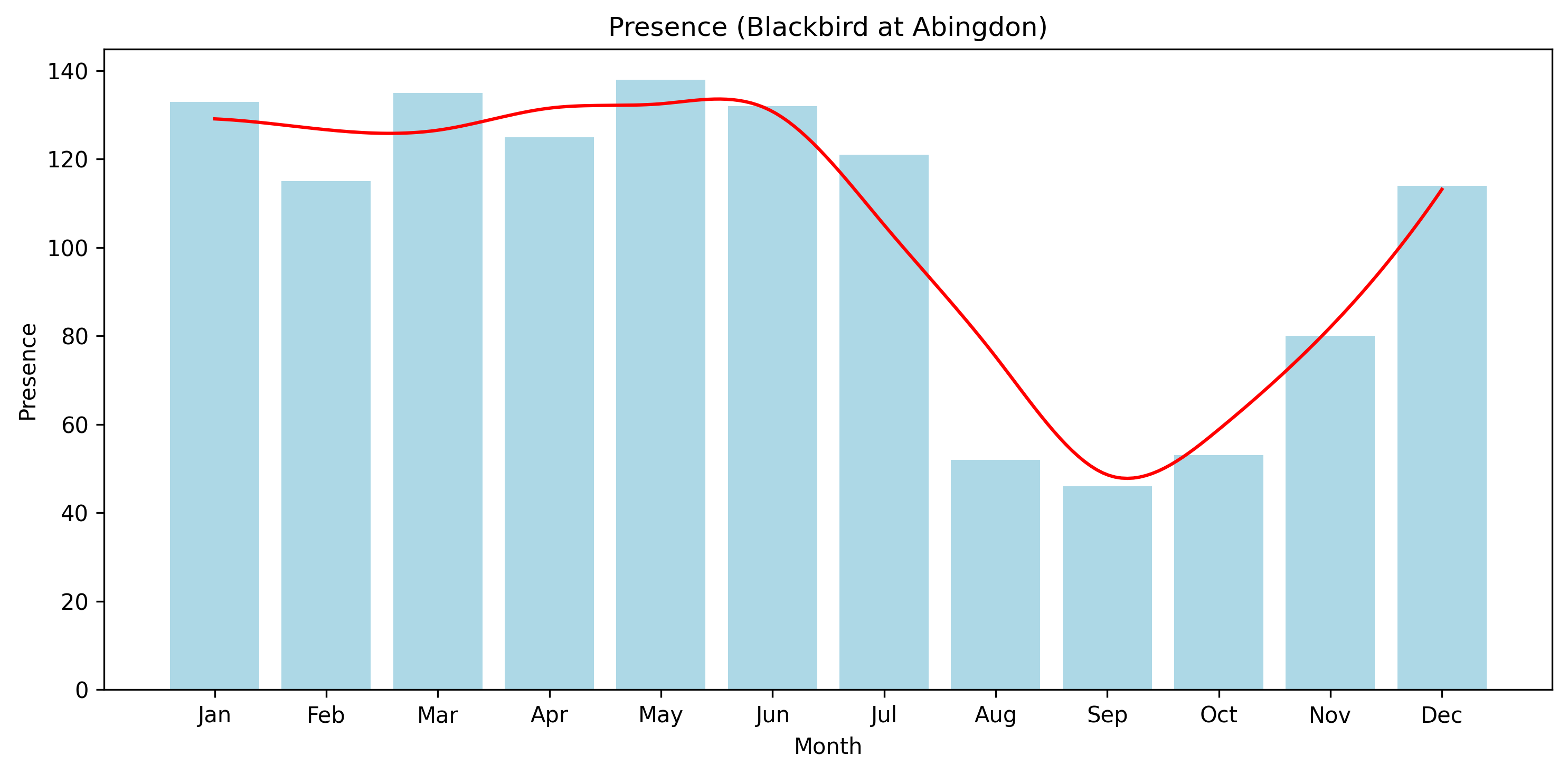
This second chart takes a slightly different approach. Instead of counting how many birds were seen, it simply asks:
On how many days did I see at least one Blackbird?
This reduces the data to a measure of encounter frequency — essentially, how likely I was to come across a Blackbird on a walk in a given month.
The overall shape is similar, but one feature stands out more clearly: A marked dip in August and September.
Interpreting the pattern
It would be easy to read this as “there are fewer Blackbirds in late summer”, but that’s probably too strong a conclusion.
A more cautious interpretation is:
Blackbirds become less detectable at that time of year.
Late summer coincides with the annual moult. During this period birds tend to be:
- Quieter (less song and calling)
- More concealed in vegetation
- Generally less active in open view
From a field perspective, it’s a time when the hedgerows feel noticeably quieter — and the data here seems to reflect that.
Both charts support this idea:
- The total sightings decline
- The frequency of encounters drops even more sharply
Which suggests that the change is not just in numbers seen, but in how often the birds are noticed at all.
A Note On The Data
These records come from informal, repeated observations rather than structured surveys. Counts are often low (frequently a single bird), and recording effort varies through the year.
For that reason, the charts are best read as indicative patterns rather than precise measures. The consistency of the seasonal shape across years is what makes the signal interesting.
Closing Thoughts
What’s pleasing here is that a very simple transformation of everyday records — just grouping them by month and asking slightly different questions — is enough to bring out something recognisable.
It’s a small example, but it suggests there’s more to be found in the dataset: not just lists of sightings, but traces of how species move, behave, and become visible (or not) through the year.
Data for this chart is available to download here: