IN-2026-017 - Dandelion (Taraxacum officinale) — Leaf (W.M.)
Specimen & Context
| Date | 2026-04-13 |
| Species | Taraxacum officinale |
| Common Name | Dandelion |
| Habit | Basal rosette herb with broad, lobed leaves |
| Material | Fresh leaf |
| Location | Abingdon, Oxfordshire, UK |
| Preparation | Leaf, Whole Mount (W.M.) |
| Stain | None |
| Series | Scheme of Structural Investigations - Series II — Support & Conduction |
Overview
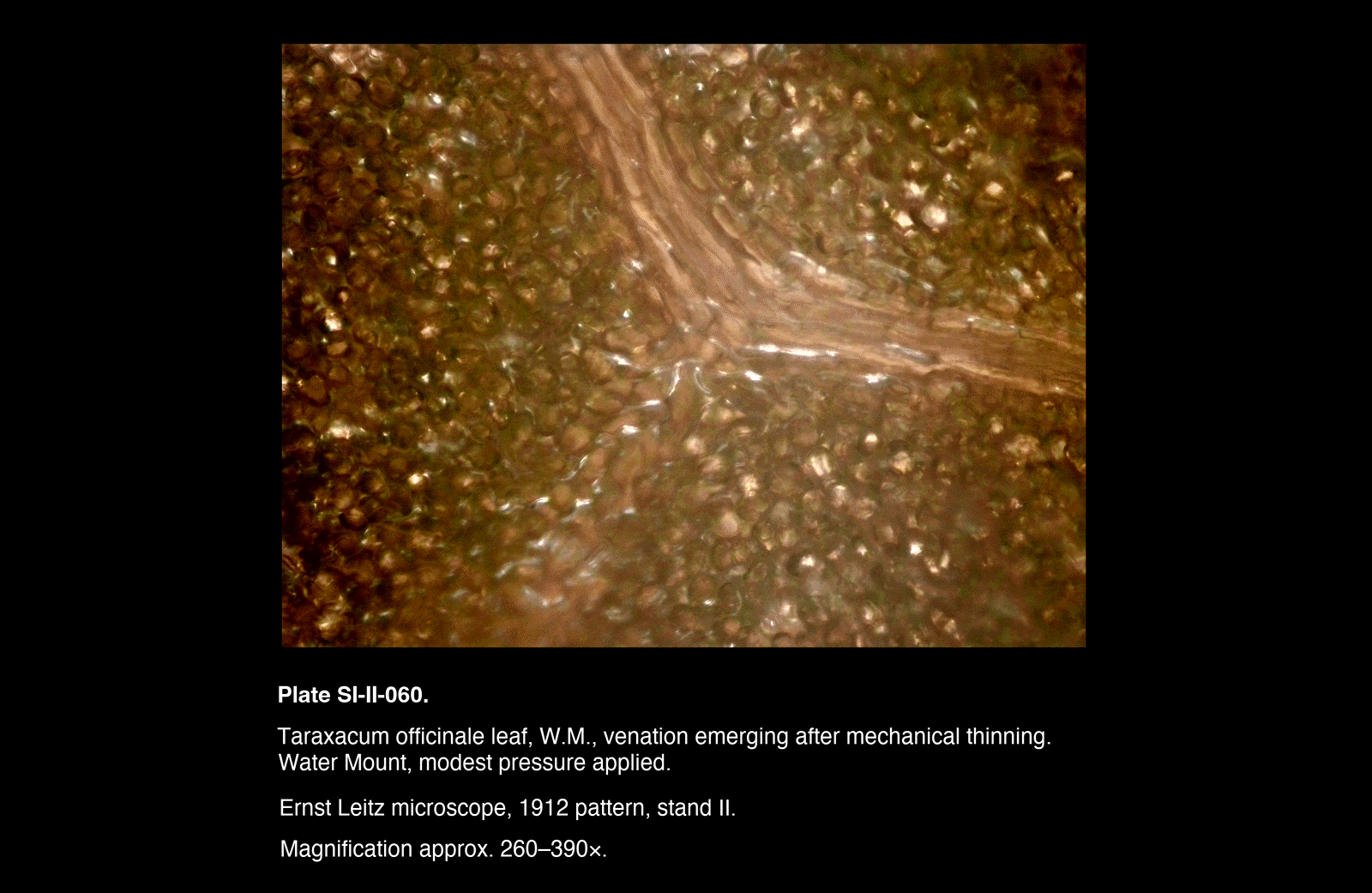
This investigation examines the venation of the leaf of Taraxacum officinale using whole mounts. The aim was to observe how vascular structure is expressed within intact tissue, and how visibility of that structure changes with preparation.
Particular attention was given to the relationship between venation and the surrounding mesophyll, and to the effect of light mechanical thinning applied after mounting.
Method (Summary)
- Small sections cut from fresh leaf material
- Mounted in water (W.M.) under cover glass
- Observed under moderate to high magnification
- Selected preparations subjected to modest pressure post-mounting
- Multiple fields examined to capture variation in visibility of structure
Observations
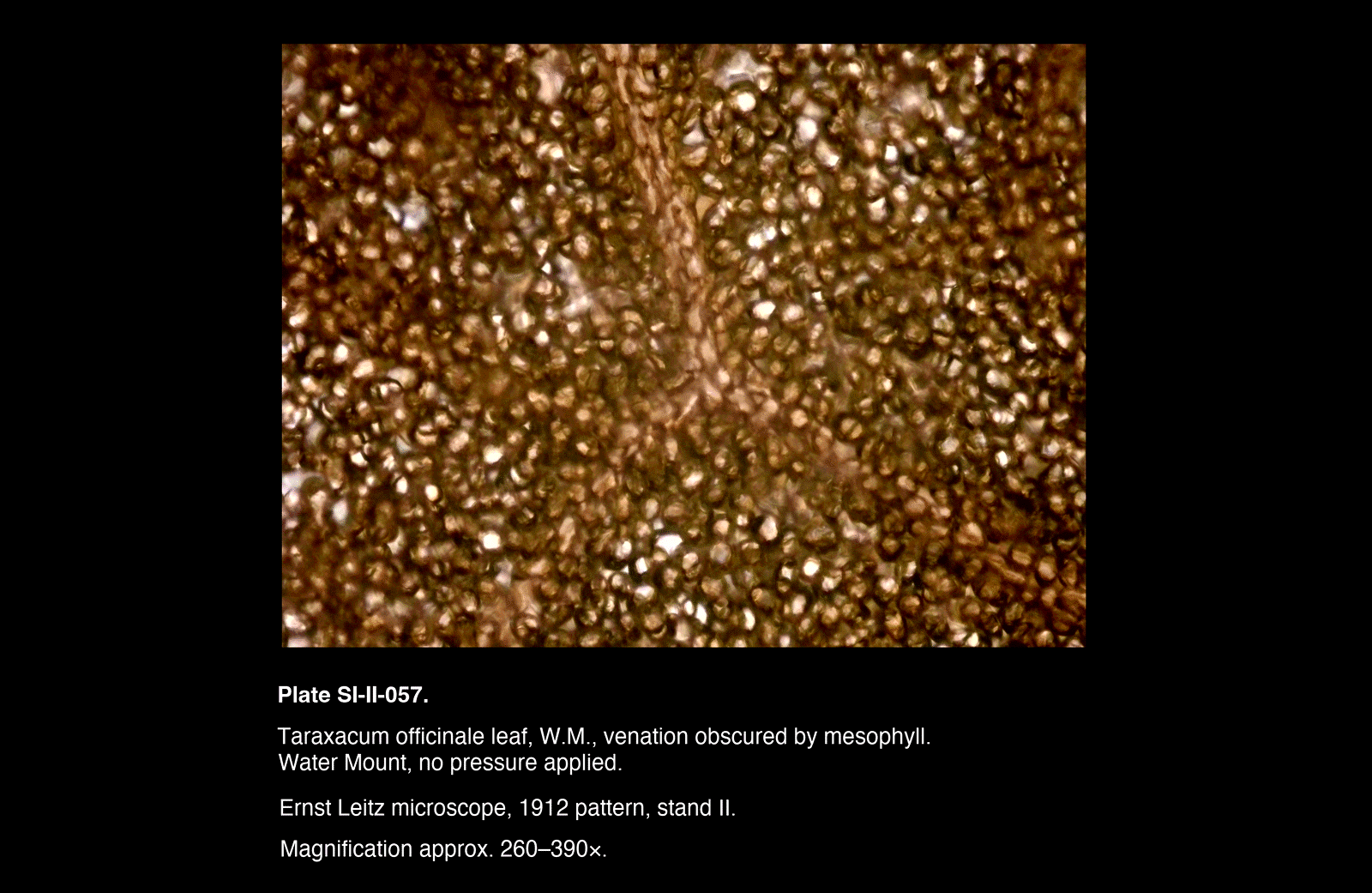
- In untreated mounts, venation is often partially or fully obscured by mesophyll tissue
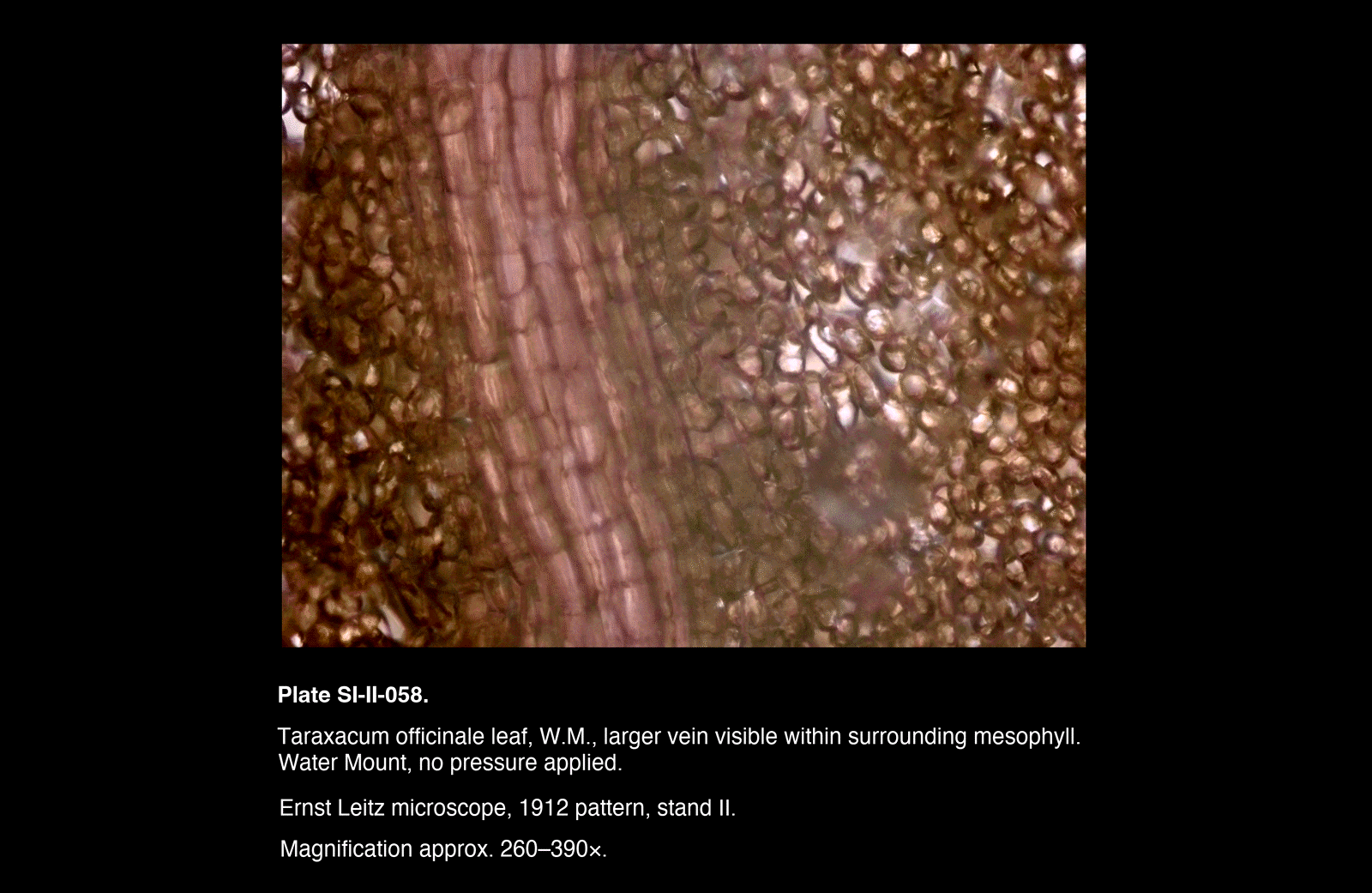
- Larger veins (including the midrib) are more readily resolved, even without pressure
- Application of modest pressure results in:
- Displacement and thinning of mesophyll
- Increased contrast between vascular tissue and surroundings
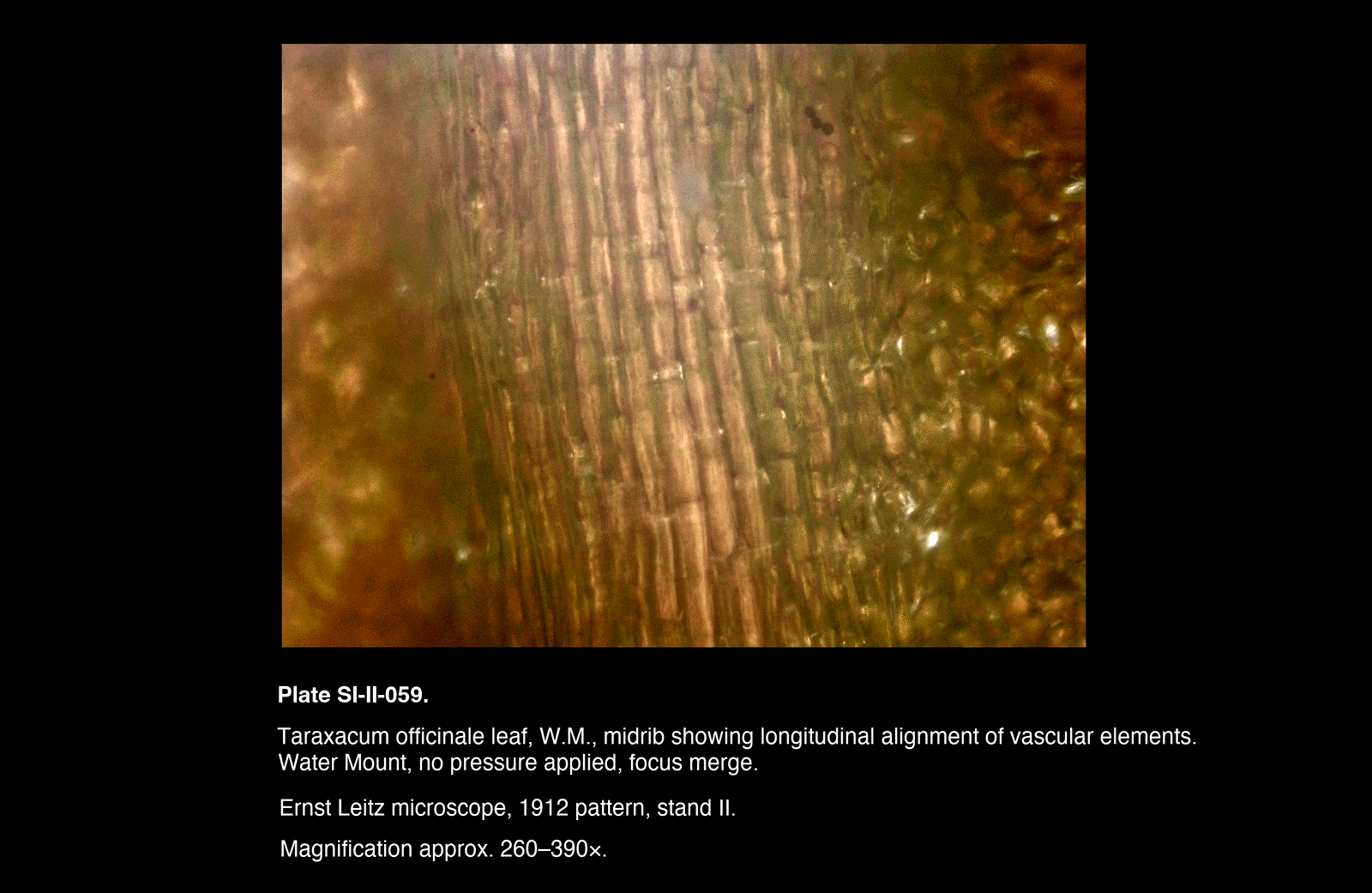
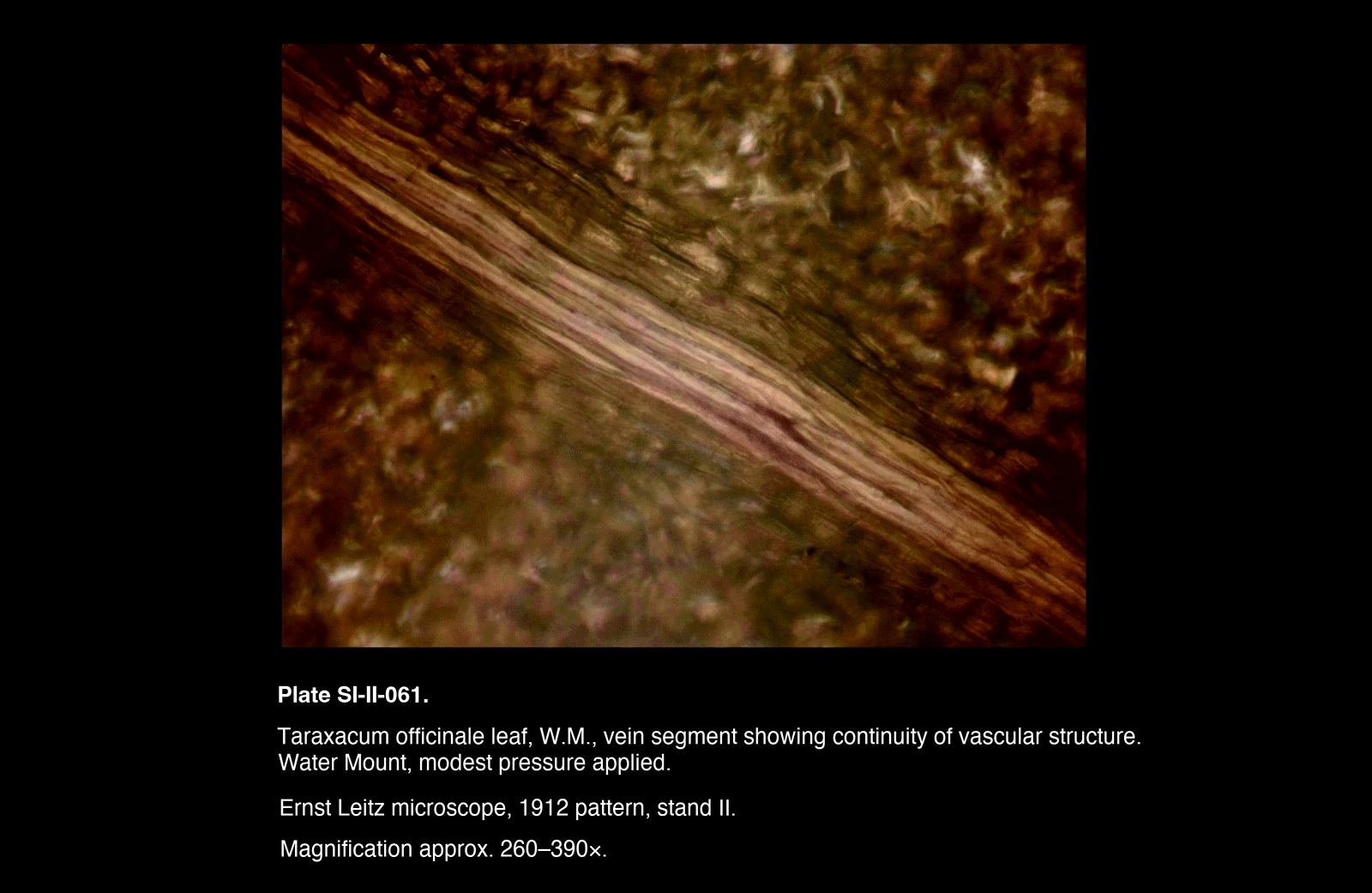
- Veins appear as elongate, continuous structures, with visible internal alignment in larger elements
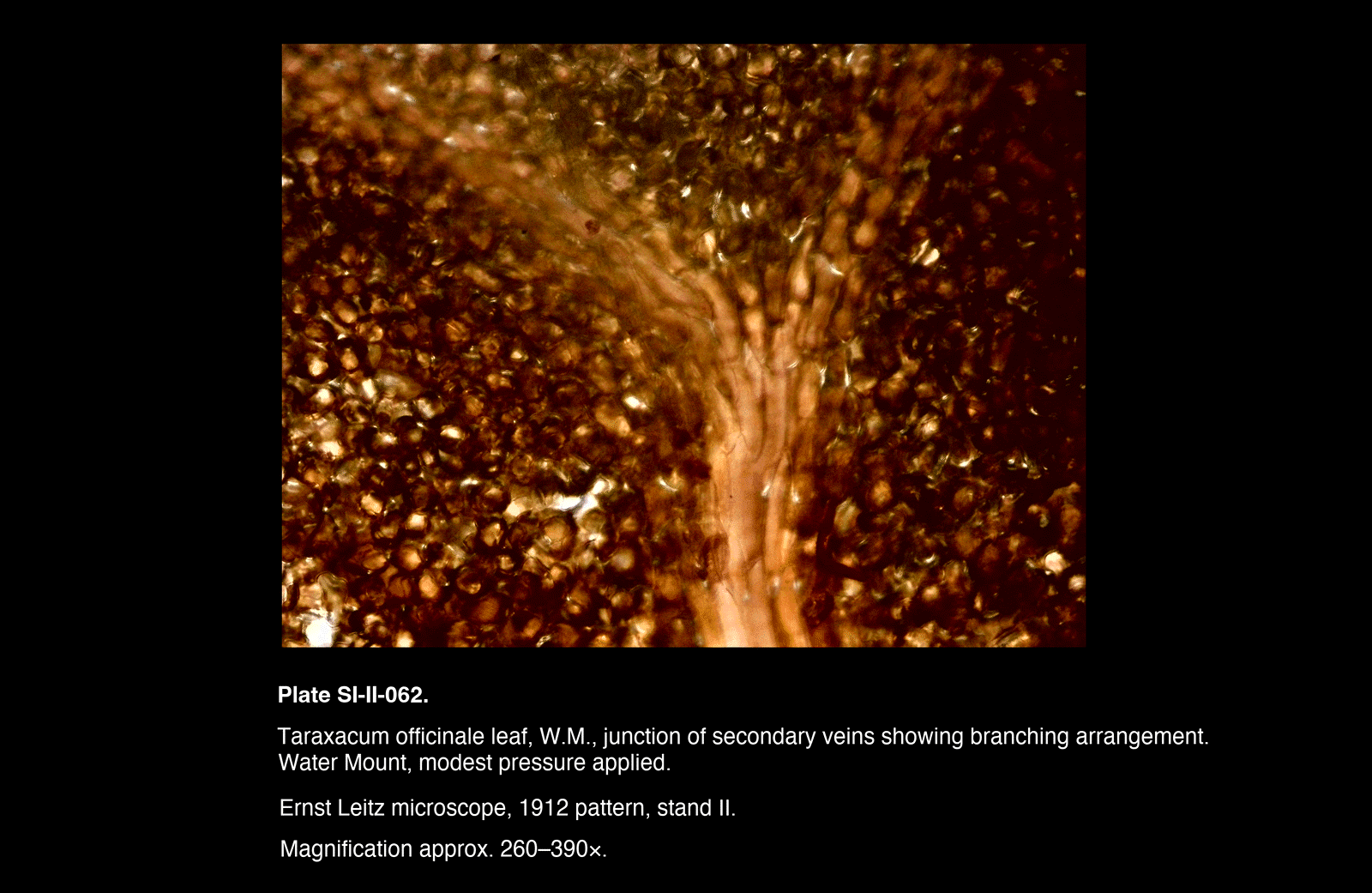
- Points of branching show a clear hierarchical organisation, with smaller veins diverging from larger axes
- Considerable variation exists between fields depending on:
- Local tissue thickness
- Degree of pressure applied
- Orientation of the specimen
Plates
Selected Plates
/Taraxacum%20officinale%20leaf,%20W.M.,%20venation%20obscured%20by%20mesophyll)
/Taraxacum%20officinale%20leaf,%20W.M.,%20larger%20vein%20visible%20within%20surrounding%20mesophyll)
/Taraxacum%20officinale%20leaf,%20W.M.,%20midrib%20showing%20longitudinal%20alignment%20of%20vascular%20elements.)
/Taraxacum%20officinale%20leaf,%20W.M.,%20venation%20emerging%20after%20mechanical%20thinning)
/Taraxacum%20officinale%20leaf,%20W.M.,%20vein%20segment%20showing%20continuity%20of%20vascular%20structure)
/Taraxacum%20officinale%20leaf,%20W.M.,%20junction%20of%20secondary%20veins%20showing%20branching%20arrangement)
Plates
Selected Plates
These plates show a progression from obscured structure to clear expression of venation, including midrib organisation, emergence, continuity, and branching.
Interpretation
Visibility of Structure
In whole mounts, the venation of the leaf is not immediately apparent. The mesophyll acts as an optically dense matrix, scattering light and obscuring underlying vascular elements.
The application of modest pressure alters this relationship. By redistributing and thinning the mesophyll, the vascular system becomes progressively more visible without the need for sectioning or staining.
Organisation of Venation
Where resolved, the venation shows a clear structural hierarchy:
- The midrib forms a dominant longitudinal axis, with aligned internal elements
- Secondary veins extend from this axis and maintain continuity across the field
- Branch points exhibit ordered divergence rather than irregular fragmentation
This organisation suggests a coherent transport network embedded within otherwise relatively homogeneous tissue.
Structural Context
The vascular elements appear denser and more optically coherent than the surrounding mesophyll, which is composed of more loosely arranged, rounded cells.
The contrast between these tissues is not absolute but becomes apparent under suitable preparation, indicating that structural differences are present but not always visually accessible in intact material.
Methodological Note
This investigation highlights the value of mechanical preparation as a continuum, rather than a binary choice between whole mount and section.
- Untreated mounts preserve structure but limit visibility
- Light pressure improves visibility while retaining overall context
- Excessive pressure risks distortion or artefact
The selected plates represent points along this continuum.
Remarks
- The most instructive views were obtained with modest pressure applied after mounting
- Focus merging proved particularly effective for resolving the midrib structure
- Variation between fields emphasises the importance of systematic scanning when working with whole mounts
- This investigation provides a useful counterpart to section-based studies, showing venation in situ rather than in cross-section