
IN-2026-012 - Bellis perennis — Stem (T.S.) — Differential Staining Trial
Specimen & Context
| Date | 2026-03-30 |
| Species | Bellis perennis |
| Common Name | Common Daisy |
| Habit | Low-growing herbaceous perennial forming basal rosettes |
| Material | Fresh stem |
| Location | Abingdon, Oxfordshire, UK |
| Preparation | Stem, Transverse Section (T.S.) |
| Stain | Methylene blue & eosin (variable timings) |
| Series | Scheme of Structural Investigations - Series 0 — Method and Basic Discipline With the Microscope |
Overview
This investigation explores the effect of varying staining durations using a combined methylene blue and eosin protocol applied to transverse sections of Bellis perennis stem material.
The aim was not primarily anatomical, but methodological: to determine staining conditions that provide useful differentiation between tissue types without obscuring structure.
Method (Summary)
- Freehand transverse sections prepared from fresh stem
- Sections mounted in water (W.M.)
-
Sequential staining applied:
- Methylene blue (MB)
- Rinse in water
- Eosin
- Brief final rinse
- Multiple slides prepared using different timing variations
- Observations made under consistent optical conditions
Staining Regimes
| Plates | Methylene Blue | Rinse | Eosin | Final Rinse |
|---|---|---|---|---|
| SI-0-001 to 004 | 60 s | 30 s | 20 s | 5 s |
| SI-0-005 to 007 | 90 s | 30 s | 30 s | 5 s |
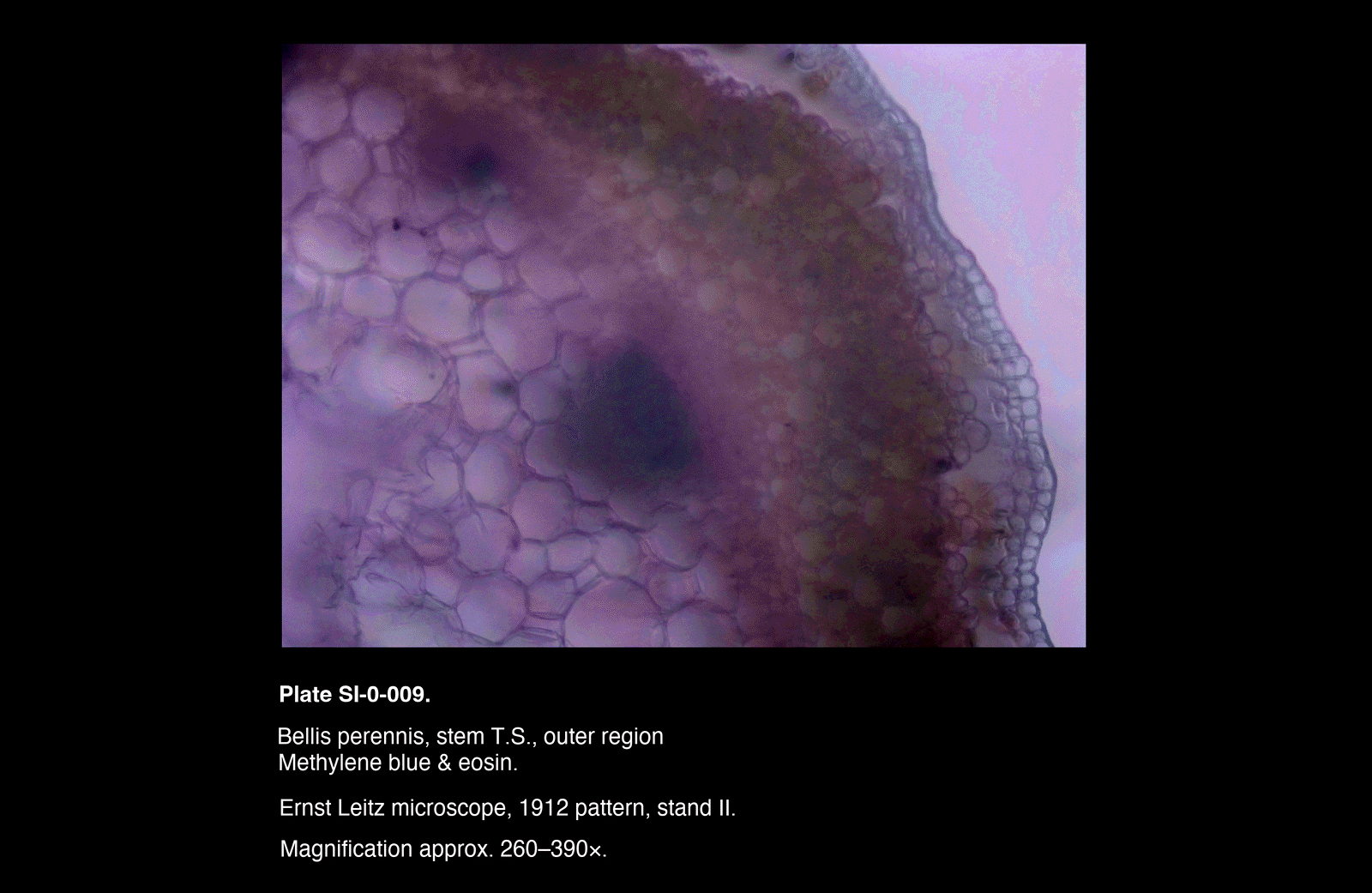
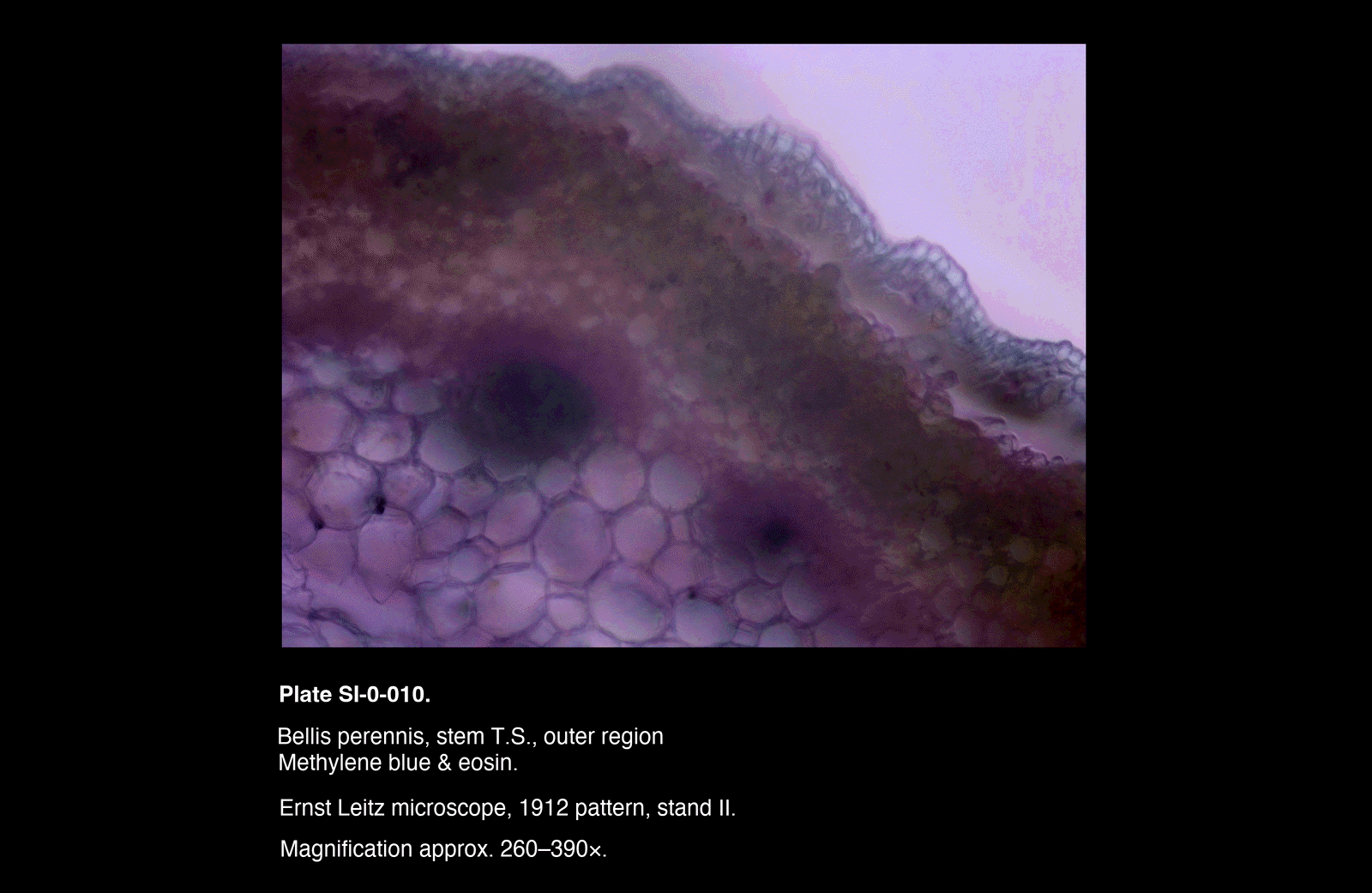
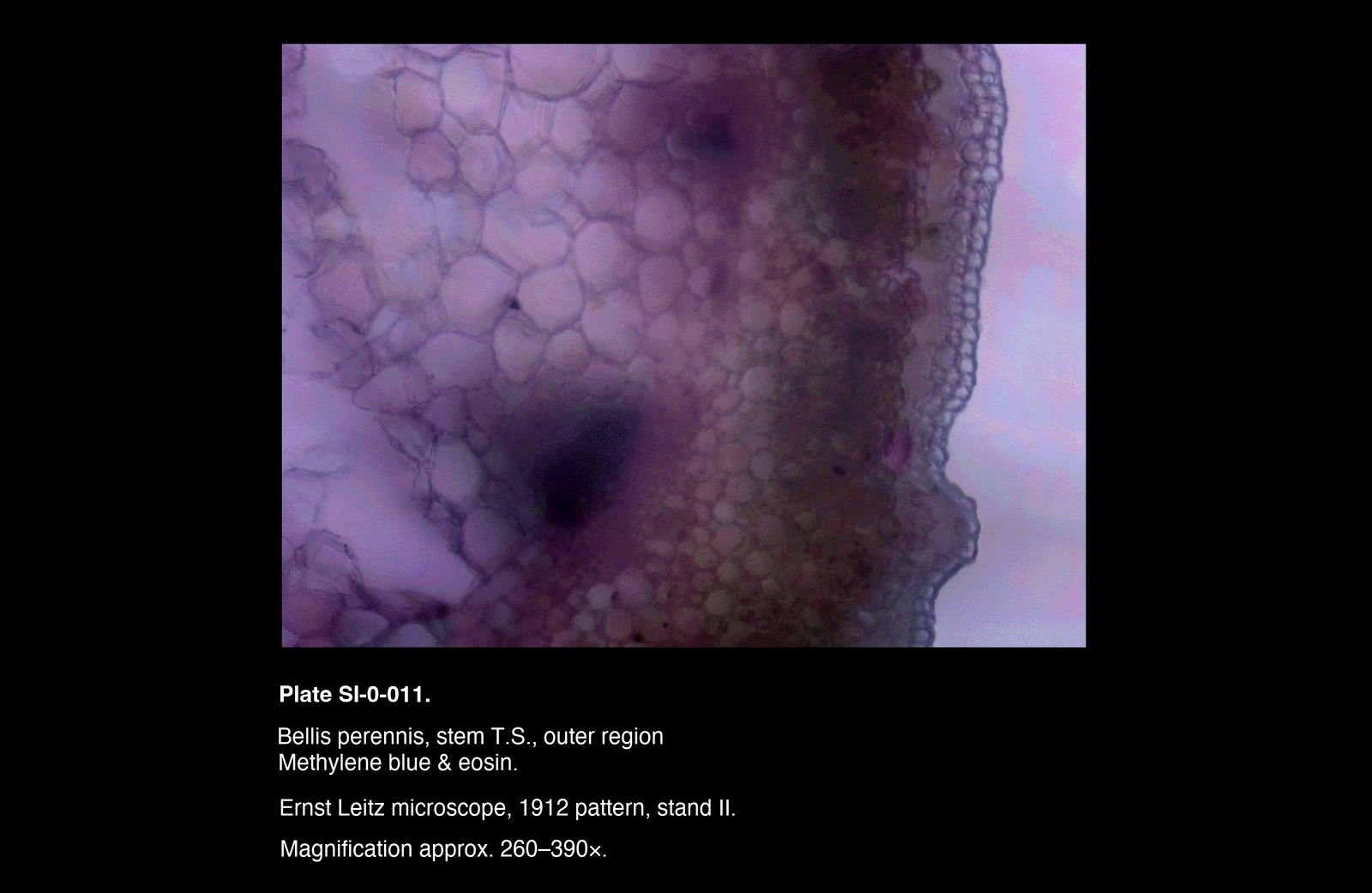
| SI-0-008 to 011 | 75 s | 30 s | 30 s | 5 s |
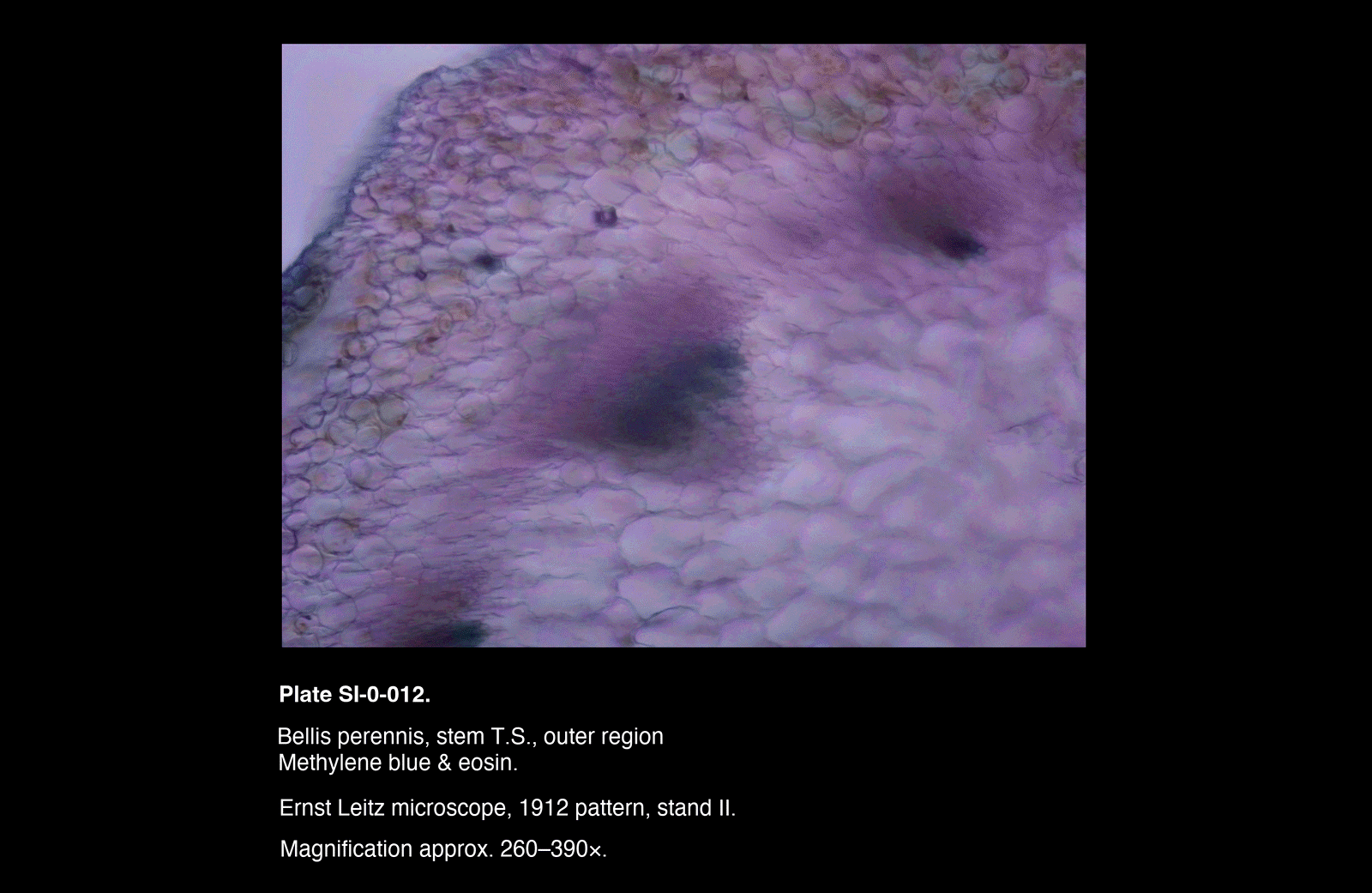
| SI-0-012 | 70 s | 40 s | 25 s | 5 s |
Plates
/Bellis%20perennis,%20T.S.)
/Bellis%20perennis,%20T.S.)
/Bellis%20perennis,%20trichome,%20isolated%20from%20stem%20T.S.)
/Bellis%20perennis,%20stem%20T.S.,%20inner%20cortex%20and%20vascular%20bundle%20region)
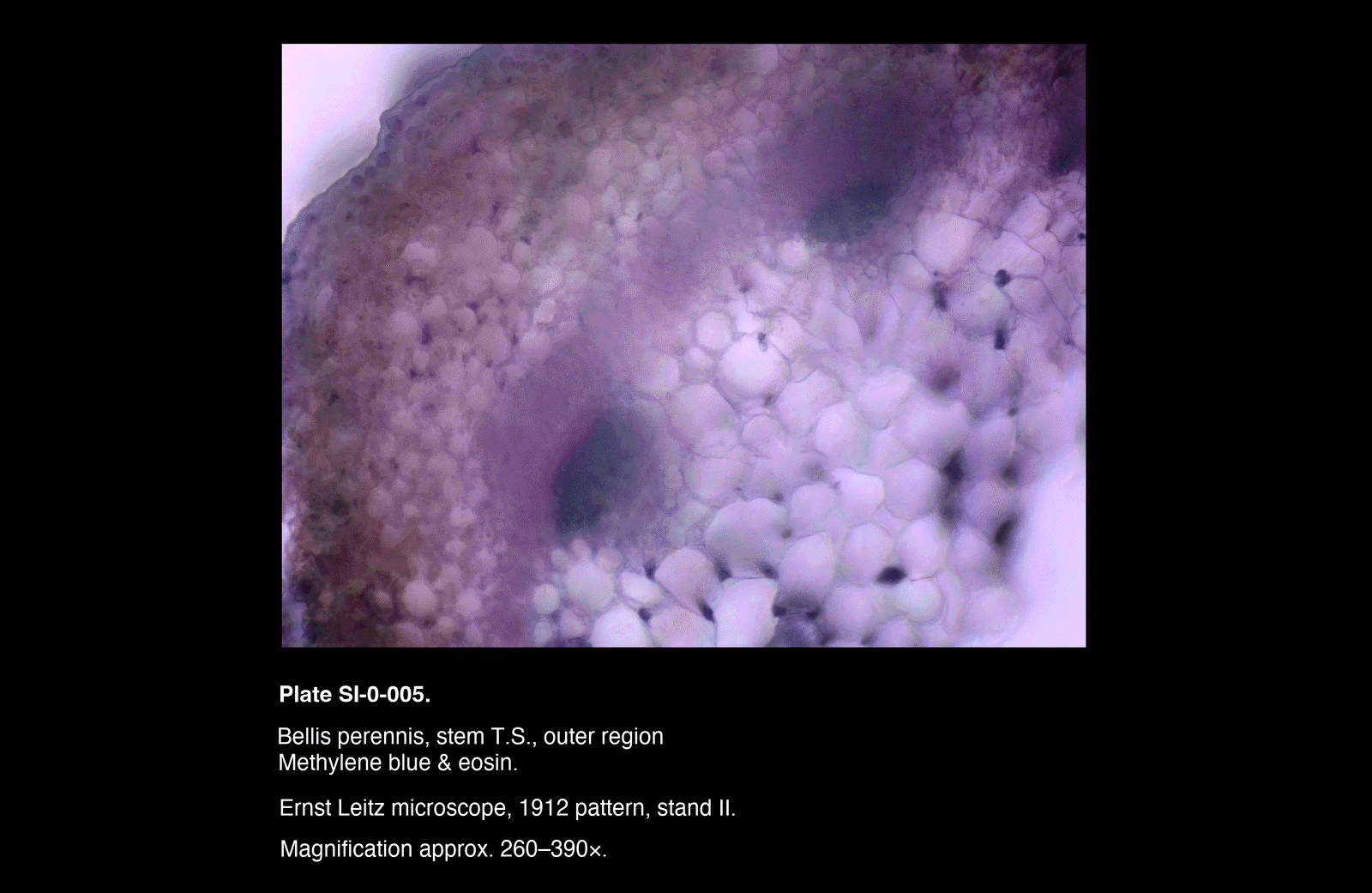
/Bellis%20perennis,%20stem%20T.S.,%20outer%20region)
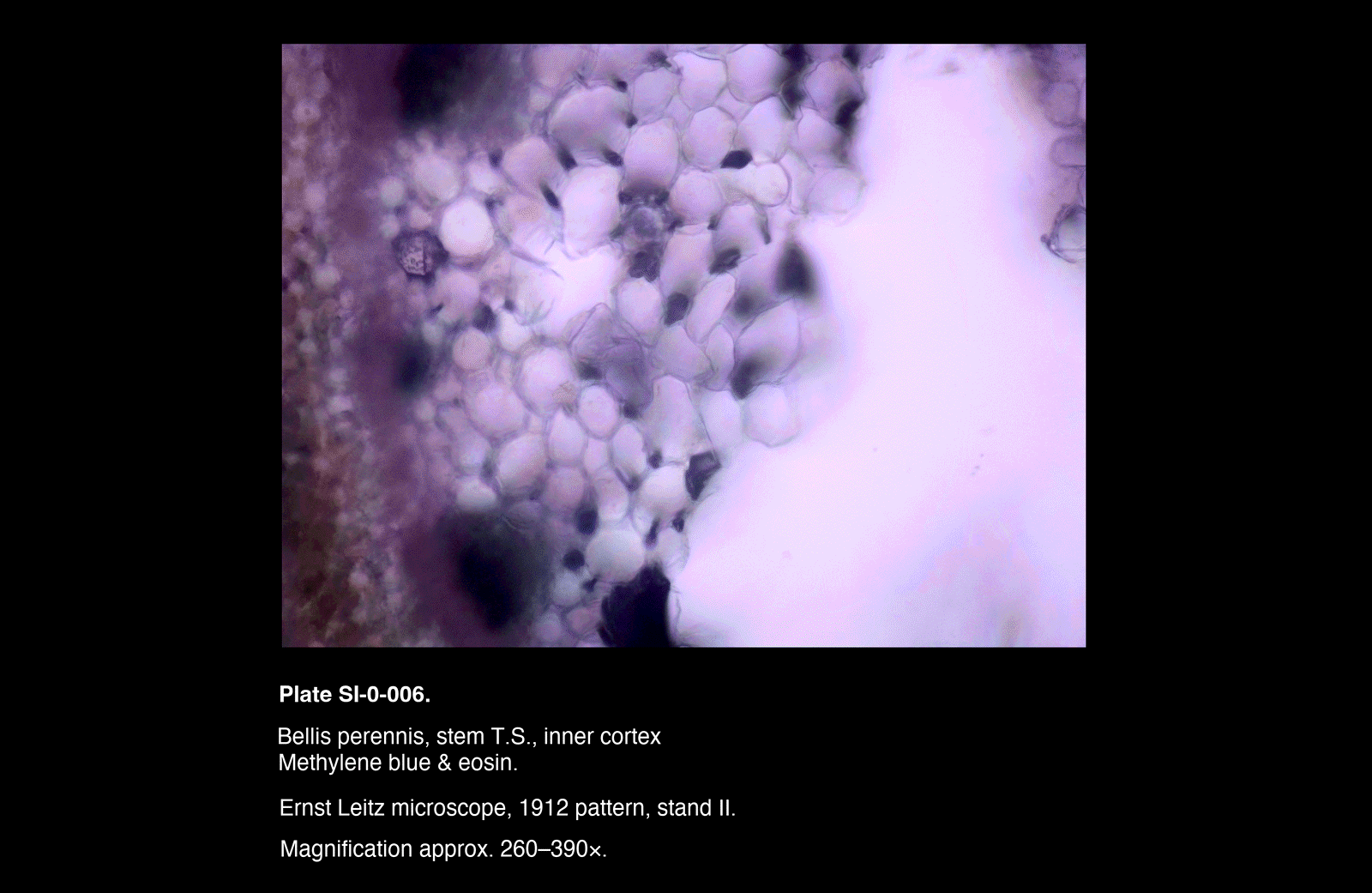
/Bellis%20perennis,%20stem%20T.S.,%20inner%20cortex)
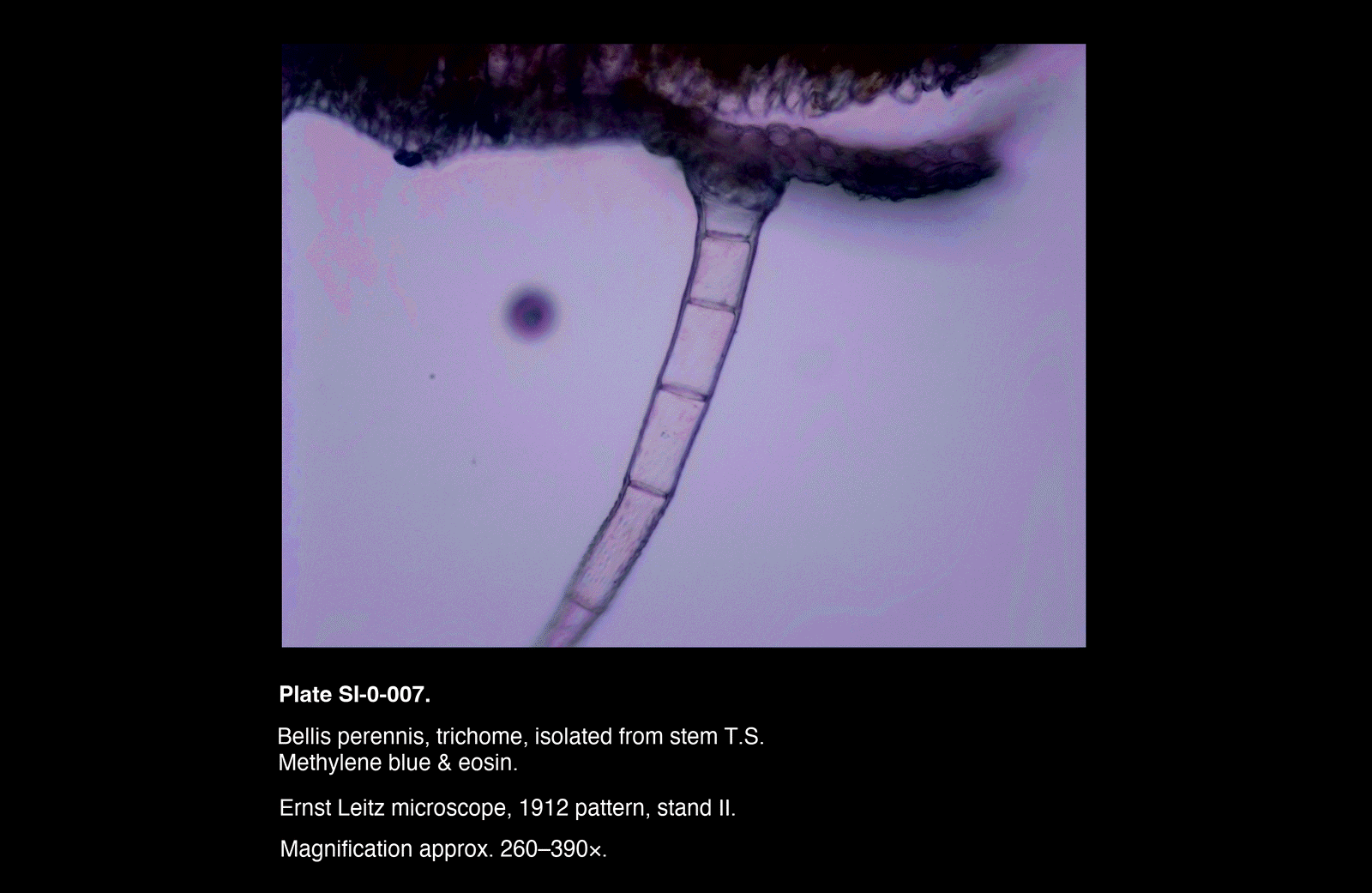
/Bellis%20perennis,%20trichome,%20isolated%20from%20stem%20T.S.)
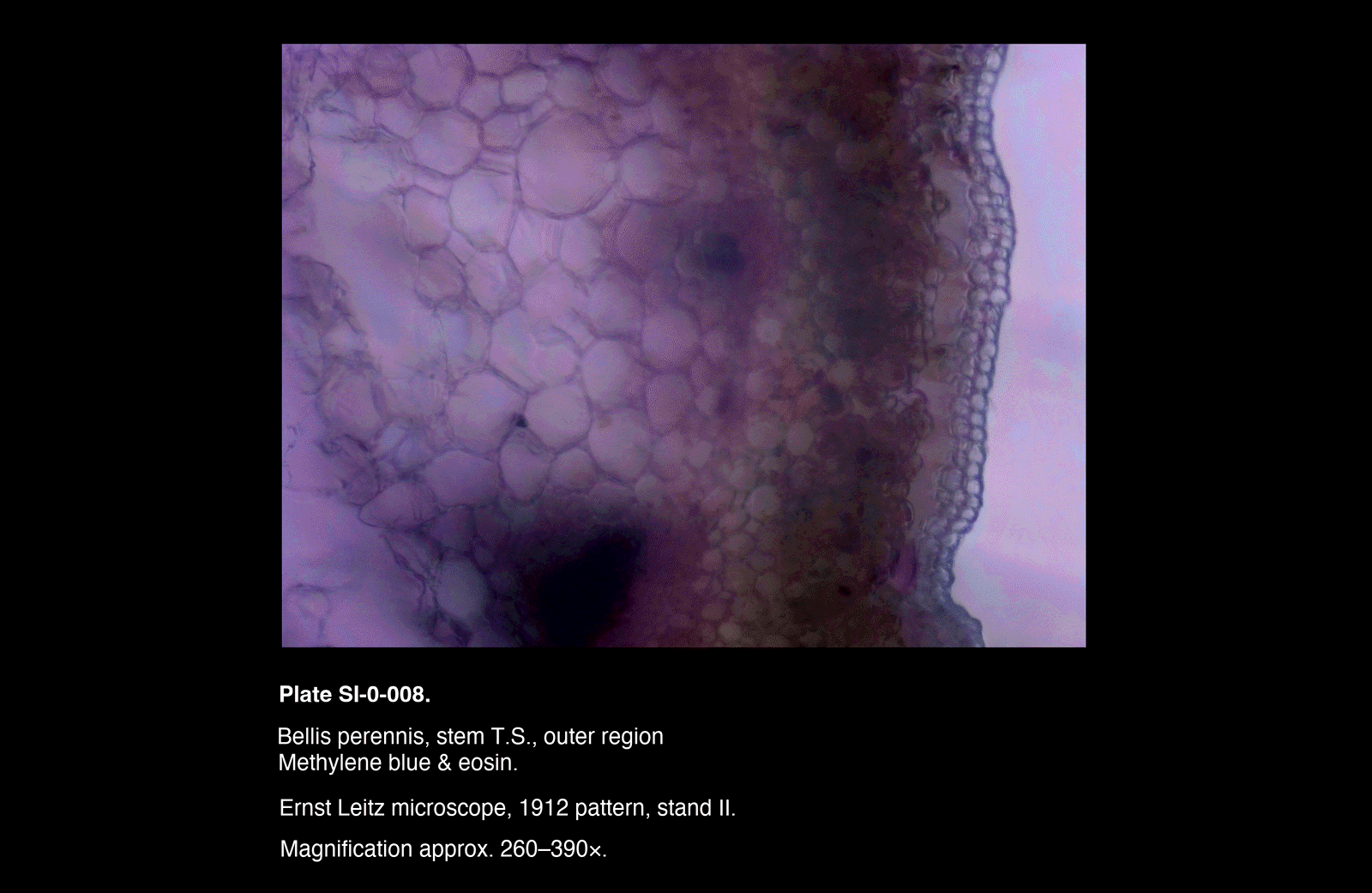
/Bellis%20perennis,%20stem%20T.S.,%20outer%20region)
/Bellis%20perennis,%20stem%20T.S.,%20outer%20region)
/Bellis%20perennis,%20stem%20T.S.,%20outer%20region)
/Bellis%20perennis,%20stem%20T.S,%20outer%20region)
/Bellis%20perennis,%20stem%20T.S,%20outer%20region)
Observations
General Behaviour
- Methylene blue preferentially stained denser and structurally defined regions (e.g. vascular areas and outer tissues)
- Eosin contributed a broader background tone, particularly within parenchymatous regions
- Balance between the two stains was highly sensitive to timing and rinsing
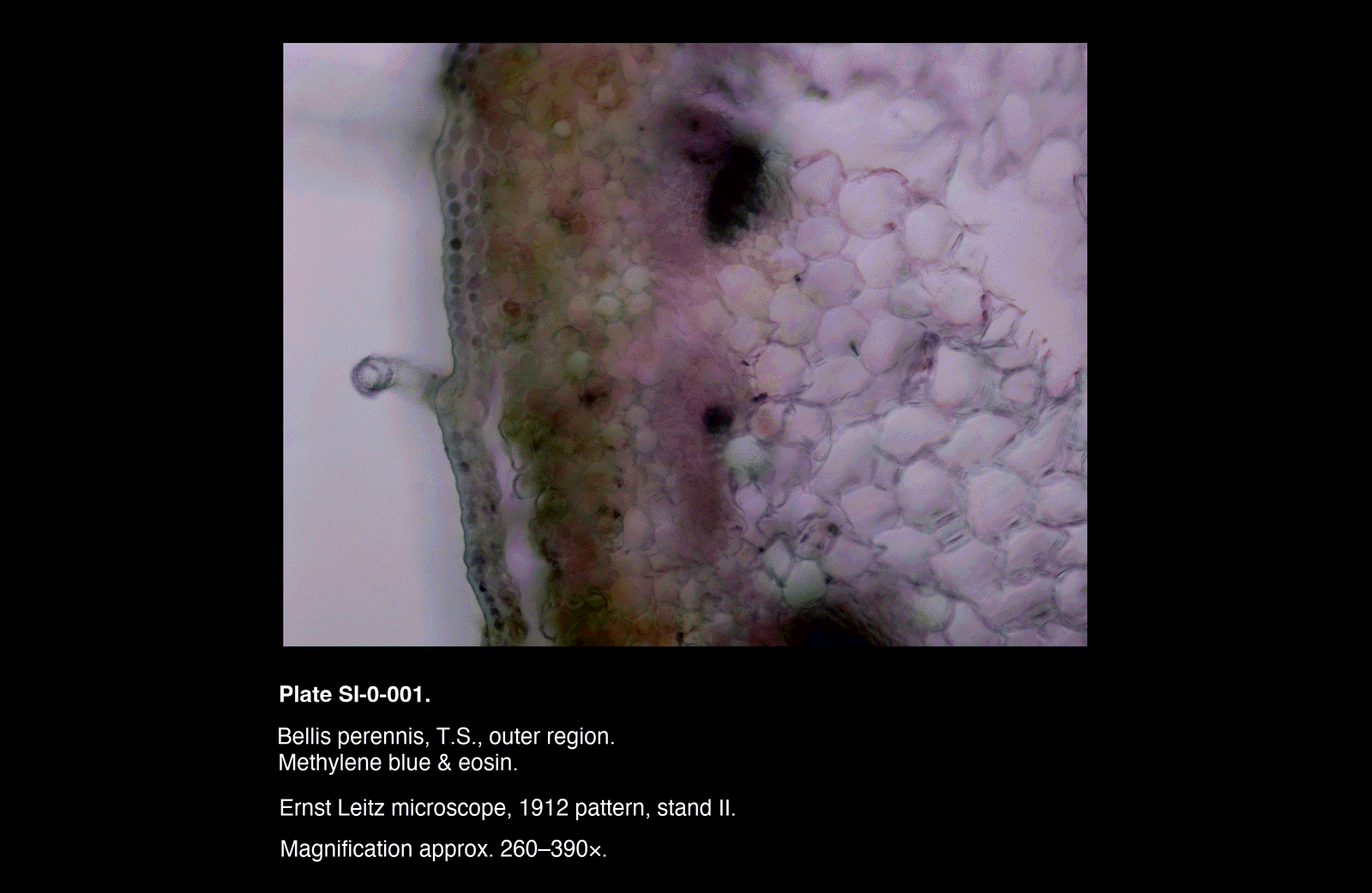
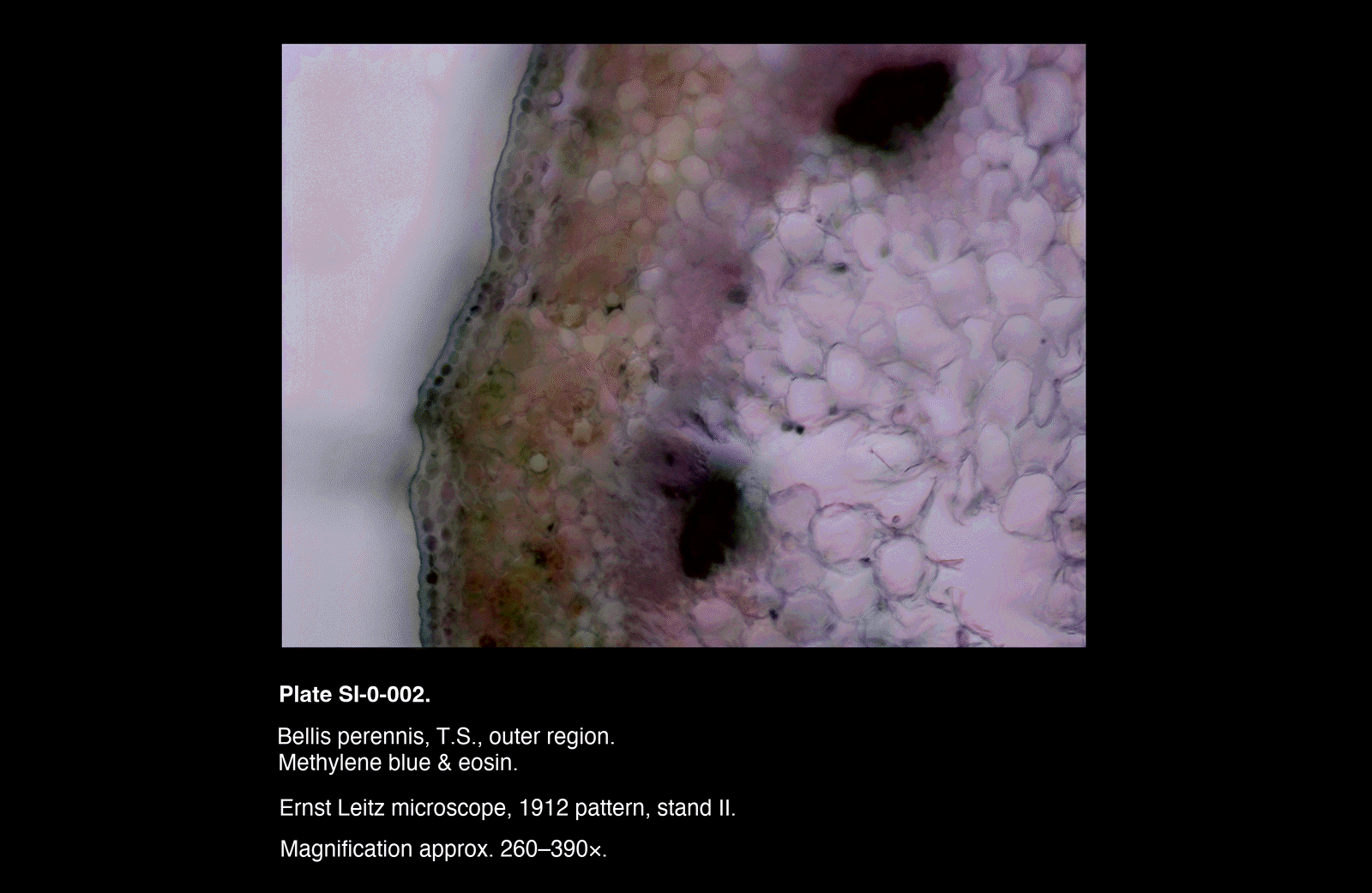
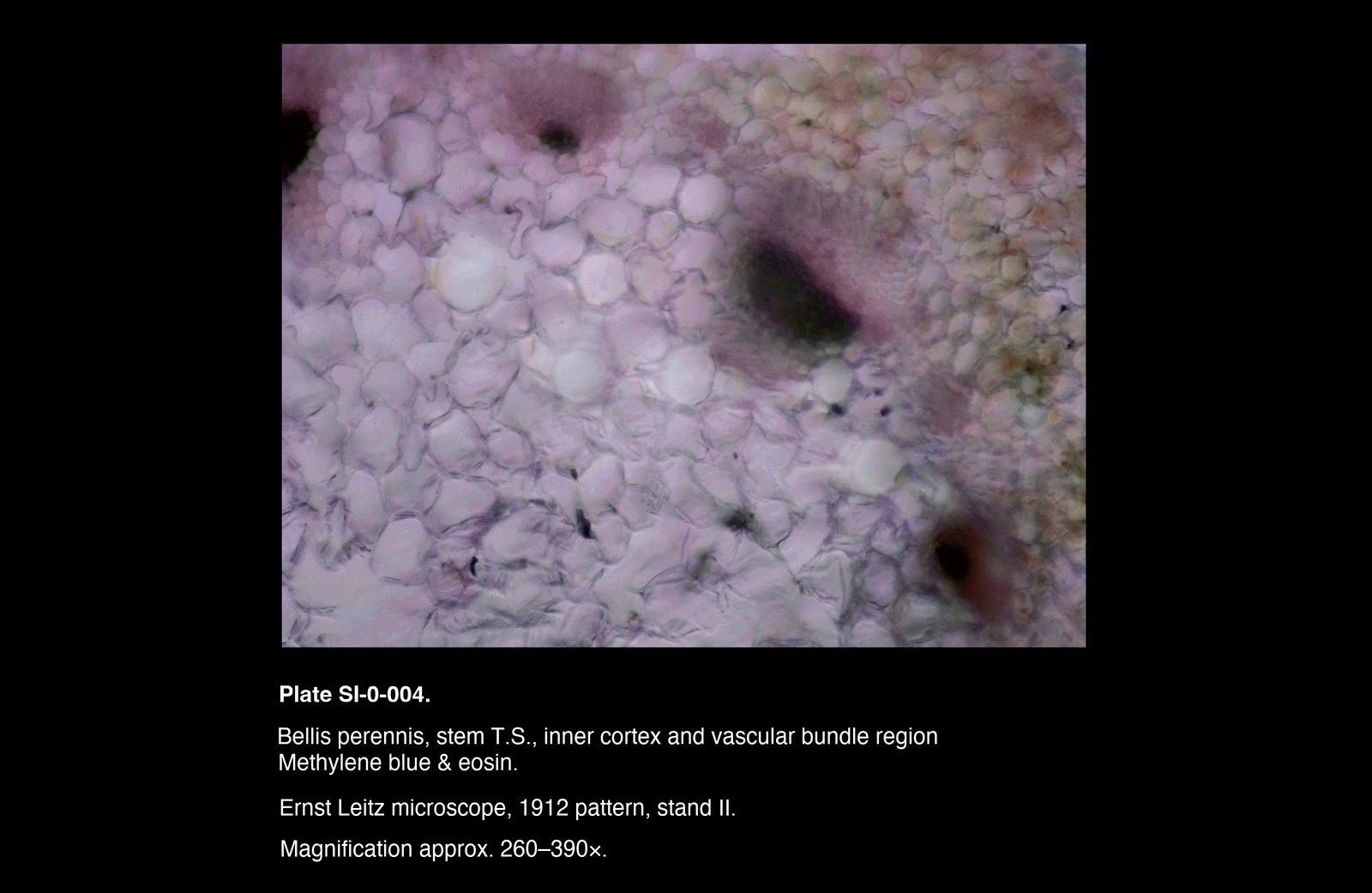
Shorter Staining (SI-0-001 > 004)
- Relatively light overall staining
- Structural detail remains clear
- Limited differentiation between tissue types
- Trichomes visible but not strongly contrasted
Longer Staining (SI-0-005 > 007)
- Markedly increased stain intensity
- Some regions begin to appear over-saturated, particularly vascular areas
- Fine structural detail partially obscured
- Trichomes well defined but with reduced internal clarity
Intermediate Staining (SI-0-008 > 011)
- Best overall balance between contrast and clarity
- Clear differentiation between:
- Outer tissues
- Cortex
- Vascular bundles
- Cellular boundaries remain visible without excessive darkening
- Considered the most effective regime in this series
Modified Rinse (SI-0-012)
- Slightly softer staining profile
- Reduced background intensity compared to intermediate set
- Suggests rinse duration plays a meaningful role in controlling final contrast
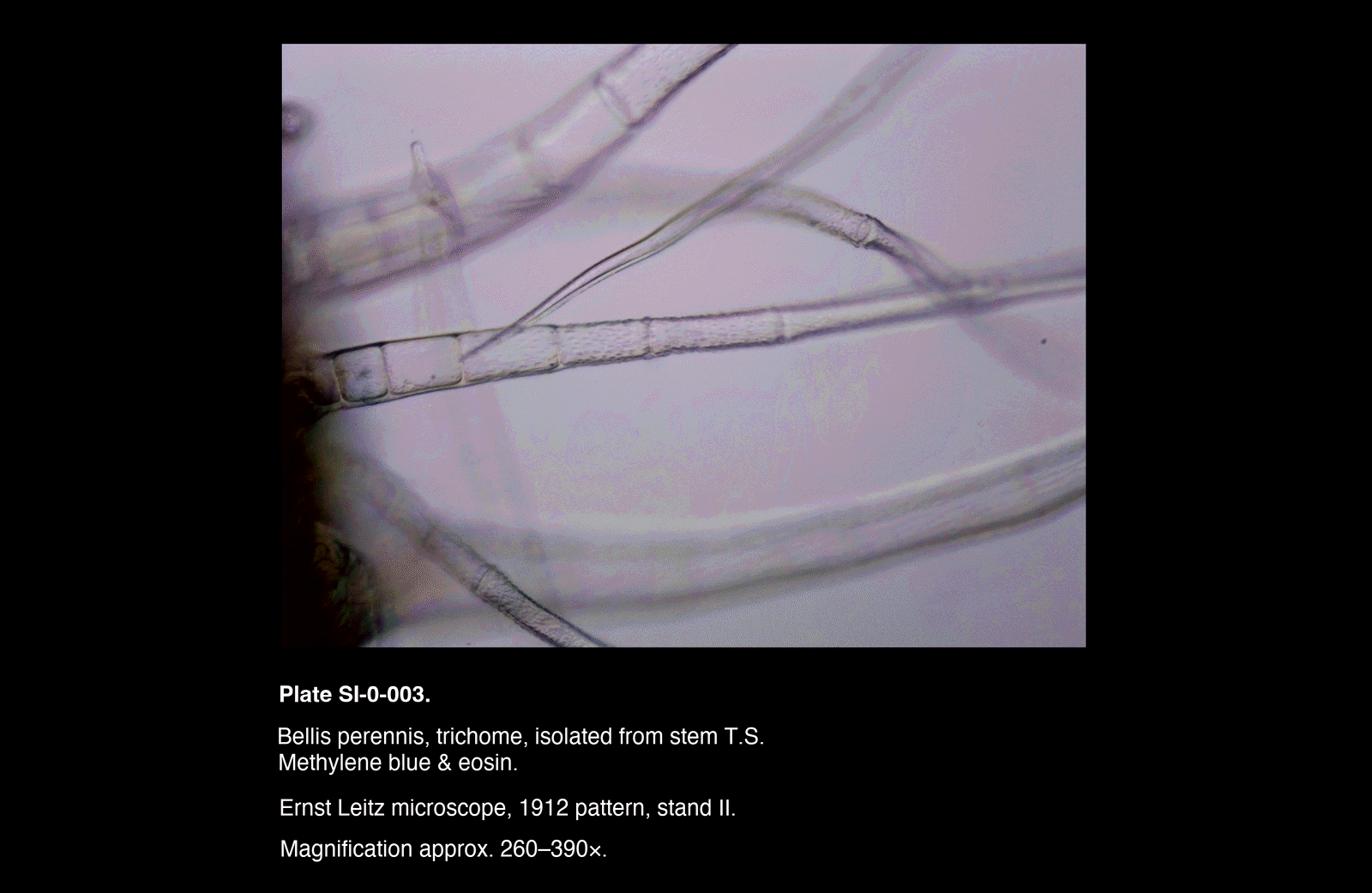
Trichomes (SI-0-003, SI-0-007)
Isolated trichomes show:
- Segmented cellular structure
- Moderate uptake of methylene blue along cell walls
- Internal detail best preserved under moderate staining conditions
Interpretation
Stain Interaction
The combination of methylene blue and eosin behaves as a simple differential stain, though without the strong selectivity of more specialised protocols.
- Methylene blue provides structural emphasis
- Eosin provides general contrast and background tone
The interaction between the two is governed less by chemistry than by relative exposure time and rinsing
Practical Findings
- Under-staining > insufficient differentiation
- Over-staining > loss of structural clarity
- Optimal range lies in a moderate exposure window (approx. 70–75 s MB, 30 s eosin)
Rinsing is critical:
- Too brief > muddy, over-saturated image
- Too long > loss of contrast
Methodological Value
This experiment establishes a repeatable baseline staining protocol for routine work on soft plant tissues using this instrument and preparation method.
It also highlights:
- The importance of timing control
- The sensitivity of results to minor procedural variations
- The value of producing comparative plate series rather than single exemplars
Remarks
- Variation between plates reflects both staining differences and natural variation in section thickness
- The inclusion of trichomes proved useful in assessing stain penetration in elongated, thin-walled structures