
Field Notes Entry
A Year in the Life of a Wren (Abingdon)
A hypothesis-driven look at how detectability and behaviour shape the record of a familiar species
In the previous posts, the patterns have been derived directly from the data.
For this species, I took a slightly different approach: beginning with a hypothesis, and then testing it against the record.
The Wren (Troglodytes troglodytes) is a familiar resident species, present throughout the year. However, it is small, fast-moving, and most often encountered in dense cover.
This suggests a simple hypothesis:
While Wrens are present year-round, they may be recorded unevenly through the year due to changes in visibility and behaviour.
In particular, I expected:
- Relatively high visibility in winter and early spring
- A reduction during summer, when vegetation is dense and birds are quieter
- A recovery into autumn
Monthly Sightings
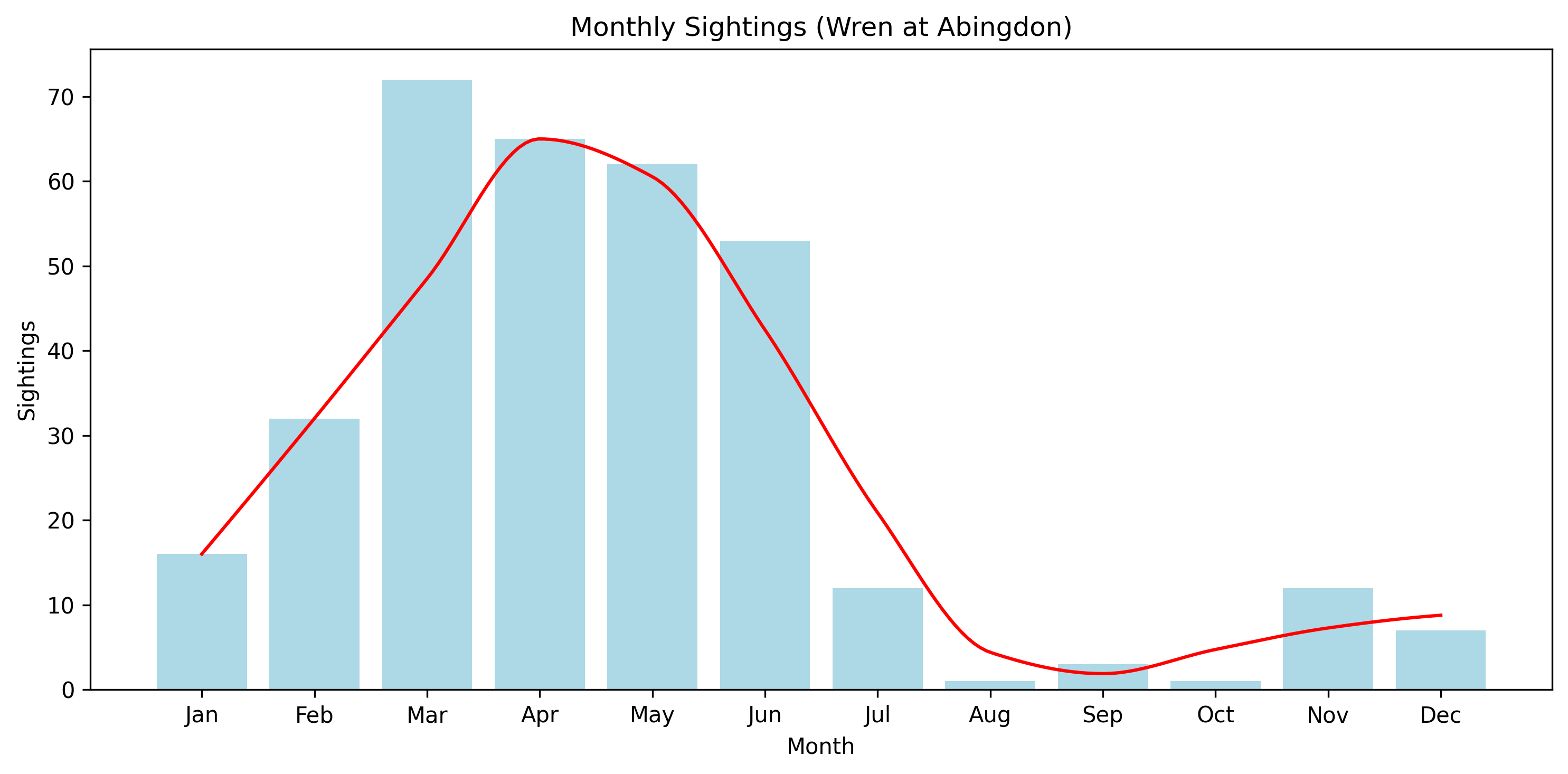
The result is striking.
Rather than a gentle reduction, the number of sightings drops sharply through the summer months, reaching very low levels in August and September.
This is a much stronger effect than anticipated.
Presence — How Often Are They Seen?
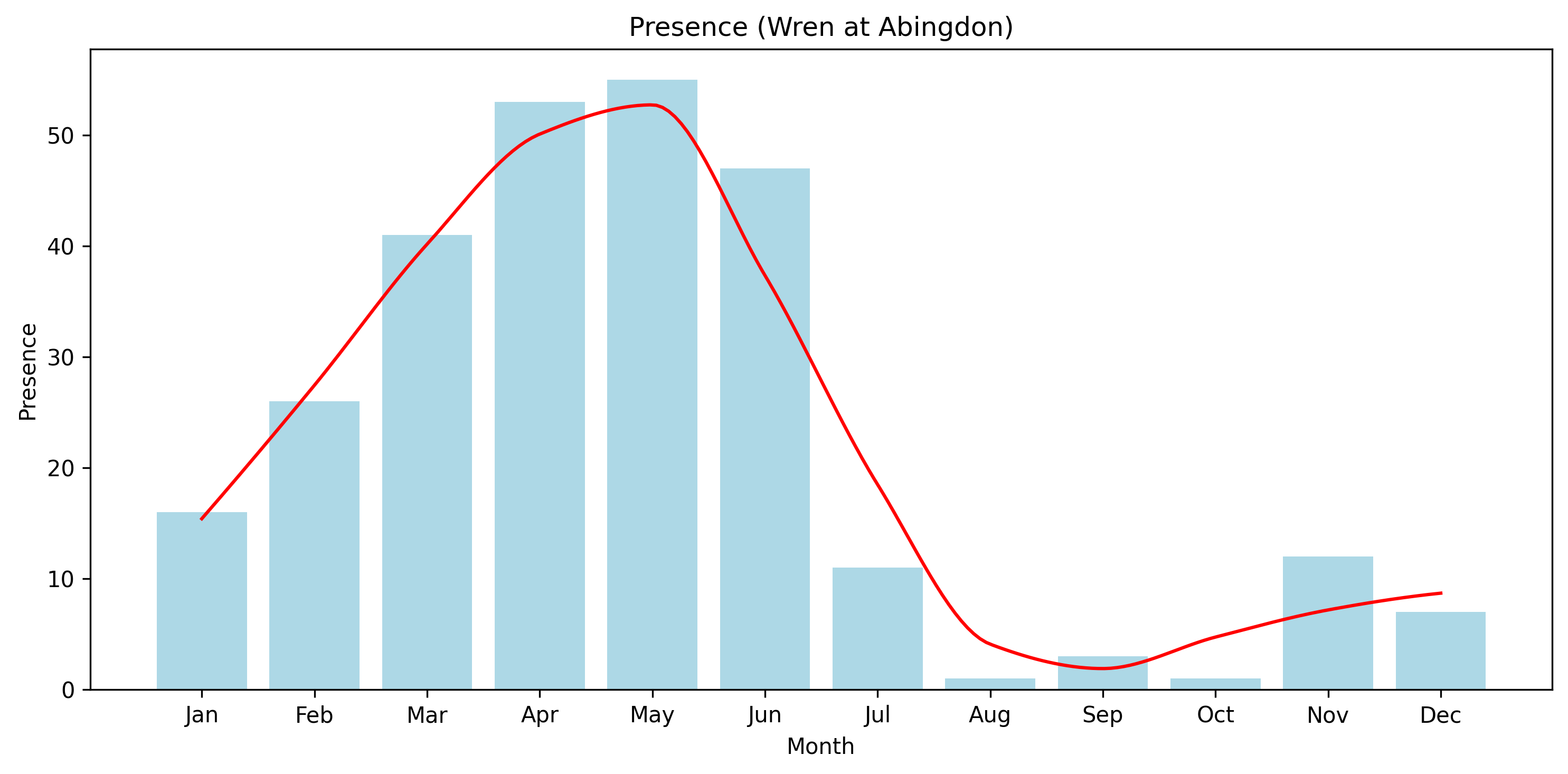
The presence data shows the same pattern.
Wrens are frequently recorded through winter and spring, but almost disappear from the record during late summer.
This is particularly notable given that the species is known to be resident.
Interpreting the pattern
The hypothesis — that detectability would influence the record — is supported, but the magnitude of the effect is unexpected.
The Wren appears not merely less visible in summer, but largely absent from the record.
This is unlikely to reflect a true absence. Instead, it suggests a combination of factors:
- Dense summer vegetation, reducing visibility
- A marked reduction in song and conspicuous behaviour
- A shift into habitats or micro-locations less frequently encountered
Taken together, these factors reduce the overlap between the observer and the species.
In other words, the Wren is still present — but largely outside the scope of casual observation.
A Note On Observation
This example highlights an important aspect of the dataset.
These records do not represent a systematic survey, but a series of informal observations made over time. As such, they reflect not only the behaviour of the species, but also the conditions under which it is observed.
The Wren makes this particularly clear.
Placing This Alongside Other Species
Compared with other resident species, the Wren shows one of the strongest seasonal patterns in the series.
| Species | Primary driver of pattern | Key feature |
|---|---|---|
| Robin | Detectability | Late-summer dip |
| Blackbird | Detectability | Reduced visibility in late summer |
| Wren | Detectability (strong) | Near-absence in late summer |
| Woodpigeon | Aggregation | Year-round presence, variable counts |
The Wren can be seen as an extreme example of a detectability-driven pattern.
Closing Thoughts
What began as a simple hypothesis has revealed a more pronounced pattern than expected.
The Wren is present throughout the year, but its visibility — and therefore its representation in the record — varies dramatically.
This serves as a reminder that absence in the data does not necessarily imply absence in the landscape.
As with the other species in this series, a simple monthly aggregation is enough to bring this into view — provided it is interpreted with care.
Data for this chart is available to download here: