
Field Notes Journal Entry
Improved Improvised Sectioning: Galium aparine and Taraxacum officinale Revisited
Revisiting Galium aparine and Taraxacum officinale stem sections using an improved version of the improvised double-bladed sectioning tool
Revisiting earlier work on Galium aparine and Taraxacum officinale, I set out to improve the quality of transverse stem sections by refining the improvised sectioning tool.
In the initial experiment, sections were produced using the first iteration of the tool, a double-bladed design described on the Microscopy UK site - “How to make thin slices of specimens. And mount them.”. The design placed the two cutting edges next to one another.
The second iteration involved the introduction of a single-sheet thickness slip of printer or photocopier paper between the blades to provide separation, with the intention of improving the chances of very fine sections being captured between the blades without being compressed between them.
Technique
As before, sections were taken by drawing the blade smoothly across the specimen rather than pressing downward. Multiple sections were cut in succession, and the thinnest, taken from between the blades, were selected for mounting.
Observations
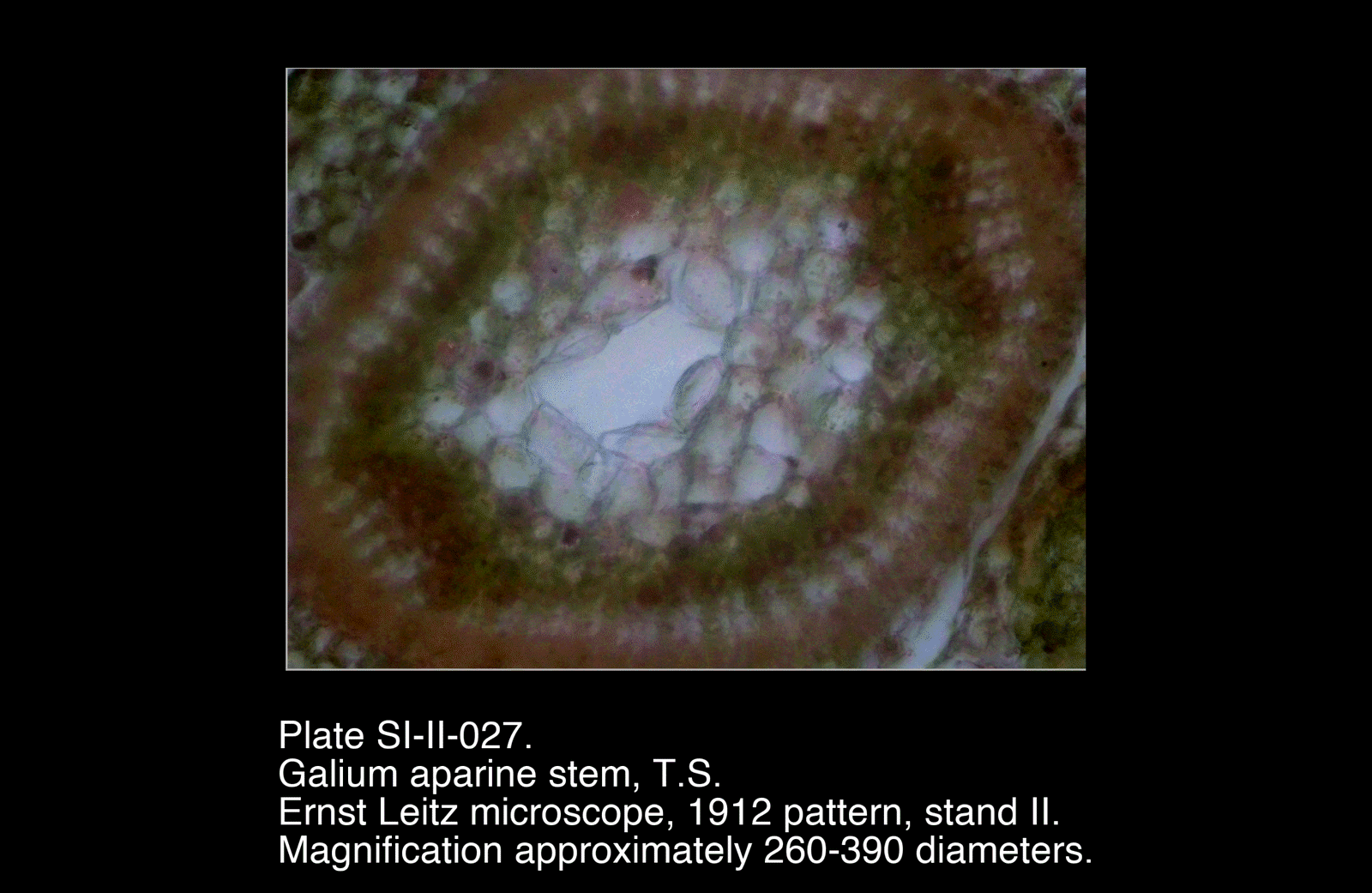
With the spacer in place, the blades act more like a controlled slicing system, resulting in much more uniform sections.
This has a few knock-on benefits:
- Cleaner cell structure – individual cells, especially in the cortex, are more regularly shaped and less collapsed
- Better definition of tissues – the transition between outer tissue and the vascular region is clearer and easier to interpret
- Improved visibility of overall anatomy – the characteristic star-shaped outline of the stem is more sharply defined
- Reduced artefacts – less tearing, smearing, and compression across the section
Perhaps most importantly, the vascular ring—only hinted at in earlier attempts—is now consistently visible and structurally readable.
In practical terms, this small modification has turned a workable tool into a reliable one, producing sections that are not just usable, but genuinely informative.