
Wren
Role in the year: Detectability-driven resident
The Wren is a small but characterful resident of Abingdon’s gardens, hedgerows, and woodland edges. Despite its abundance, it is often overlooked except when in full voice, when its powerful song carries far beyond its size.
This page summarises how the species appears in the records: how it occupies the year.
Seasonal Pattern
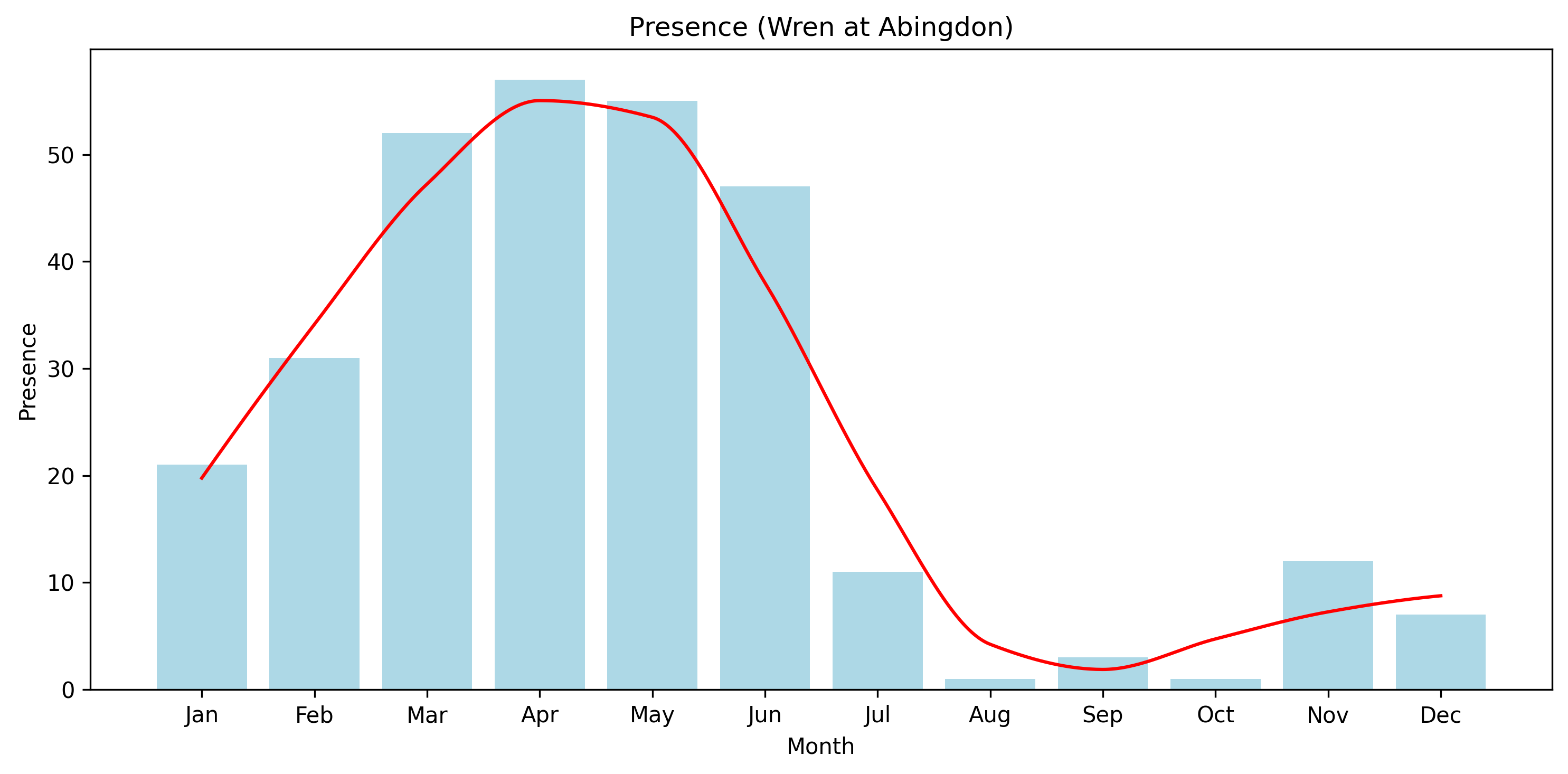
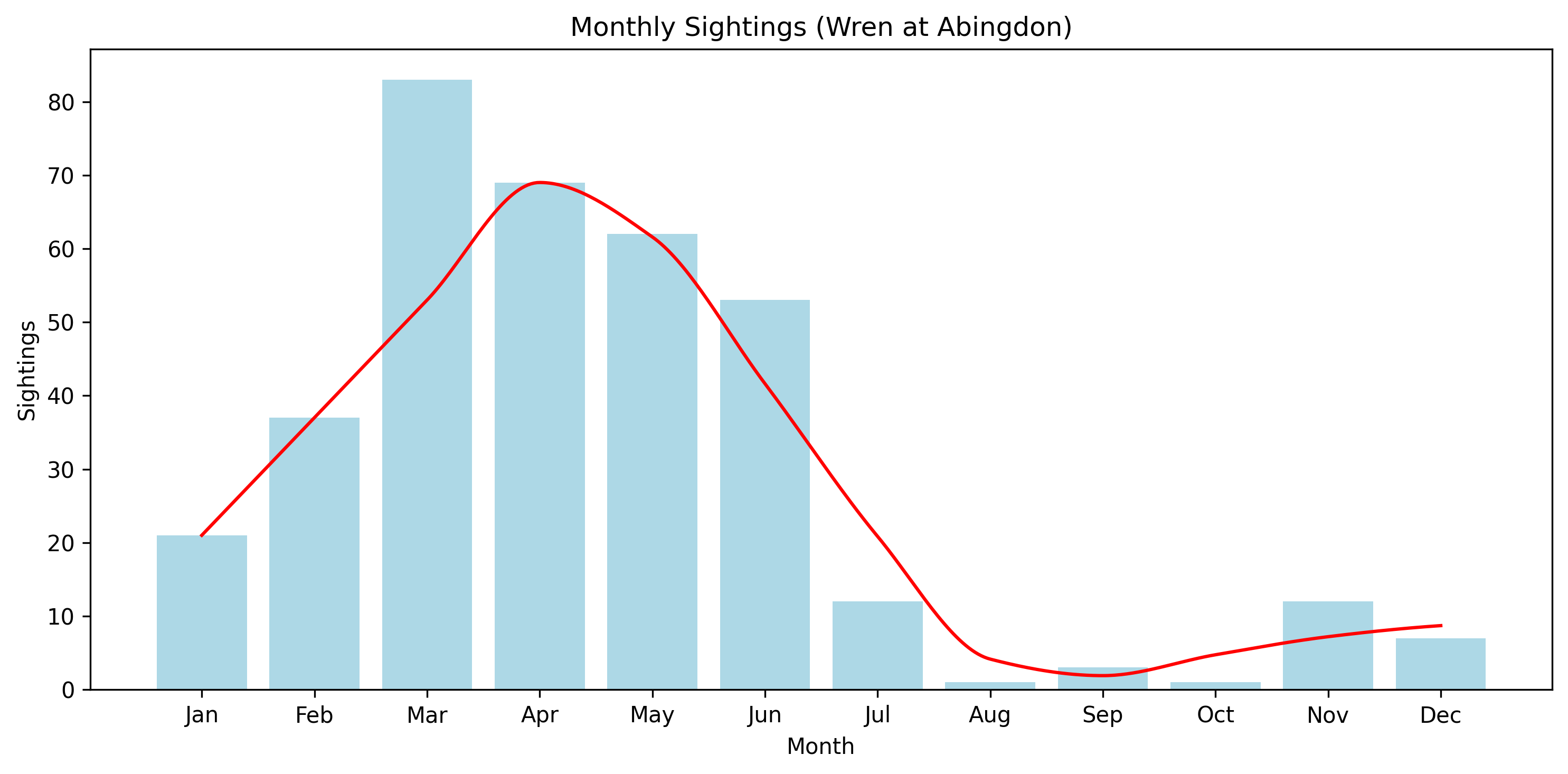
Wren shows a year-round presence with a strongly seasonal pattern in detectability.
Records occur in every month, but with a pronounced peak in spring. Sightings increase sharply from late winter, reaching a maximum in March and April, and remaining relatively high into early summer.
From mid-summer, records decline rapidly, reaching a marked minimum in August and September, when the species is only occasionally recorded.
From autumn into winter, sightings increase again, though not to the same levels as the spring peak.
The overall pattern is that of a resident species with a strong spring maximum and a late-summer minimum, driven primarily by changes in visibility rather than presence.
Interpretation
The Wren’s seasonal pattern is a clear example of detectability-driven variation.
The species is present throughout the year, occupying a wide range of habitats and remaining locally common. However, how often it is recorded varies dramatically with behaviour.
The sharp rise into spring reflects the onset of territorial singing. Wrens become highly vocal during this period, delivering loud, sustained song from exposed perches, making them far easier to detect.
The peak in March and April corresponds to the main breeding period, when singing activity is at its highest.
The steep decline from summer into early autumn reflects a shift to much quieter and more secretive behaviour:
- Singing largely ceases after breeding
- Birds remain low in dense vegetation
- Detectability drops sharply despite continued presence
The partial recovery in autumn and winter likely reflects increased movement and occasional vocal activity, but without the sustained song of spring.
Unlike aggregation-driven species, total counts remain relatively stable, reinforcing that the pattern is not driven by changes in abundance but by how often individuals are encountered.
Overall, the Wren exemplifies a resident species whose seasonal pattern in the data is dominated by behaviour and detectability rather than true changes in occupancy or numbers.
Summary
| Aspect | Classification |
|---|---|
| Seasonal pattern | Detectability-driven resident |
Notes
These patterns are derived from long-term personal field records and should be read as descriptions of observed behaviour rather than complete biological accounts.
For species such as Wren, seasonal variation in records is strongly influenced by vocal activity and behaviour. Peaks in spring reflect increased detectability during the breeding season, while summer minima likely represent reduced visibility rather than true absence.