
Woodpigeon
Role in the year: Aggregation-driven resident
The Woodpigeon is one of the most familiar and widespread birds in Abingdon, present in gardens, farmland, and woodland throughout the year. Its steady cooing and frequent movement across the landscape make it a constant backdrop to everyday observation.
This page summarises how the species appears in the records: how it occupies the year.
Seasonal Pattern
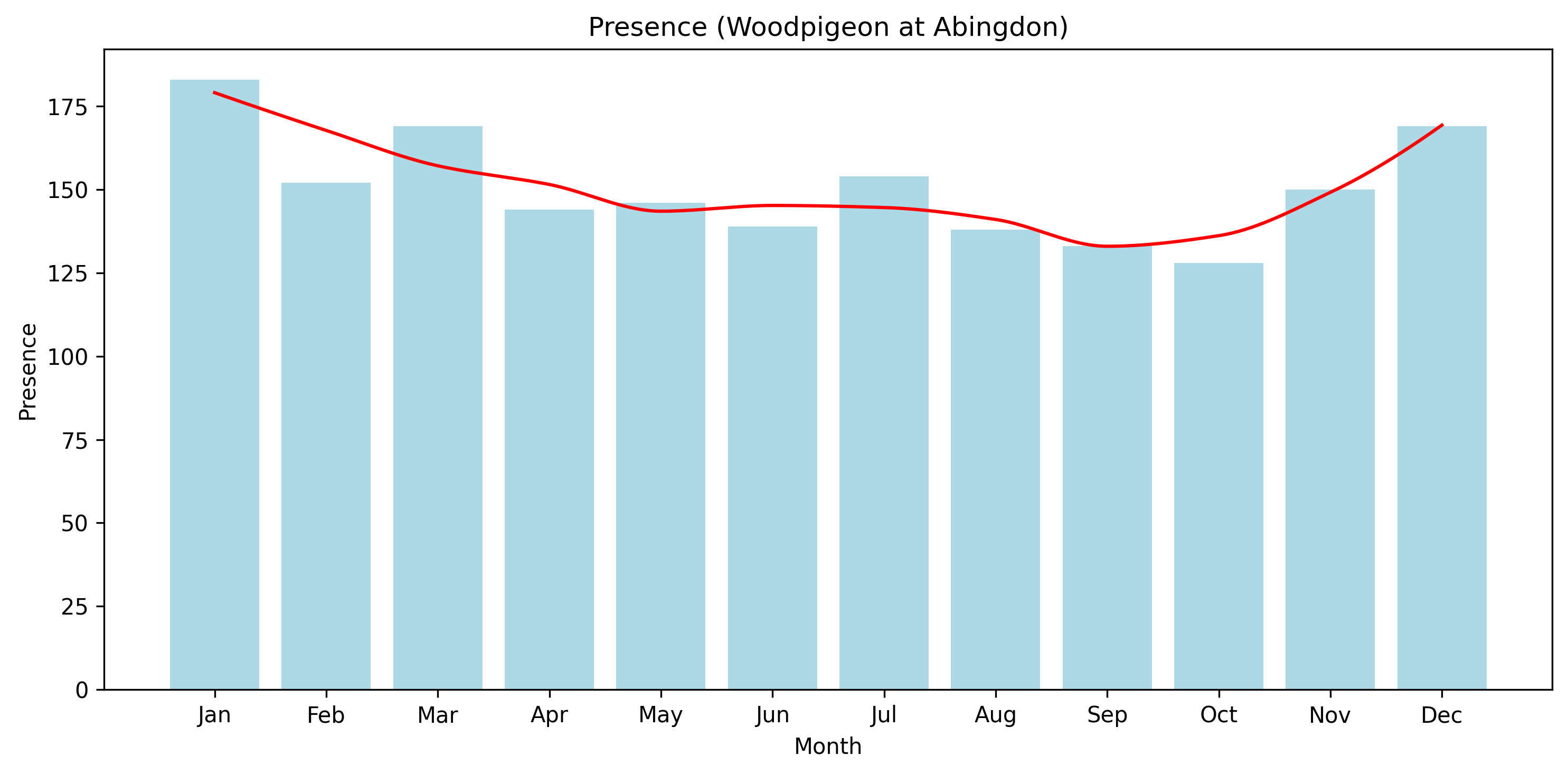
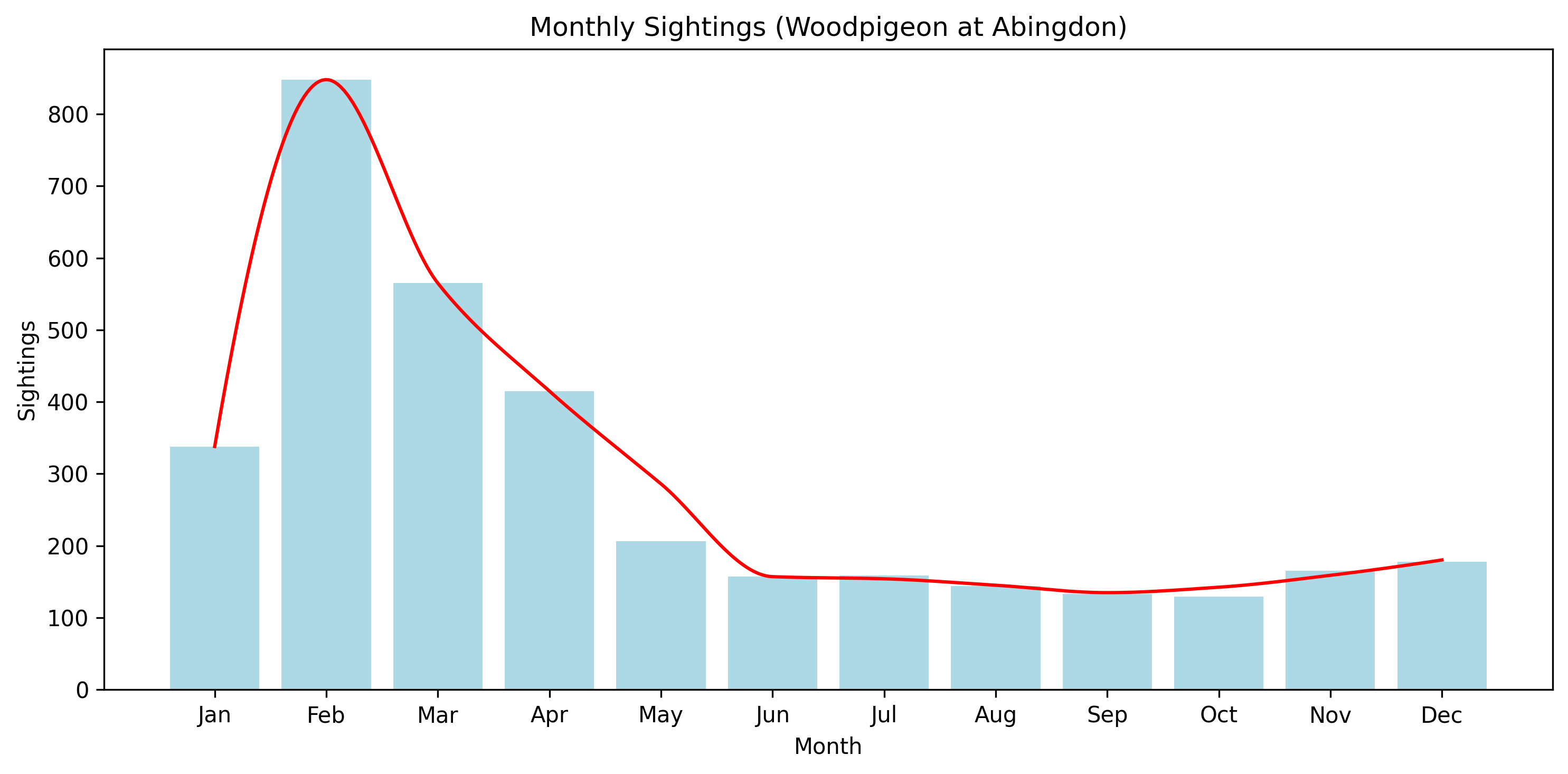
Woodpigeon shows a consistently high presence throughout the entire year, with only modest seasonal variation.
Records occur in every month, with presence remaining broadly stable from winter through summer. There is a slight tendency toward higher levels in winter and early spring, but the overall pattern is remarkably even.
In contrast, total sightings show greater variability, with more pronounced peaks and troughs across the year.
The overall pattern is that of a fully resident species, always present but with changing group sizes rather than changing occupancy.
Interpretation
The key feature of Woodpigeon’s seasonal pattern is the decoupling of presence and abundance.
The species is recorded in every month, and in a large proportion of days within each month. This reflects its status as a true resident, occupying the landscape continuously throughout the year.
However, the number of individuals recorded varies more strongly. This suggests that:
- Birds form larger or more visible groups at certain times of year
- Movements within the local landscape affect how many individuals are encountered at once
The slightly elevated presence in winter and early spring may reflect increased visibility as birds range more widely over open farmland or gather in loose flocks.
During the breeding season, birds are more dispersed and territorial, which can reduce the number of individuals recorded per observation even though the species remains present.
Overall, the pattern reflects a species that is always there, but not always encountered in the same way. Seasonal structure is driven less by arrival or departure, and more by shifts in grouping behaviour and local movement.
Summary
| Aspect | Classification |
|---|---|
| Seasonal pattern | Aggregation-driven resident |
Notes
These patterns are derived from long-term personal field records and should be read as descriptions of observed behaviour rather than complete biological accounts.
For species such as Woodpigeon, presence alone provides limited seasonal insight, as the species is recorded consistently throughout the year. Instead, variation in counts and grouping behaviour plays a more important role in shaping the observed pattern.