
Swift
Role in the year: Summer visitor (highly seasonal, short-duration)
The Swift is one of the most distinctive birds of summer in Abingdon, spending almost its entire life on the wing and announcing its presence with high-pitched screaming calls as it races over rooftops.
This page summarises how the species appears in the records: how it occupies the year.
Seasonal Pattern
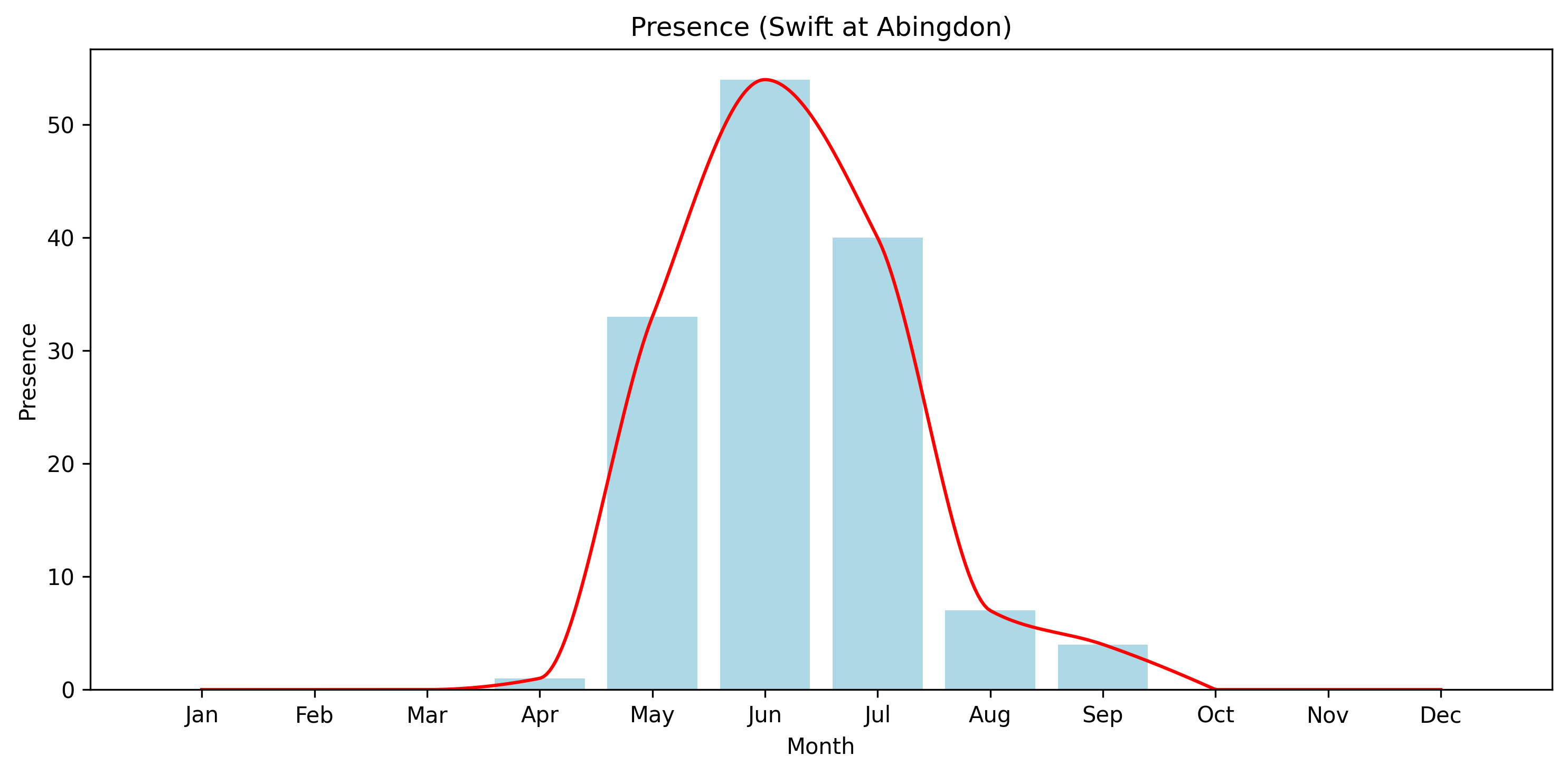
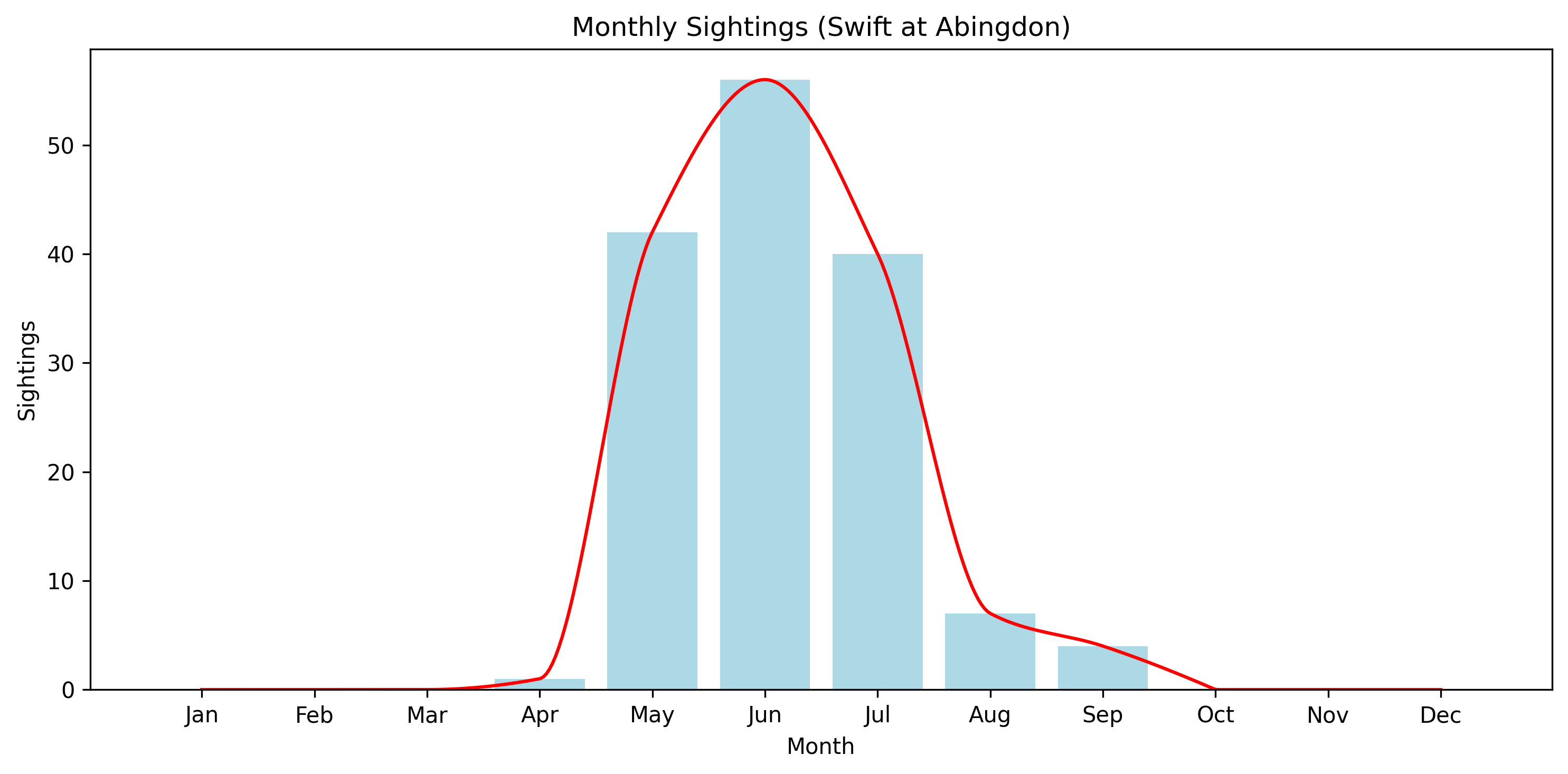
Swift shows an extremely compressed seasonal pattern, even among summer visitors.
There are no records through winter and spring. The species appears abruptly in May, rising immediately to a peak.
High levels are sustained through June and into July, forming a tight midsummer plateau.
From late July into August, records decline rapidly, with only a small number of sightings persisting into early August before the species disappears completely.
The overall pattern is that of a short-duration summer visitor, present for a brief and sharply defined window in the year.
Interpretation
The Swift’s seasonal pattern reflects one of the most tightly constrained migratory schedules of any regularly observed species.
Arrival is typically sudden, with birds returning in May and immediately becoming highly visible as they forage and interact vocally in the airspace above the town.
The strong peak through June and July corresponds to the breeding period, during which screaming parties and constant aerial movement make the species especially conspicuous.
The rapid decline from late July is characteristic. Adults begin departing early, with numbers falling quickly even while some juveniles remain briefly.
By August, most birds have left, and by late summer the species is entirely absent.
Compared to Swallow, the Swift’s presence is:
- Later to arrive
- More tightly concentrated
- Earlier to depart
Overall, the pattern represents a pure and highly constrained migratory signal, with presence in the records almost perfectly matching the species’ brief residency in the UK.
Summary
| Aspect | Classification |
|---|---|
| Seasonal pattern | Summer visitor (May arrival, June–July peak, early departure) |
Notes
These patterns are derived from long-term personal field records and should be read as descriptions of observed behaviour rather than complete biological accounts.
For species such as Swift, presence in the dataset closely reflects true occupancy of the landscape, with minimal ambiguity introduced by detectability. The sharply defined seasonal window makes Swift one of the clearest indicators of midsummer in the annual cycle.