Song Thrush
Role in the year: Resident (strong spring peak, late-summer minimum)
The Song Thrush is a familiar garden and woodland-edge bird in Abingdon, best known for its rich, repetitive song, often delivered from a prominent perch.
This page summarises how the species appears in the records: how it occupies the year.
Seasonal Pattern
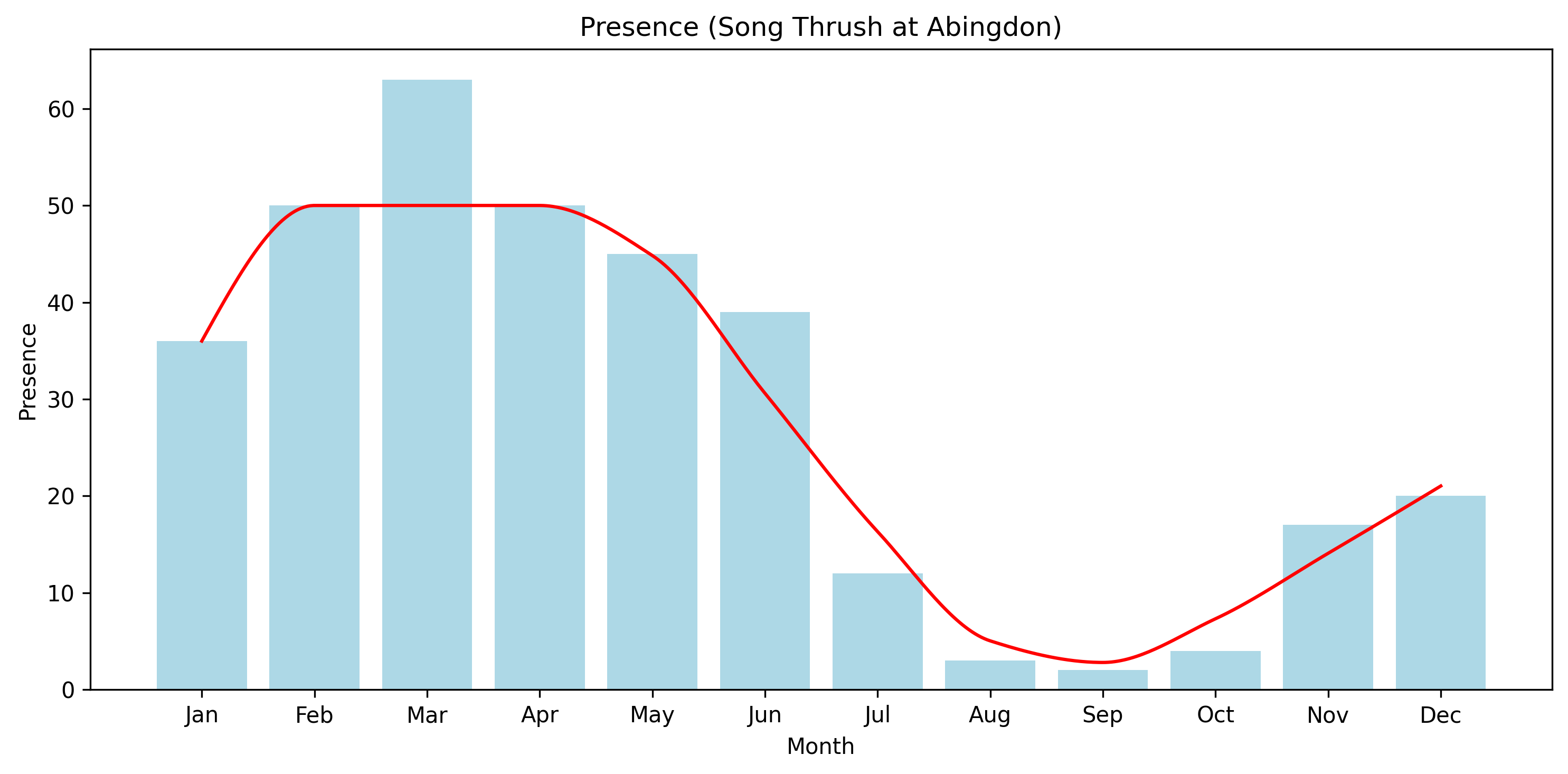
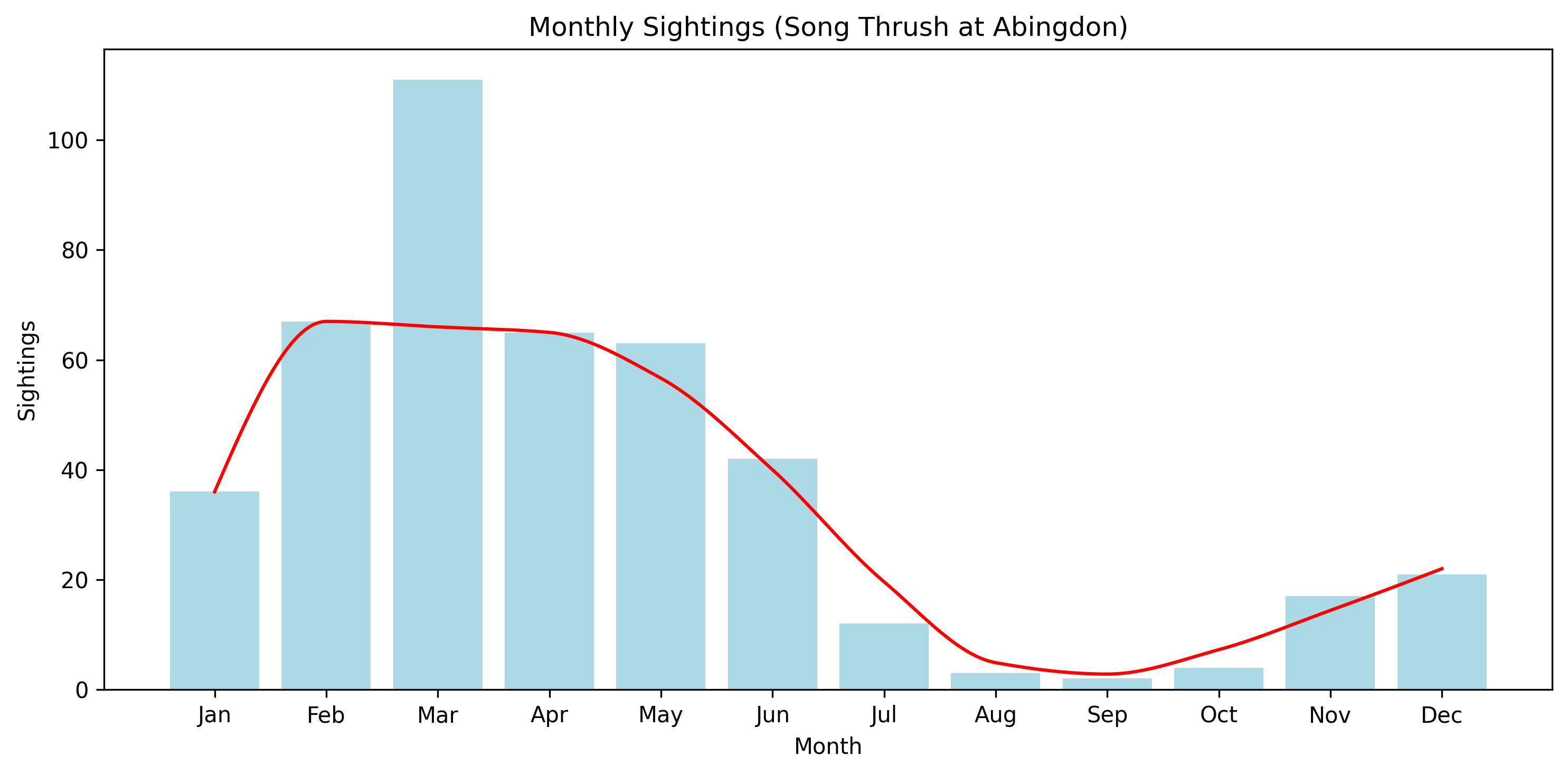
Song Thrush shows a year-round presence with a strong seasonal structure.
Records are already well established in winter, rising through late winter to a clear peak in March. High levels continue through April and May before gradually declining into early summer.
From July through September, the species reaches a pronounced minimum, with only occasional records.
From October onwards, sightings increase again through autumn into early winter, though at lower levels than the spring peak.
The overall pattern is that of a resident species with a strong spring maximum, a late-summer trough, and a modest autumn–winter recovery.
Interpretation
The seasonal pattern of Song Thrush is strongly influenced by detectability, particularly through song.
The rise from winter into early spring reflects the onset of territorial singing. Males begin singing early in the year, often in late winter, making the species far more conspicuous than at other times.
The peak in March and sustained high levels through April and May correspond to the main breeding season, when song is frequent and birds are easily located.
The steady decline into summer, and especially the sharp drop from July to September, likely reflects a combination of factors:
- Reduced singing after breeding
- Dispersal of juveniles
- More secretive behaviour during moult
During this period, birds remain present but are far less detectable.
The recovery in autumn and early winter suggests a return to more visible foraging behaviour, possibly combined with local movements or an influx of birds, though without the strong acoustic signal seen in spring.
Overall, the pattern reflects a resident species whose visibility in the records is heavily shaped by seasonal changes in behaviour rather than simple presence or absence.
Summary
| Aspect | Classification |
|---|---|
| Seasonal pattern | Resident (spring peak, late-summer minimum, detectability-driven) |
Notes
These patterns are derived from long-term personal field records and should be read as descriptions of observed behaviour rather than complete biological accounts.
For species such as Song Thrush, seasonal variation in records is strongly influenced by vocal activity and behaviour. Peaks in spring reflect heightened detectability during the breeding season, while summer minima likely represent reduced visibility rather than true absence.