
Shepherd’s Purse
Flowering period type: Extended flowering period (early start, persistent)
Shepherd’s Purse is a small and easily overlooked plant of disturbed ground, gardens, and field edges in Abingdon. Its tiny white flowers and distinctive heart-shaped seed pods make it recognisable on closer inspection.
This page summarises how the species appears in the records: the structure of its flowering period across the year.
Flowering Period
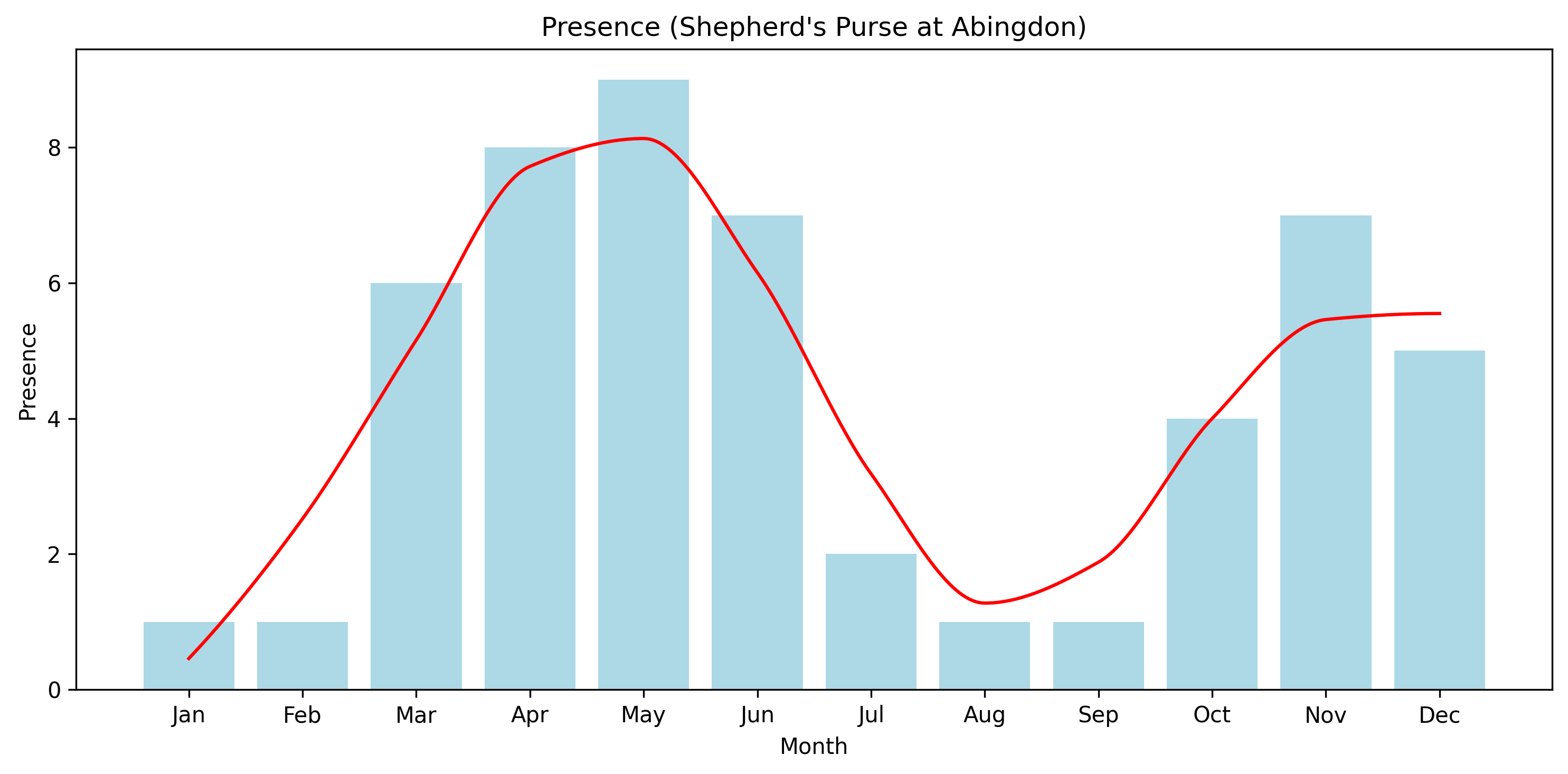
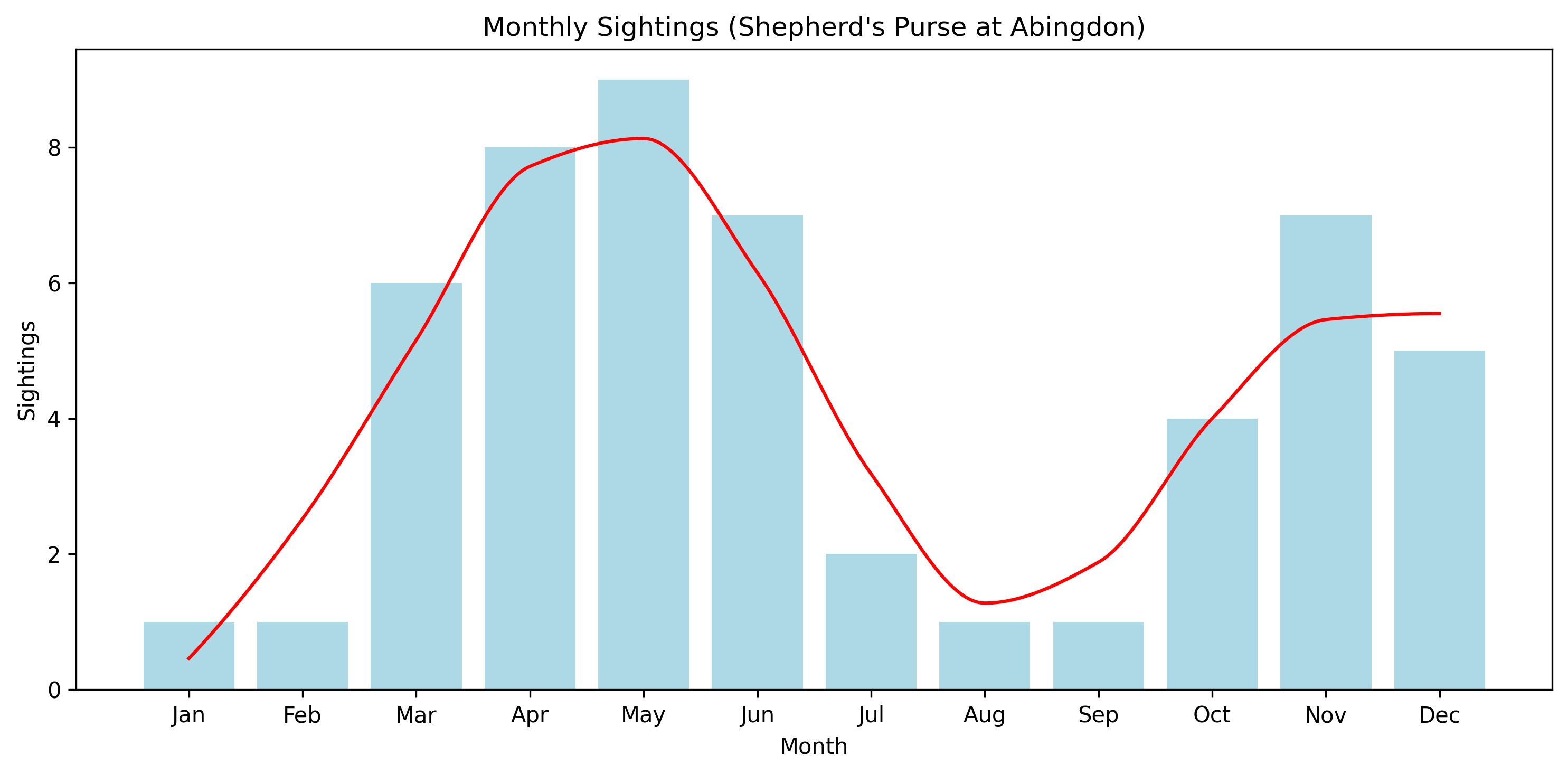
Shepherd’s Purse shows a broad and extended flowering period, beginning early in the year and continuing across multiple seasons.
Records appear from early spring and persist through much of the year, with no sharply defined peak. Activity is spread across a wide range of months, with gradual variation rather than strong seasonal pulses.
The overall pattern is that of an early-starting, persistent flowering presence.
Interpretation
The flowering pattern of Shepherd’s Purse reflects a highly flexible and opportunistic life strategy.
The species is able to:
- Begin flowering early in the season
- Continue flowering whenever conditions remain favourable
- Occupy disturbed and nutrient-rich habitats throughout the year
This results in:
- A long flowering window
- Relatively even levels of activity across months
- A lack of a dominant seasonal peak
Like Red dead-nettle, it contributes to the background continuity of flowering, rather than forming a strong seasonal signal.
However, its persistence may extend further across the year, reinforcing its role as a nearly continuous presence in suitable habitats.
Overall, the pattern reflects a species that flowers opportunistically over a long period, helping to maintain a continuous low-level flowering signal in the landscape.
Summary
| Aspect | Classification |
|---|---|
| Flowering period | Extended flowering period (early start, persistent) |
Notes
These patterns are derived from long-term personal field records and should be read as descriptions of observed flowering rather than complete biological accounts.
For species such as Shepherd’s Purse, flowering may occur across a wide seasonal window and is often influenced by local conditions and disturbance. The observed pattern reflects both biological flexibility and the likelihood of recording a small, inconspicuous plant.