
Robin
Role in the year: Winter presence and quietly extended breeding season
The Robin is one of the most familiar and consistently encountered birds in Abingdon, present throughout the year but changing markedly in behaviour and visibility between seasons. Its seasonal pattern differs from many other species, with highest visibility in winter and a relative decline during the breeding period.
This page summarises how the species appears in the records: how it occupies the year, and how its breeding activity becomes visible.
Seasonal Pattern
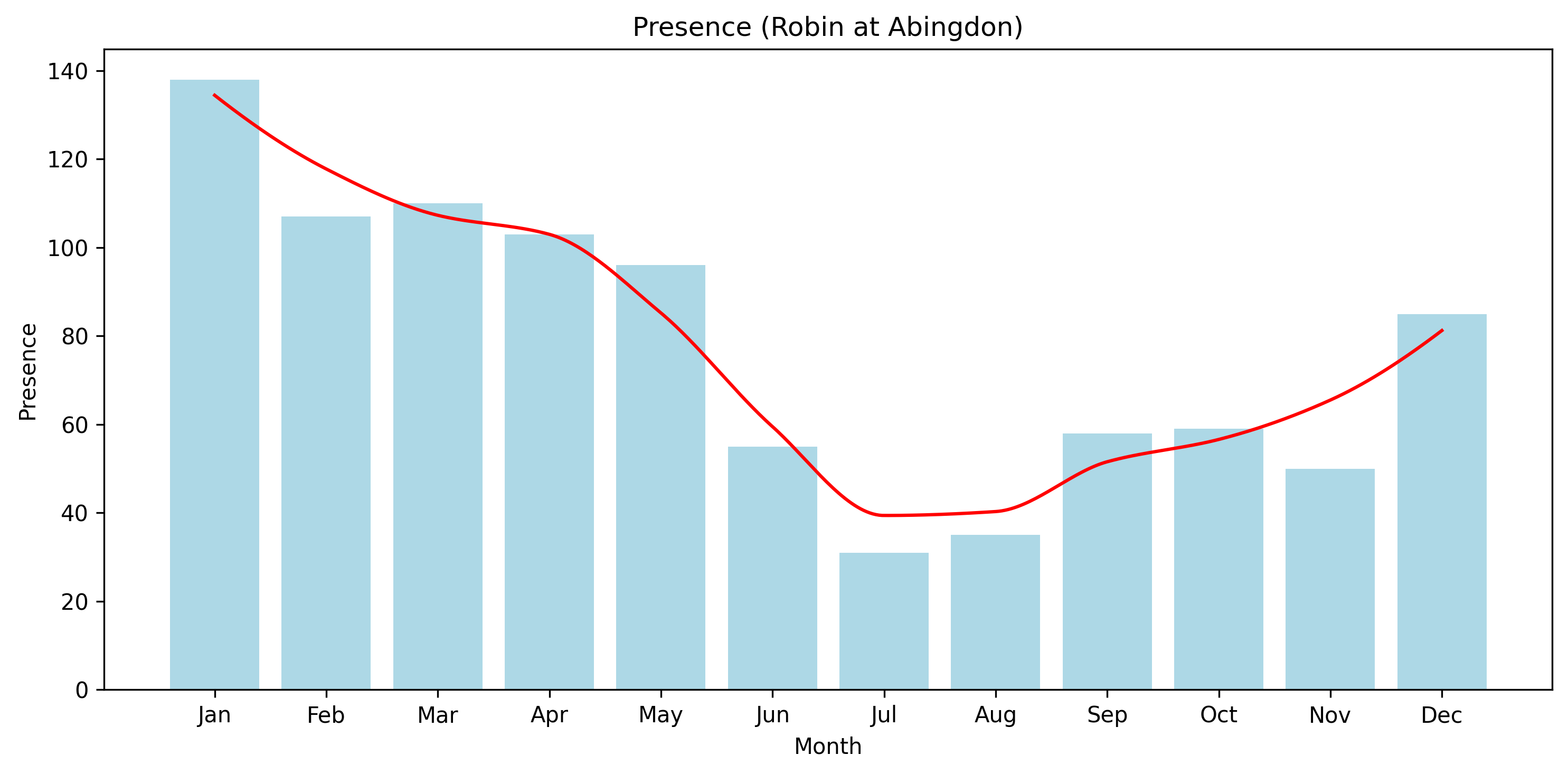
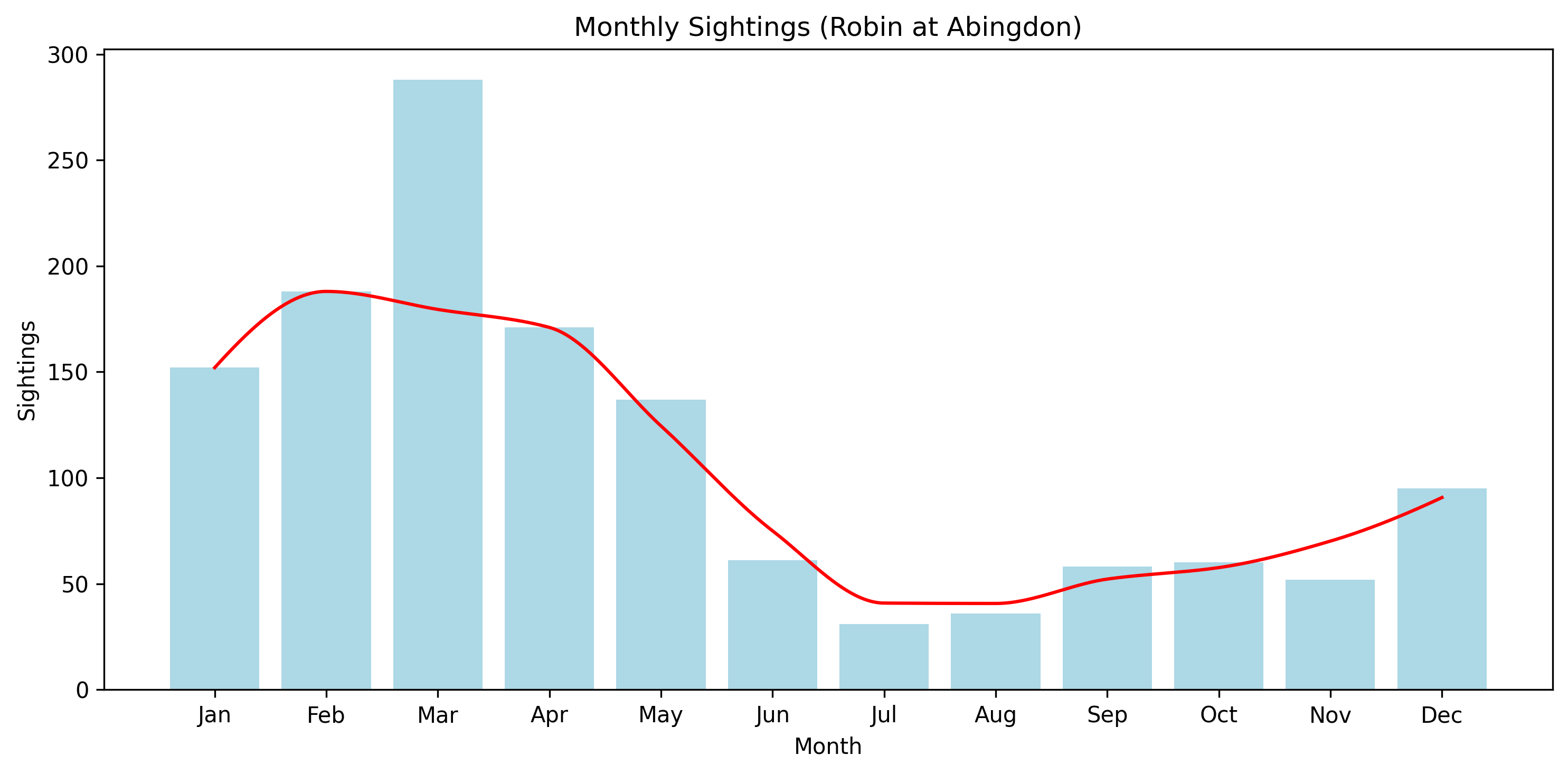
The Robin is recorded throughout the year, but with a pattern that contrasts with many other resident species.
Presence is highest through the winter months, reflecting both increased activity in open habitats and the tendency for birds to be encountered singly and conspicuously. Through spring and into early summer, the signal declines, reaching its lowest point in mid-summer before gradually increasing again into autumn and winter.
This pattern reflects a shift from winter visibility to breeding-season dispersion. During the breeding period, birds are more widely spaced and less frequently encountered, even though they remain present.
The overall pattern is best described as a detectability-driven resident, with a distinctive winter-weighted signal shaped by behaviour rather than true seasonal absence.
Observed Breeding Activity
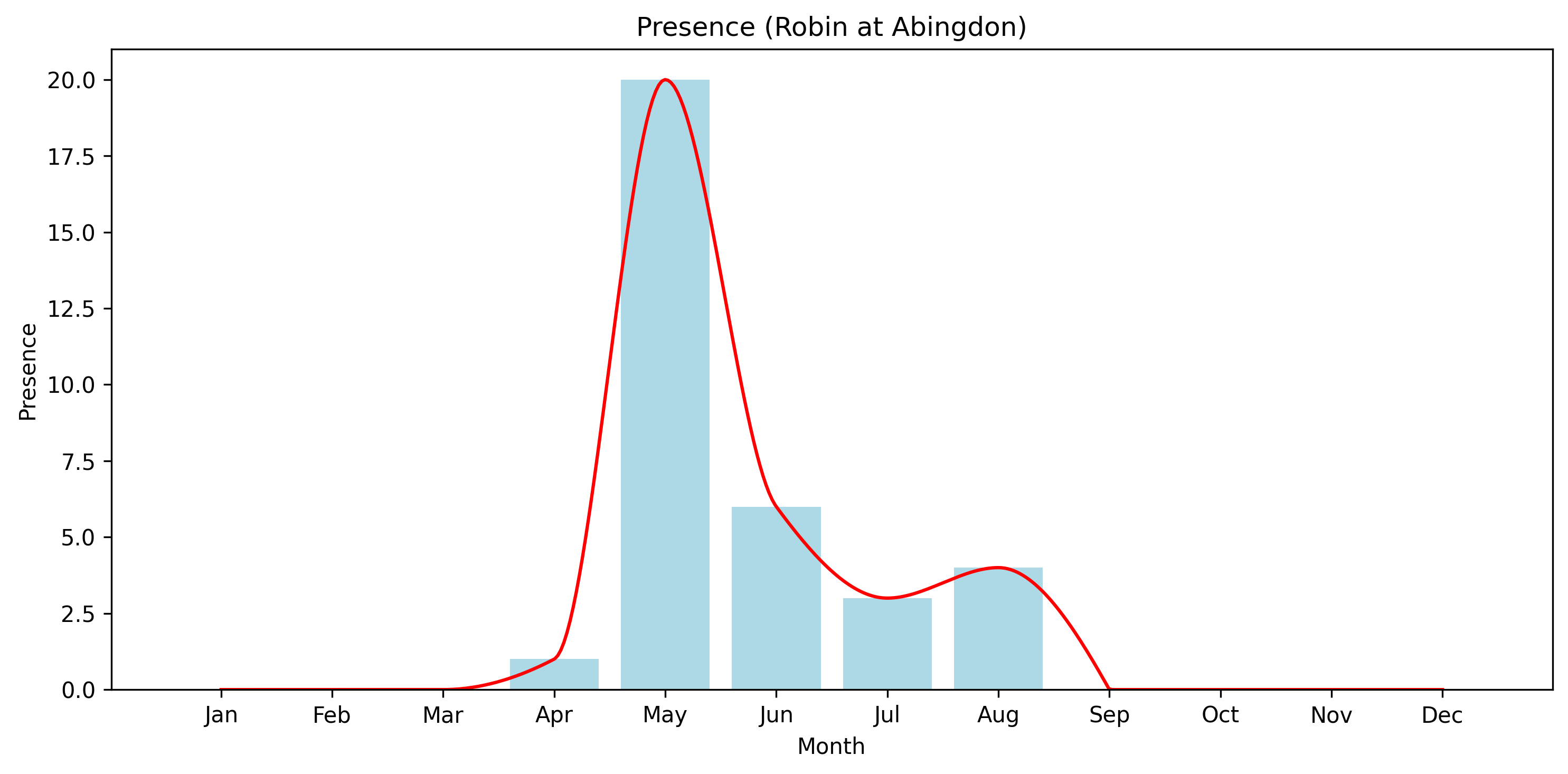
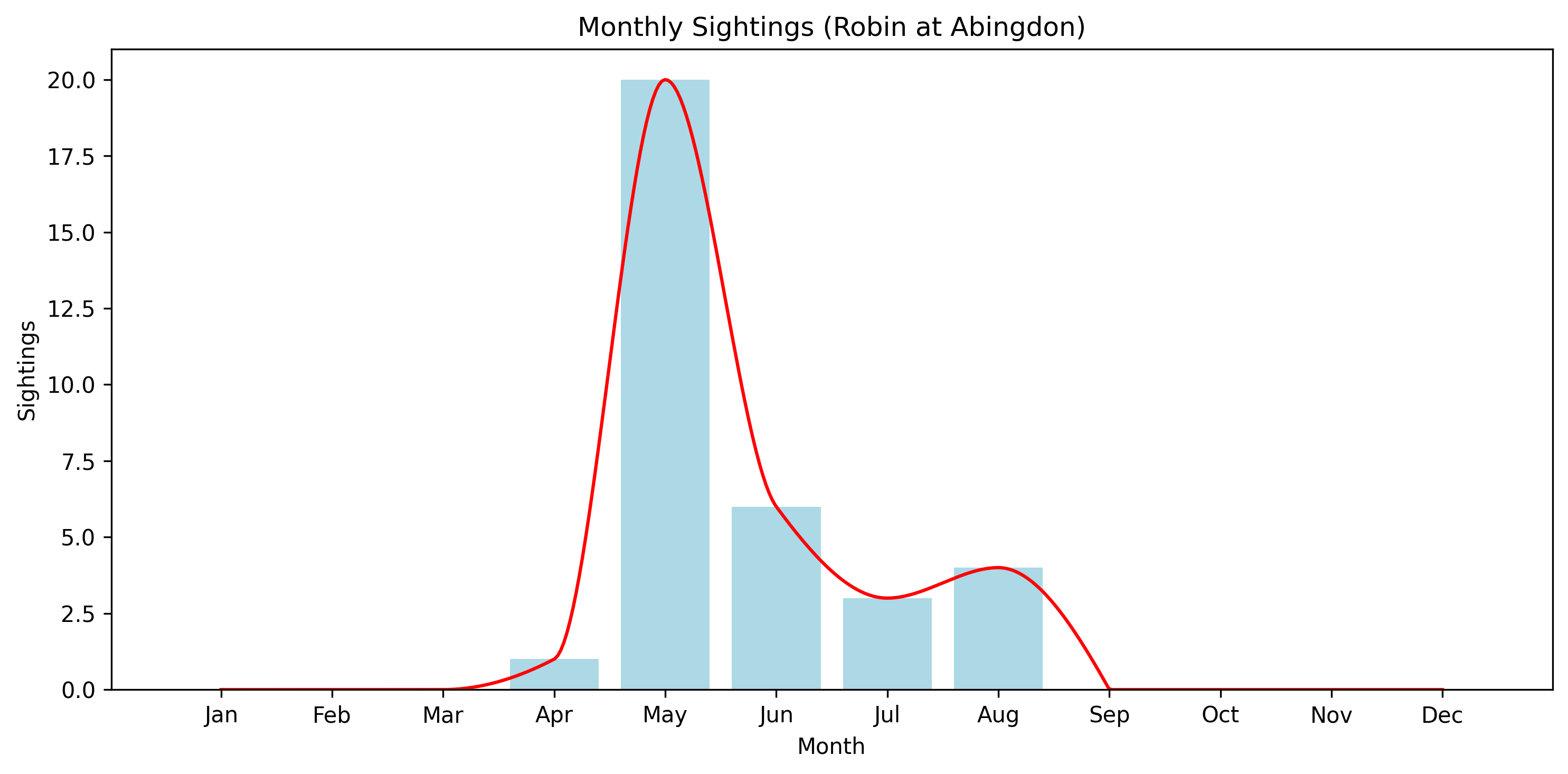
Records of Robin with dependent young form a clear but extended seasonal signal.
Breeding activity becomes visible in late spring, peaks in May, and then continues at lower levels through June, July, and into August. Unlike more tightly bounded breeding patterns, the signal does not drop away sharply after the peak, but tapers gradually across several months.
This pattern is consistent with a moderately extended breeding window, reflecting the potential for multiple broods and the continued visibility of dependent young over an extended period.
Interpretation
Taken together, these patterns describe a species whose seasonal behaviour runs counter to many others.
In winter, Robins are highly visible. Birds occupy and defend territories individually, often in open or semi-open habitats, and are frequently encountered. This produces a strong winter signal, even though overall population size may not be at its highest.
As spring approaches, activity remains high, but the nature of the signal begins to change. With the onset of breeding, birds become more widely distributed and less conspicuous. The seasonal presence curve declines, not because birds are absent, but because they are less frequently encountered.
Breeding activity then becomes visible, but in a different way from species with tightly defined windows. Rather than a brief pulse, the Robin shows a more extended period in which young are present. This reflects both successive broods and the continued association of fledged young with suitable habitat.
By mid-summer, both presence and breeding signals are reduced. Birds are quieter, more dispersed, and less frequently recorded. Through late summer and autumn, visibility increases again, returning to the more conspicuous winter pattern.
The result is a species that is constant in presence but variable in visibility, with a seasonal rhythm shaped by behaviour rather than movement.
Summary
| Aspect | Classification |
|---|---|
| Seasonal pattern | Detectability-driven resident |
| Breeding pattern | Moderately extended breeding window |
</div>
Notes
These patterns are derived from long-term personal field records and should be read as descriptions of observed behaviour rather than complete biological accounts.
Seasonal presence reflects when the species is encountered. Breeding activity reflects when dependent young are visible. Both are shaped by behaviour, detectability, and observer experience as much as by underlying biology.