
Red Campion
Flowering period type: Extended flowering period (spring–summer, moderate peak)
Red Campion is a familiar and attractive plant of hedgerows, woodland edges, and grassy banks in Abingdon. Its bright pink flowers are often among the first to bring colour to the landscape as spring progresses.
This page summarises how the species appears in the records: the structure of its flowering period across the year.
Flowering Period
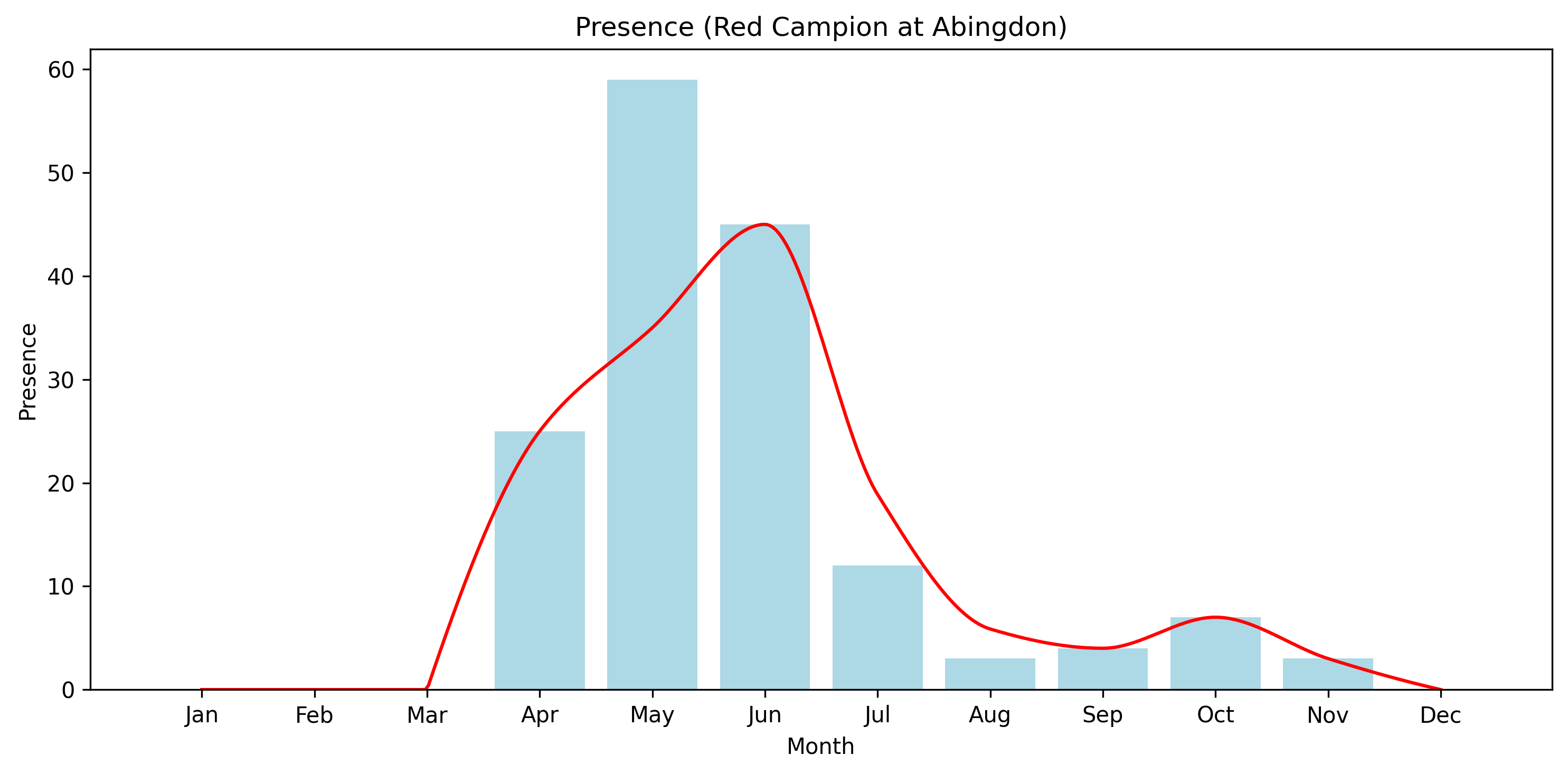
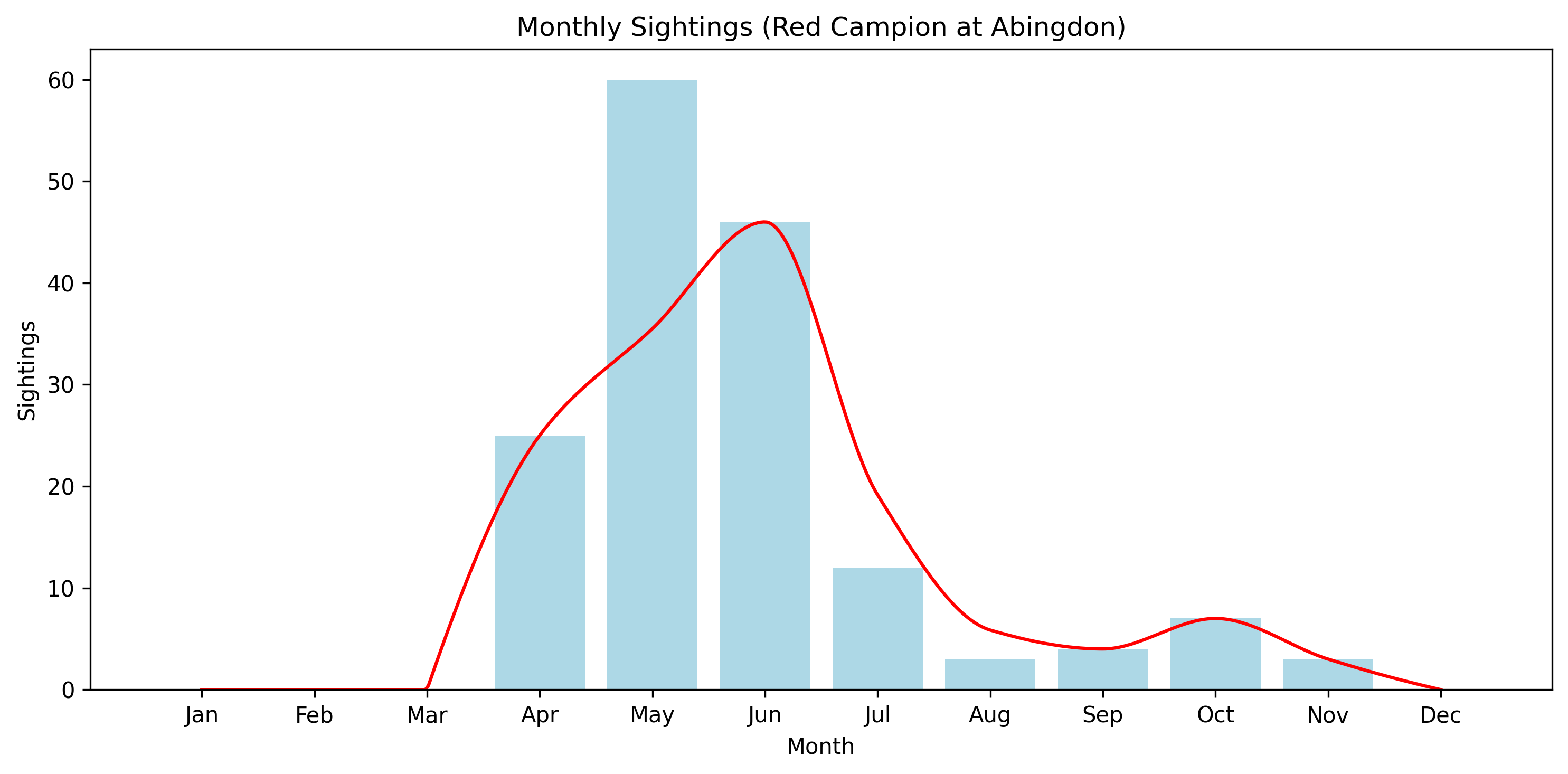
Red Campion shows a broad flowering period extending from spring into summer.
Records begin in spring, rising to a clear peak in late spring or early summer. Flowering continues at moderate levels through the summer months before gradually declining.
The overall pattern is that of an extended flowering period with a defined but not sharply peaked centre.
Interpretation
The flowering pattern of Red Campion reflects a prolonged but structured flowering strategy.
Compared to tightly constrained spring species, Red Campion:
- Emerges relatively early in the season
- Builds steadily to a central peak
- Maintains flowering well into summer
This results in:
- A clear seasonal rise and fall
- A sustained period of visibility across multiple months
- A presence that bridges spring and summer
Unlike species with very diffuse flowering, Red Campion still shows a recognisable peak, giving it a stronger seasonal identity.
At the same time, its extended flowering period means it contributes continuity rather than a brief, synchronised display.
Overall, the pattern reflects a species that combines a clear seasonal signal with a prolonged period of flowering, helping to carry the transition from spring into summer.
Summary
| Aspect | Classification |
|---|---|
| Flowering period | Extended flowering period (spring–summer, moderate peak) |
Notes
These patterns are derived from long-term personal field records and should be read as descriptions of observed flowering rather than complete biological accounts.
For species such as Red Campion, flowering spans a relatively long period, with a clear seasonal centre but extended activity on either side. This results in both a recognisable peak and a sustained presence in the landscape.