
Peacock Butterfly
Flight period type: Bimodal (overwintering adult)
The Peacock Butterfly is a familiar and often striking species in Abingdon, easily recognised by its bold eye-spots. It is one of the species that can be encountered early in the year as overwintered adults re-emerge.
This page summarises how the species appears in the records: the structure of its flight period across the year.
Flight Period
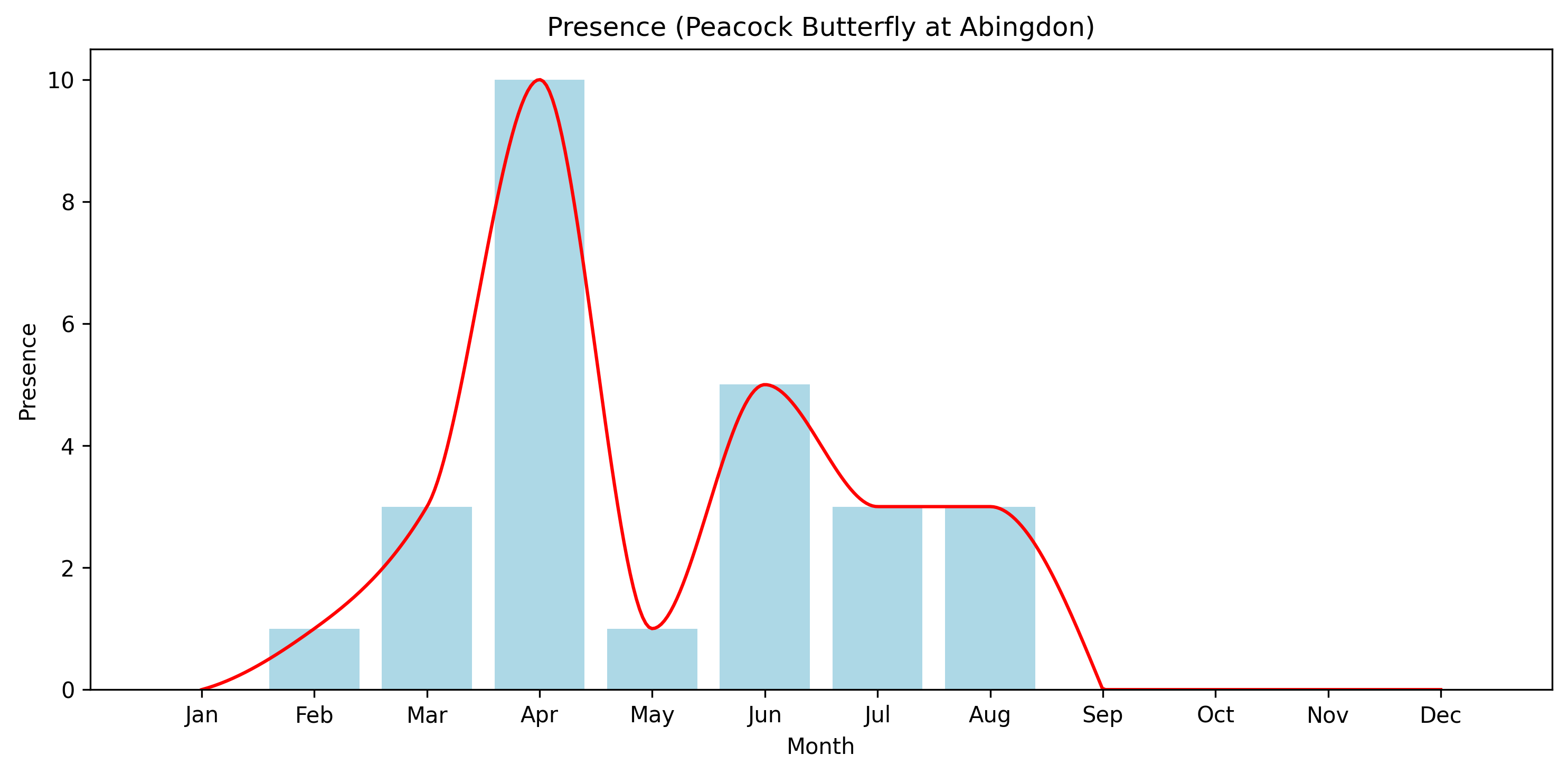
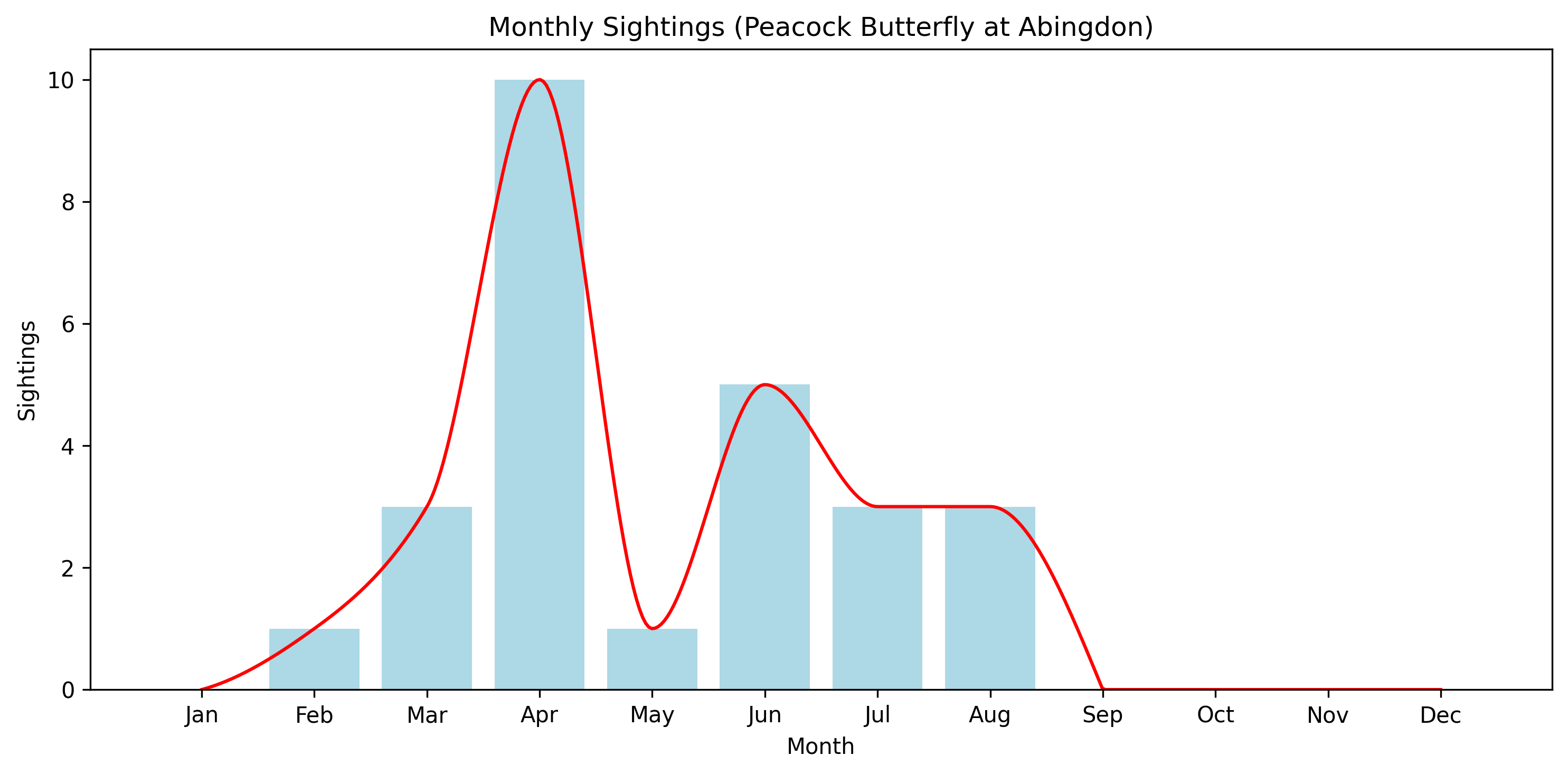
Peacock shows a bimodal flight pattern, with two distinct peaks separated by a clear dip.
The first peak occurs in spring, building from February through March to a maximum in April. Activity then drops sharply in May.
A second period of activity follows in early to mid-summer, with increased records in June, July, and August, though generally at lower levels than the spring peak.
The overall pattern is that of two distinct phases of activity within a single year.
Interpretation
The bimodal pattern reflects the Peacock’s life cycle, particularly its ability to overwinter as an adult.
The early-season peak represents overwintered individuals emerging in spring. These butterflies become active as temperatures rise, producing the strong signal seen from February to April.
The sharp dip in May reflects the end of this phase, as overwintered adults die off following breeding.
The second peak, beginning in June and continuing through summer, represents the emergence of a new generation. These newly emerged individuals form the later-season flight period.
Unlike species with separate broods, the two peaks here are not independent generations in the same way. Instead, they reflect:
- Spring activity of overwintered adults
- Summer activity of newly emerged individuals
The dip between these phases creates the clear bimodal structure seen in the data.
Overall, the pattern reflects a species with a continuous life cycle across the year, expressed as two distinct periods of adult activity linked by overwintering behaviour.
Summary
| Aspect | Classification |
|---|---|
| Flight period | Bimodal (overwintering adult) |
Notes
These patterns are derived from long-term personal field records and should be read as descriptions of observed activity rather than complete biological accounts.
For butterfly species such as Peacock, bimodal patterns often reflect overwintering behaviour, where adults are active in both early and later parts of the year. The separation between peaks represents a real biological transition rather than variation in detectability.