
Mute Swan
Role in the year: Resident presence and prolonged family association on the river
The Mute Swan is a constant and recognisable presence along the waterways of Abingdon. Unlike many smaller species, its seasonal pattern is less about absence and return, and more about gradual shifts in activity and visibility, particularly around breeding.
This page summarises how the species appears in the records: how it occupies the year, and how its breeding activity becomes visible.
Seasonal Pattern
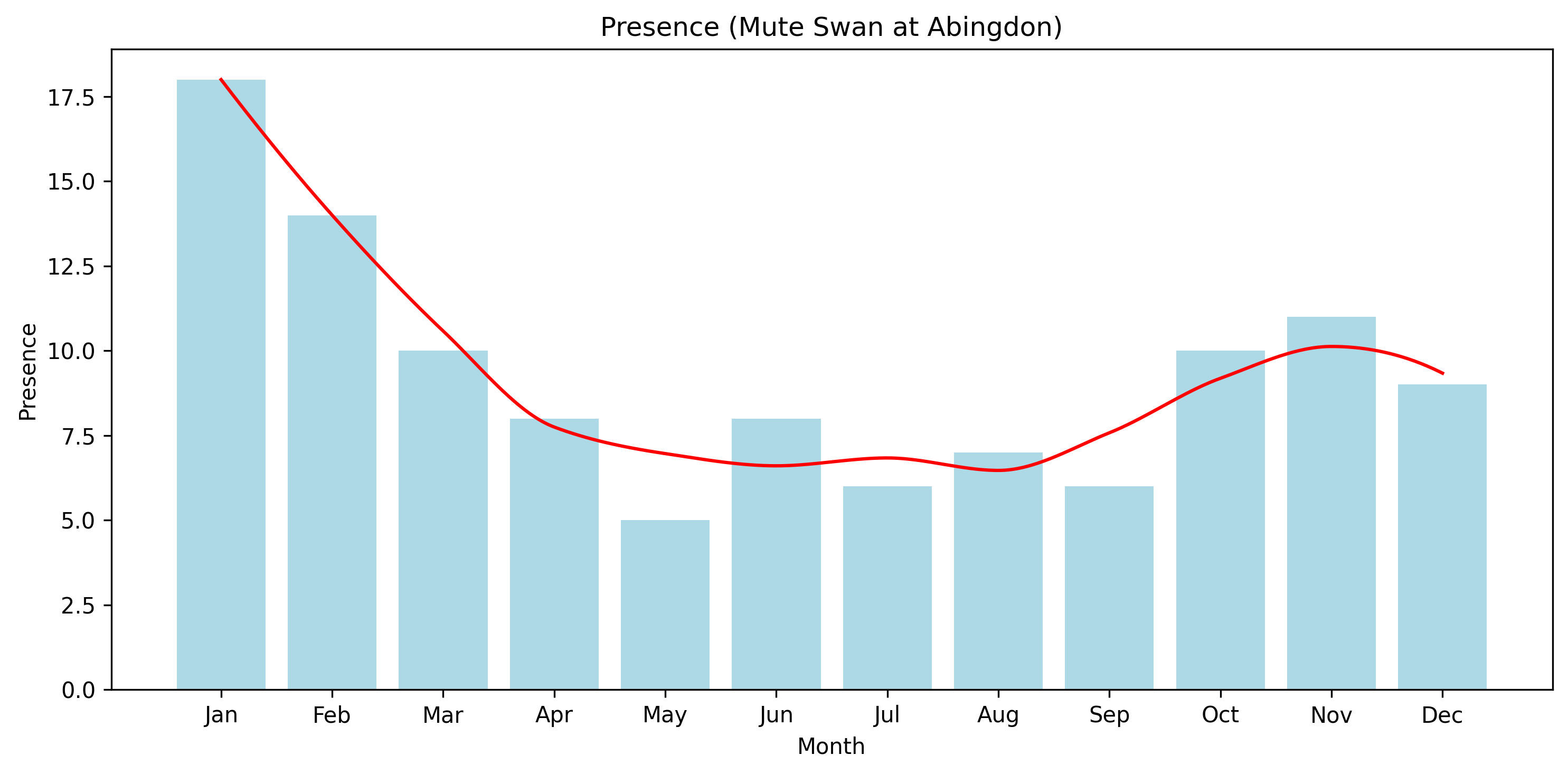
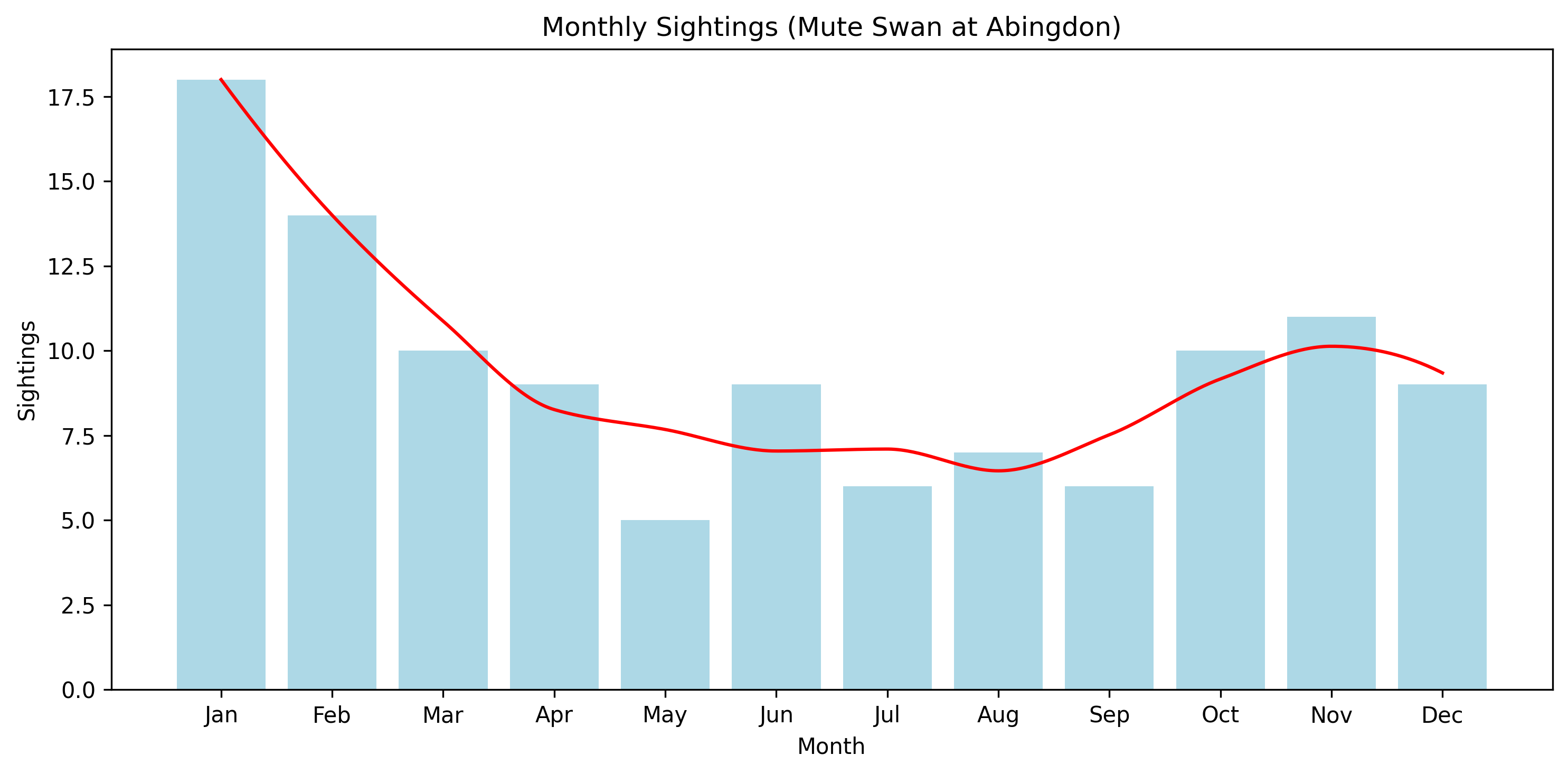
The Mute Swan is recorded throughout the year, with a relatively even distribution compared to more strongly seasonal species.
Presence remains steady across winter and spring, with a slight decline into early summer, followed by a modest increase through late summer and autumn. There is no sharp seasonal peak or absence; instead, the signal reflects a stable, local population.
This pattern is consistent with a detectability-driven resident, though with less pronounced seasonal variation than smaller, more behaviourally dynamic species. The species is consistently visible, and changes in the signal are subtle, reflecting local movement and activity rather than large-scale shifts.
Observed Breeding Activity
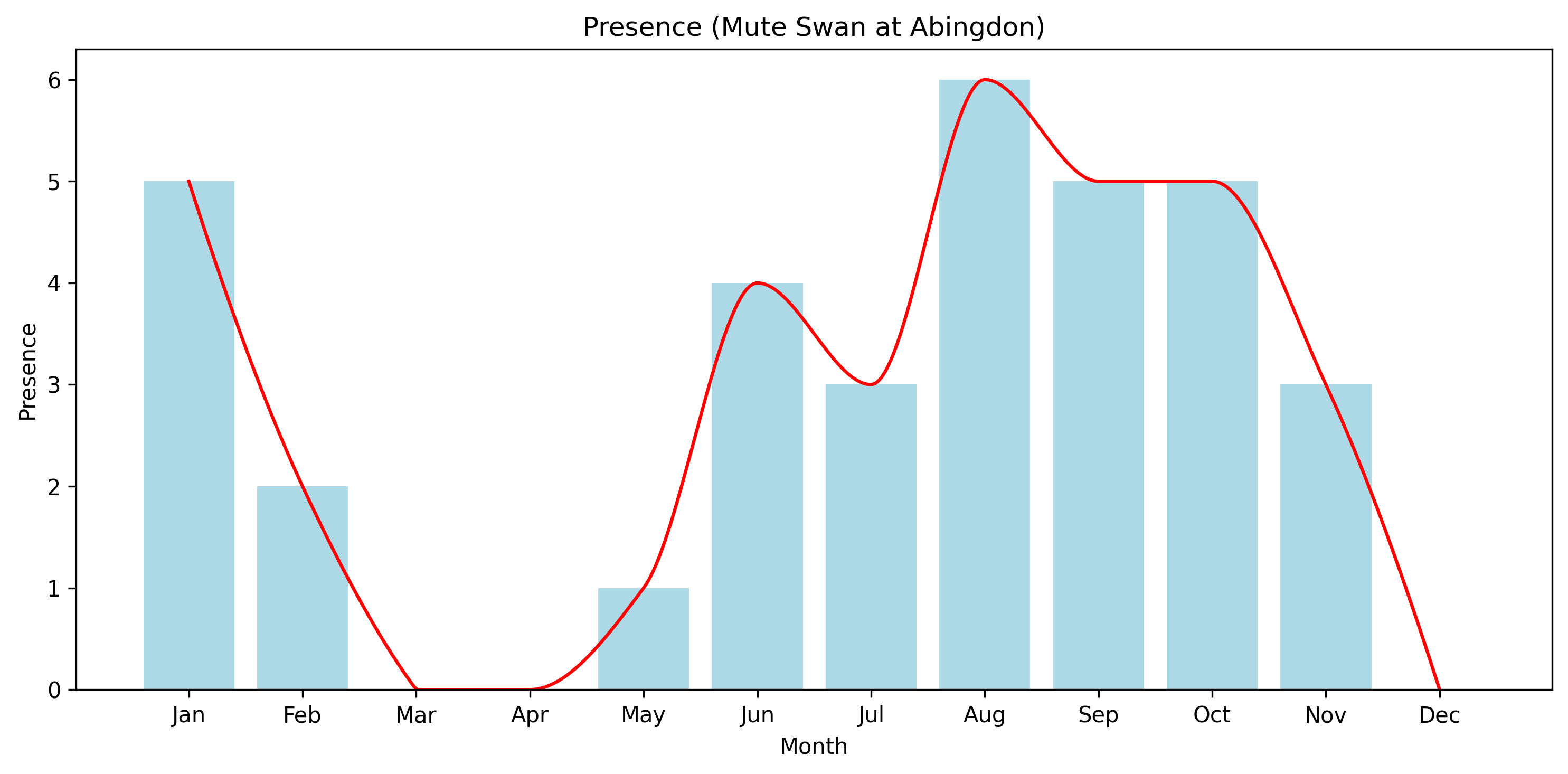
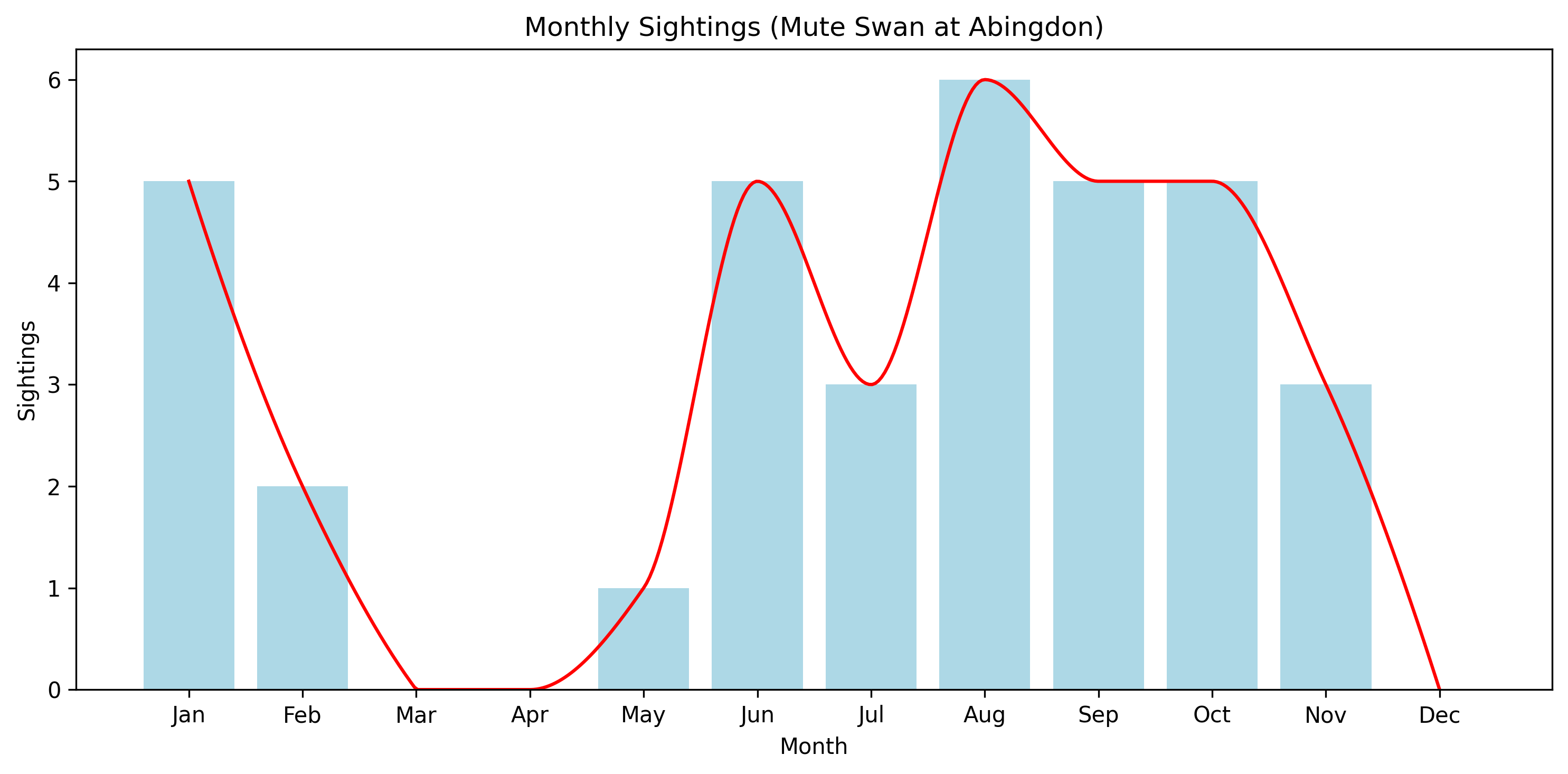
Records of Mute Swan with dependent young form a broad and extended seasonal signal.
Breeding activity becomes visible in late spring, increases through early summer, and remains present well into late summer and early autumn. Unlike more compact breeding signals, there is no sharp peak followed by rapid decline. Instead, the signal persists over several months.
This pattern is best described as a diffuse / ambiguous breeding signal, reflecting a prolonged period in which young remain associated with the adults and continue to be encountered in the field.
Interpretation
Taken together, these patterns describe a species defined by continuity rather than change.
Mute Swans are present throughout the year, forming part of the constant background of the river. Seasonal variation exists, but it is modest, and does not produce the strong peaks and troughs seen in more mobile or behaviourally variable species.
The breeding signal, however, introduces a different kind of pattern. Rather than a brief window in which young are visible, Mute Swans show a long period of family association. Cygnets remain with the adults for months, and this extended relationship is reflected directly in the data.
As a result, the breeding curve does not simply mark the moment of reproduction. It captures the continued presence of the next generation within the landscape — a slow unfolding rather than a brief event.
By late autumn, this signal fades, not because breeding has only just ended, but because the young have matured and the distinct family grouping becomes less visible.
The result is a pattern that is both stable and extended: a species that is always present, and whose breeding is experienced not as a moment, but as a season.
Summary
| Aspect | Classification |
|---|---|
| Seasonal pattern | Detectability-driven resident |
| Breeding pattern | Diffuse / ambiguous breeding signal |
</div>
Notes
These patterns are derived from long-term personal field records and should be read as descriptions of observed behaviour rather than complete biological accounts.
Seasonal presence reflects when the species is encountered. Breeding activity reflects when dependent young are visible. Both are shaped by behaviour, detectability, and observer experience as much as by underlying biology.