
Jay
Role in the year: Autumn acorn gatherer and elusive summer presence
The Jay is a shy and often fleeting woodland species in Abingdon, most often encountered at the edges of woods and copses. Although present throughout the year, its visibility varies strongly, with a pronounced seasonal pattern.
This page summarises how the species appears in the records: how it occupies the year.
Seasonal Pattern
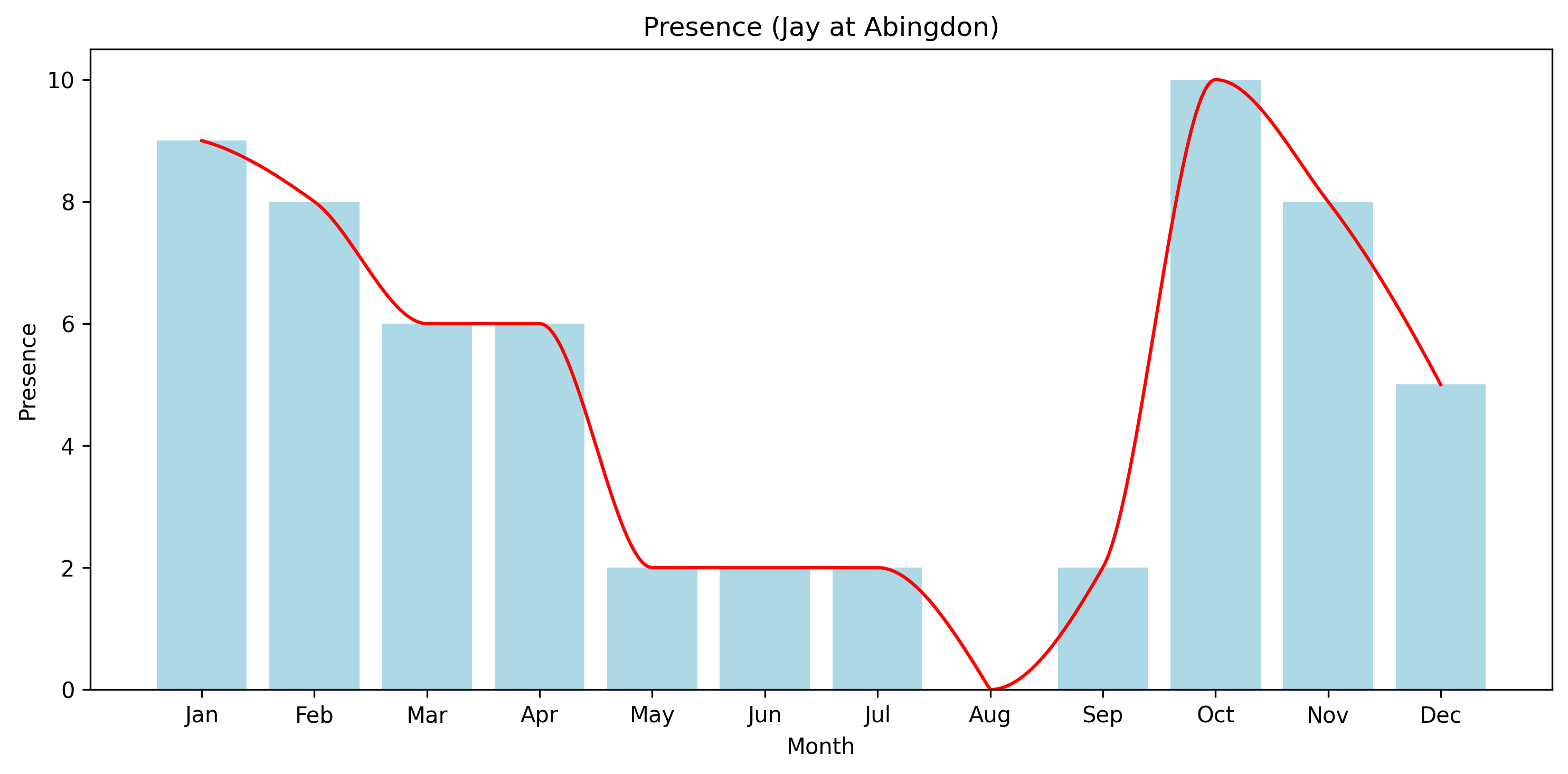
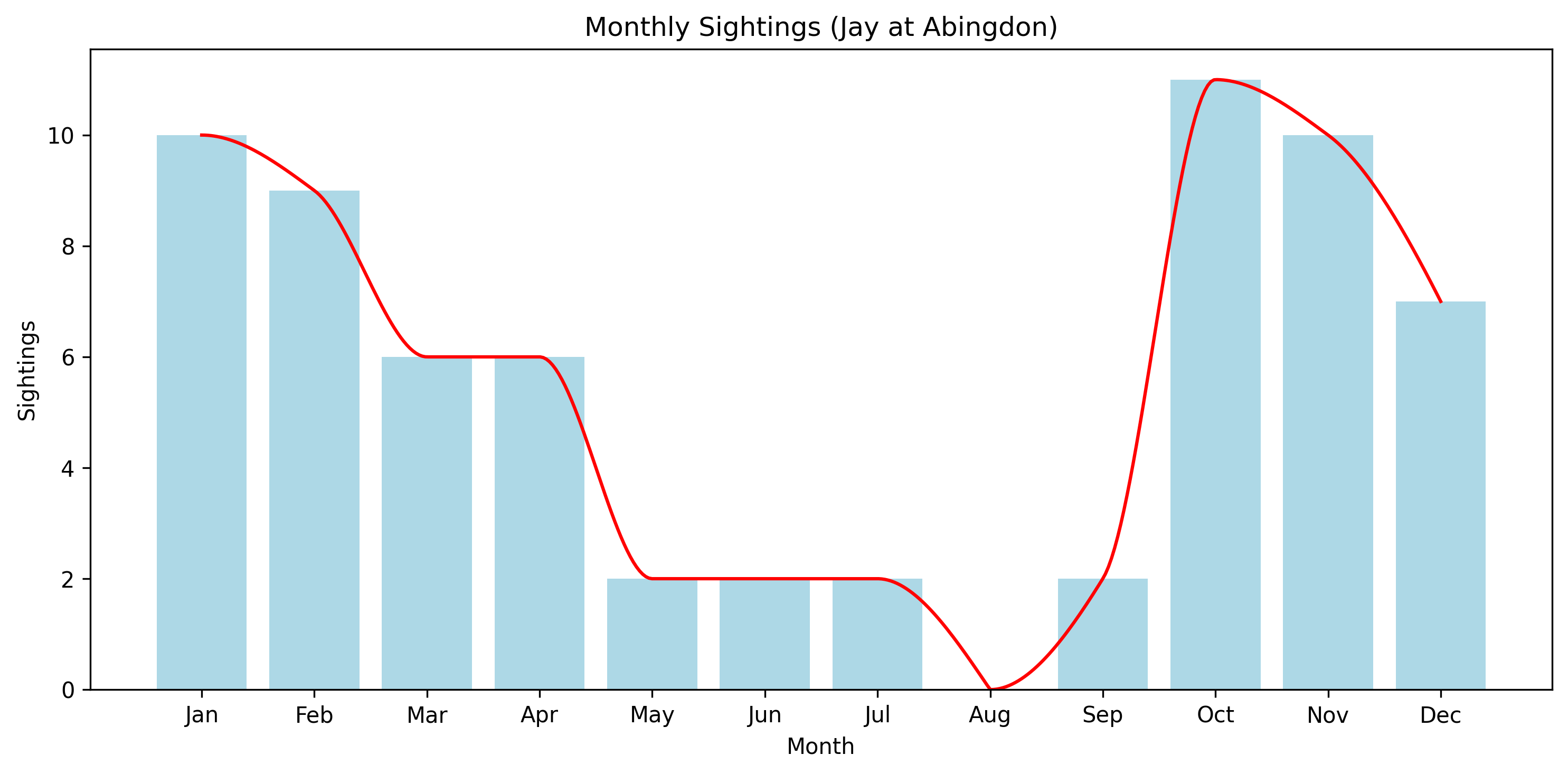
The Jay shows a strongly seasonal pattern despite being a resident species.
Records are highest in autumn and winter, with a clear peak from October through January. From late winter into spring, both presence and sightings decline steadily, reaching a minimum in summer, where the species is rarely recorded.
From early autumn, the signal increases rapidly again, returning to the winter peak.
The overall pattern is that of a resident species with a strong autumn–winter peak and a pronounced summer trough.
Interpretation
The Jay’s seasonal pattern reflects its behaviour as a woodland bird that is both secretive and seasonally mobile within the local landscape.
In autumn, Jays become far more visible as they exploit seasonal food resources, particularly acorns. This period of intense foraging activity brings birds out into more open areas and increases both their movement and detectability. The result is a sharp rise in records.
Through winter, Jays remain relatively conspicuous, often moving between feeding areas and woodland cover. Their presence remains steady and relatively easy to detect compared to other times of year.
As spring progresses, the species becomes more elusive. During the breeding season, Jays retreat deeper into woodland and dense cover, reducing their visibility. Vocal activity decreases, and encounters become infrequent.
This produces a pronounced summer trough in both presence and sightings, even though birds remain present within the area.
With the arrival of autumn, behaviour shifts again. Increased movement and feeding activity, particularly related to food caching, bring Jays back into view, producing the rapid rise into the winter peak.
The pattern therefore reflects a resident woodland species whose visibility is driven by seasonal behaviour, food availability, and use of habitat, rather than migration.
Summary
| Aspect | Classification |
|---|---|
| Seasonal pattern | Resident (autumn–winter visibility peak) |
Notes
These patterns are derived from long-term personal field records and should be read as descriptions of observed behaviour rather than complete biological accounts.
Seasonal presence reflects when the species is encountered. For woodland species such as Jay, variation in records is strongly influenced by habitat use, feeding behaviour, and seasonal visibility.