
House Sparrow
Role in the year: Constant presence rising to a busy summer colony peak
The House Sparrow is a familiar and strongly social resident in Abingdon, closely associated with buildings and gardens. It is present throughout the year, with seasonal variation reflecting changes in colony activity rather than absence.
This page summarises how the species appears in the records: how it occupies the year.
Seasonal Pattern
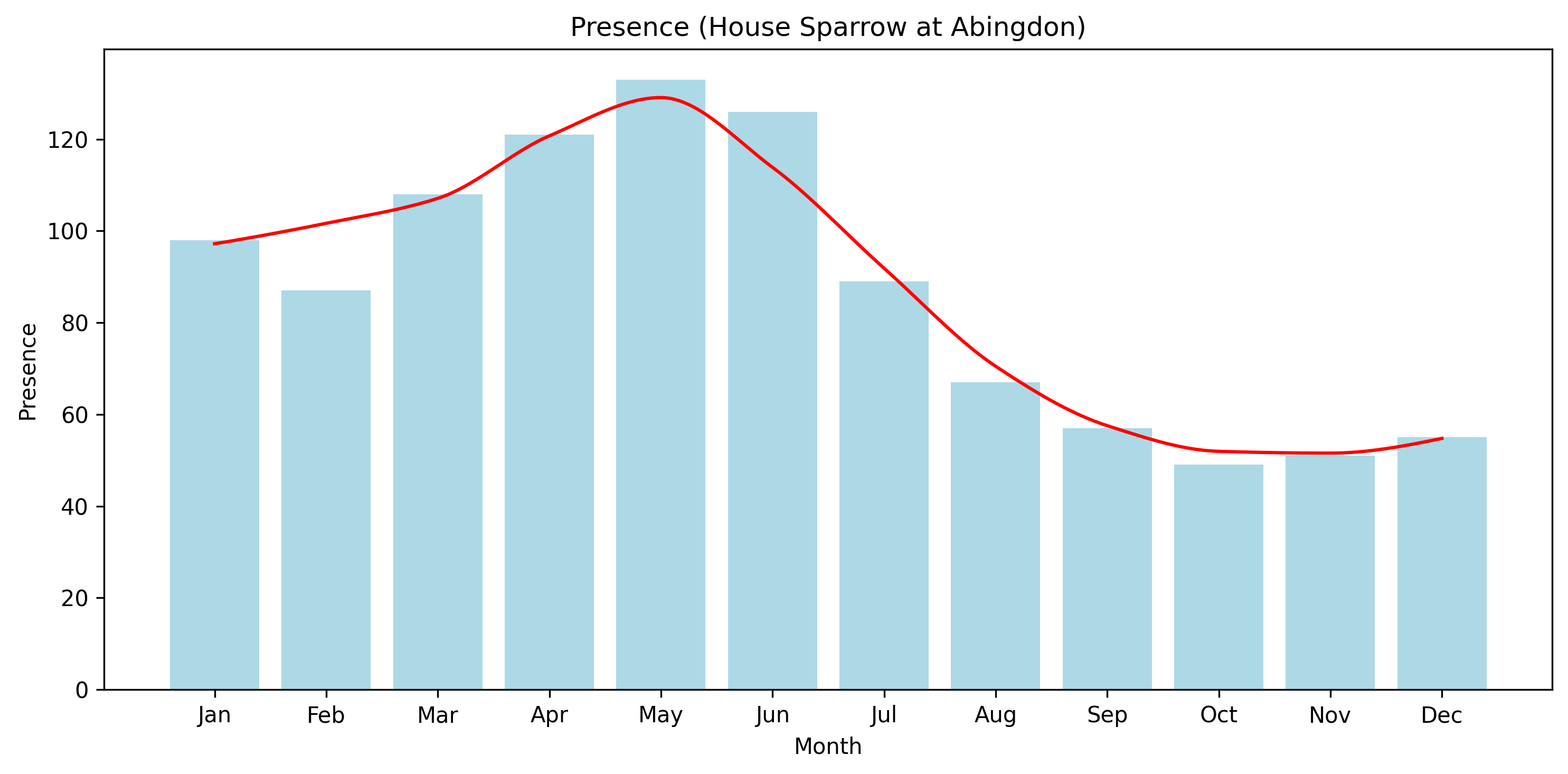
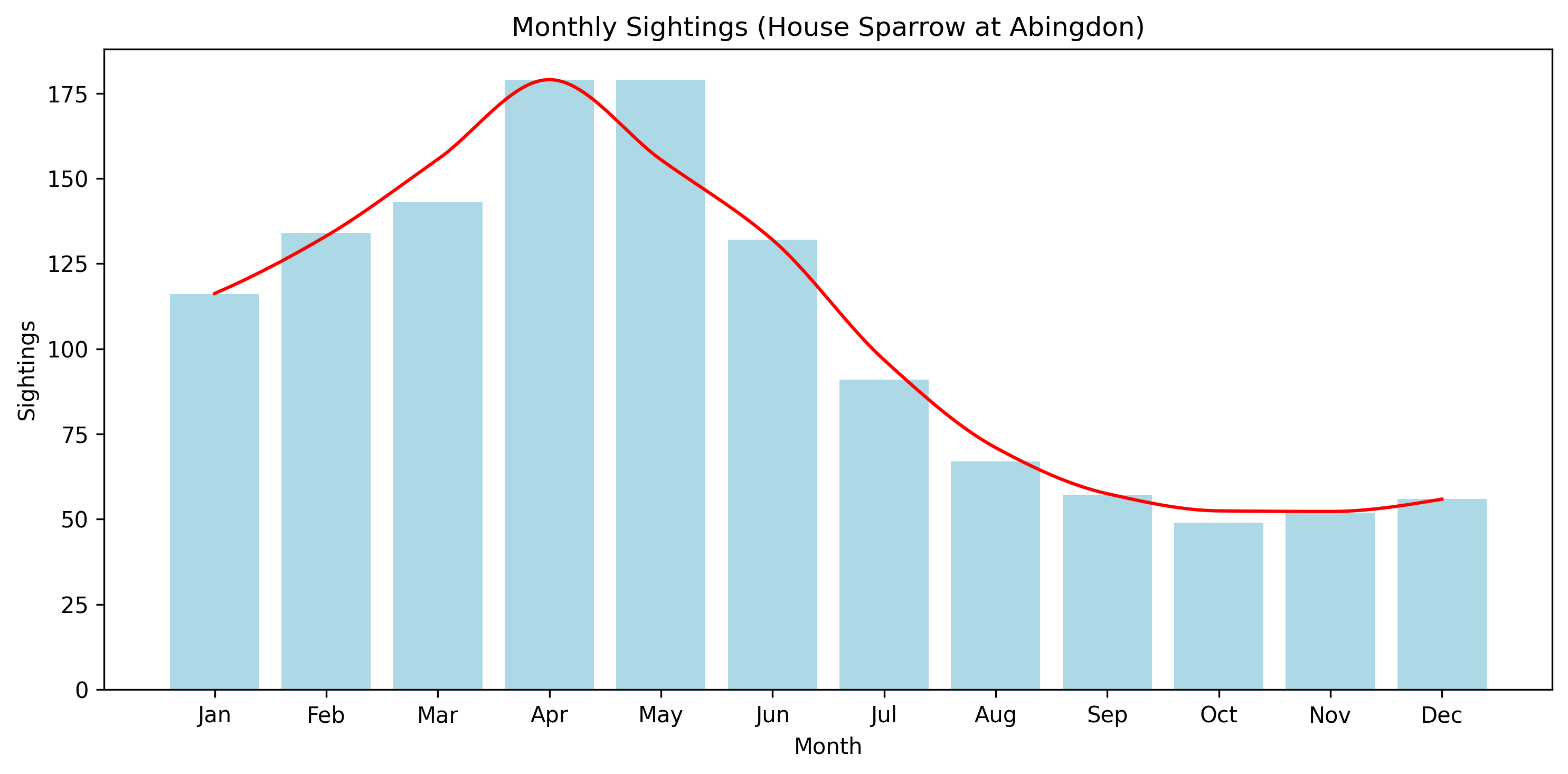
The House Sparrow shows a clear seasonal pattern despite being present throughout the year.
Presence remains relatively high year-round, but both presence and total sightings increase through spring, reaching a peak in April and May. From this peak, records decline steadily through summer into early autumn, before stabilising and recovering slightly into winter.
The overall pattern is that of a resident species with a spring–early summer peak, reflecting increased activity during the breeding season.
Interpretation
The seasonal pattern of the House Sparrow reflects its strongly social and colony-based behaviour.
Unlike more solitary species, House Sparrows are typically encountered in groups, often centred around nesting sites in buildings or gardens. During the breeding season, these colonies become highly active, with increased movement, vocalisation, and the presence of juveniles.
This results in a pronounced increase in both sightings and presence during spring and early summer. The peak in April and May likely reflects the combined effect of territorial activity, nesting behaviour, and the emergence of young birds.
As the breeding season progresses and concludes, activity levels decline. Birds remain present but are less concentrated and less conspicuous, leading to a gradual reduction in records through late summer and autumn.
In winter, the species continues to be encountered regularly, often in loose groups around feeding areas. However, without the intensity of breeding activity, both presence and total sightings remain below the spring peak.
The overall pattern therefore reflects a resident, colony-forming species whose seasonal signal is driven by breeding activity and social behaviour, rather than migration or simple detectability.
Summary
| Aspect | Classification |
|---|---|
| Seasonal pattern | Resident (spring–summer colony peak) |
Notes
These patterns are derived from long-term personal field records and should be read as descriptions of observed behaviour rather than complete biological accounts.
Seasonal presence reflects when the species is encountered. For highly social species such as House Sparrow, variation in records reflects changes in colony activity, breeding intensity, and group size.