
Great Tit
Role in the year: Spring voice and early breeding anchor
The Great Tit is one of the most familiar and consistently encountered species in Abingdon, present throughout the year but changing in character with the seasons. Its voice is among the first to reassert itself in late winter, and its breeding cycle provides one of the clearest early signals of renewal.
This page summarises how the species appears in the records: how it occupies the year, and how its breeding activity becomes visible.
Seasonal Pattern
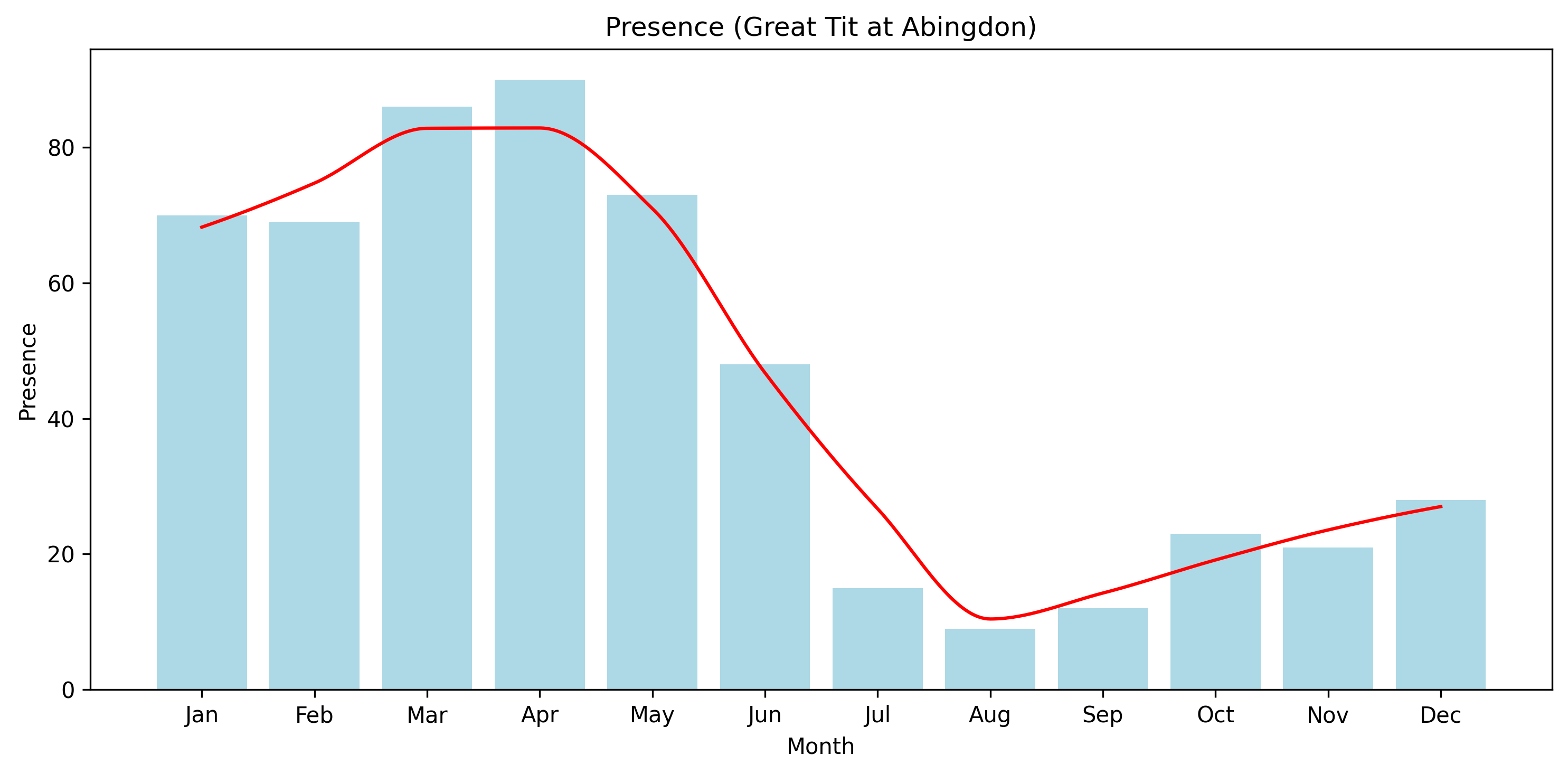
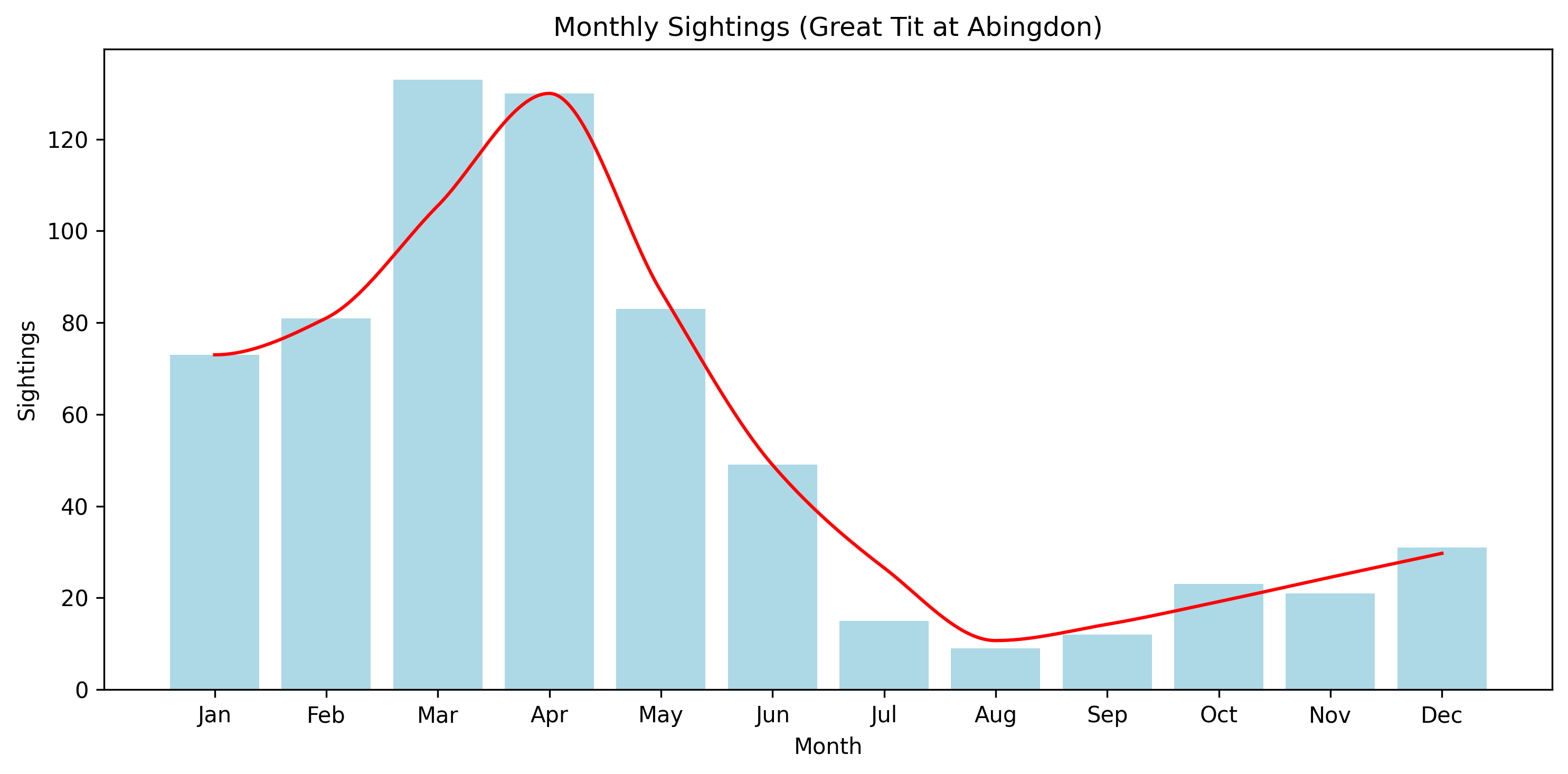
The Great Tit is recorded throughout the year, but not uniformly.
Presence rises steadily from late winter into spring, reaching a clear peak in April and May. This reflects a combination of increased activity and detectability, as birds become more vocal and territorial. Through the summer months, the signal declines, reaching its lowest point in late summer before gradually increasing again into autumn and winter.
The overall pattern is one of a detectability-driven resident: a species that is present year-round, but whose visibility is strongly shaped by seasonal behaviour rather than true absence.
Observed Breeding Activity
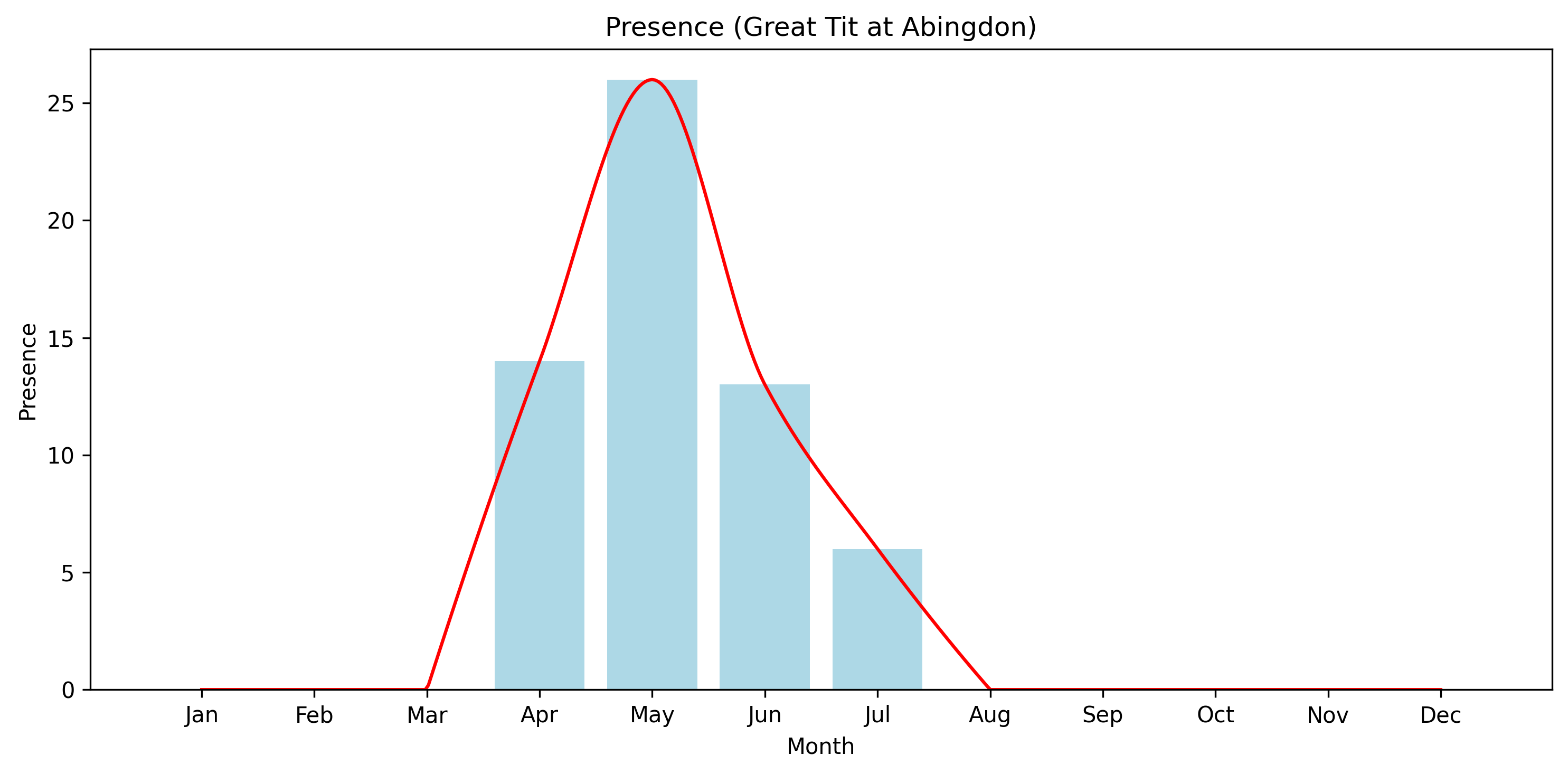
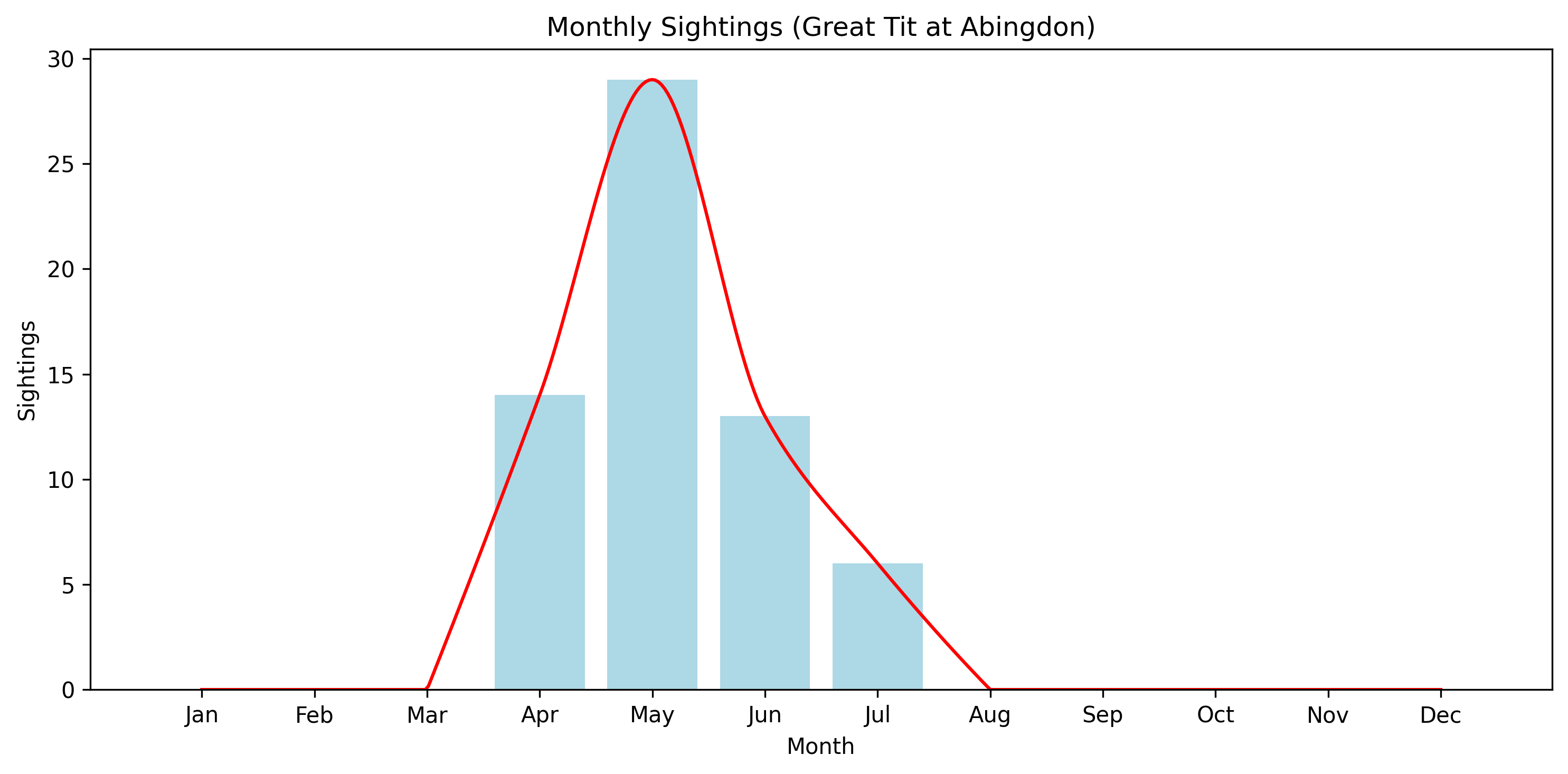
Records of Great Tit with dependent young form a clear and concentrated seasonal signal.
Breeding activity becomes visible in April, peaks strongly in May, and declines rapidly through June and July. The signal is relatively compact, with little persistence beyond early summer.
This pattern is consistent with a moderate breeding window: a recognisable seasonal period in which fledged young are encountered, without the prolonged post-peak persistence seen in species with extended parental association.
Interpretation
Taken together, these patterns describe a species that is always present, but seasonally transformed.
In winter, Great Tits are part of the background community — present, but relatively inconspicuous. As the year turns, they become one of the defining voices of early spring, their increasing activity reflected in the rising presence curve.
Shortly afterwards, the breeding signal appears. For a brief period, the familiar adult birds are joined by newly fledged young, and the cycle of renewal becomes visible. This phase is relatively short-lived: by mid-summer, the breeding signal has largely disappeared, even though the species itself remains.
By late summer, activity declines to its lowest point. Birds are quieter, less territorial, and less frequently encountered. Through autumn and into winter, presence increases again, but without the intensity of spring.
The result is a pattern that is both constant and seasonal: a species that forms part of the fabric of the place throughout the year, but which defines a particular moment within it.
Summary
| Aspect | Classification |
|---|---|
| Seasonal pattern | Detectability-driven resident |
| Breeding pattern | Moderate breeding window |
</div>
Notes
These patterns are derived from long-term personal field records and should be read as descriptions of observed behaviour rather than complete biological accounts.
Seasonal presence reflects when the species is encountered. Breeding activity reflects when dependent young are visible. Both are shaped by behaviour, detectability, and observer experience as much as by underlying biology.