Garlic Mustard (Jack-by-the-Hedge)
Flowering period type: Single flowering period (spring–early summer, moderate duration)
Garlic Mustard is a common plant of hedgerows, woodland edges, and shaded verges in Abingdon. Its small white flowers and distinctive scent make it a characteristic, if often understated, feature of the spring landscape.
This page summarises how the species appears in the records: the structure of its flowering period across the year.
Flowering Period
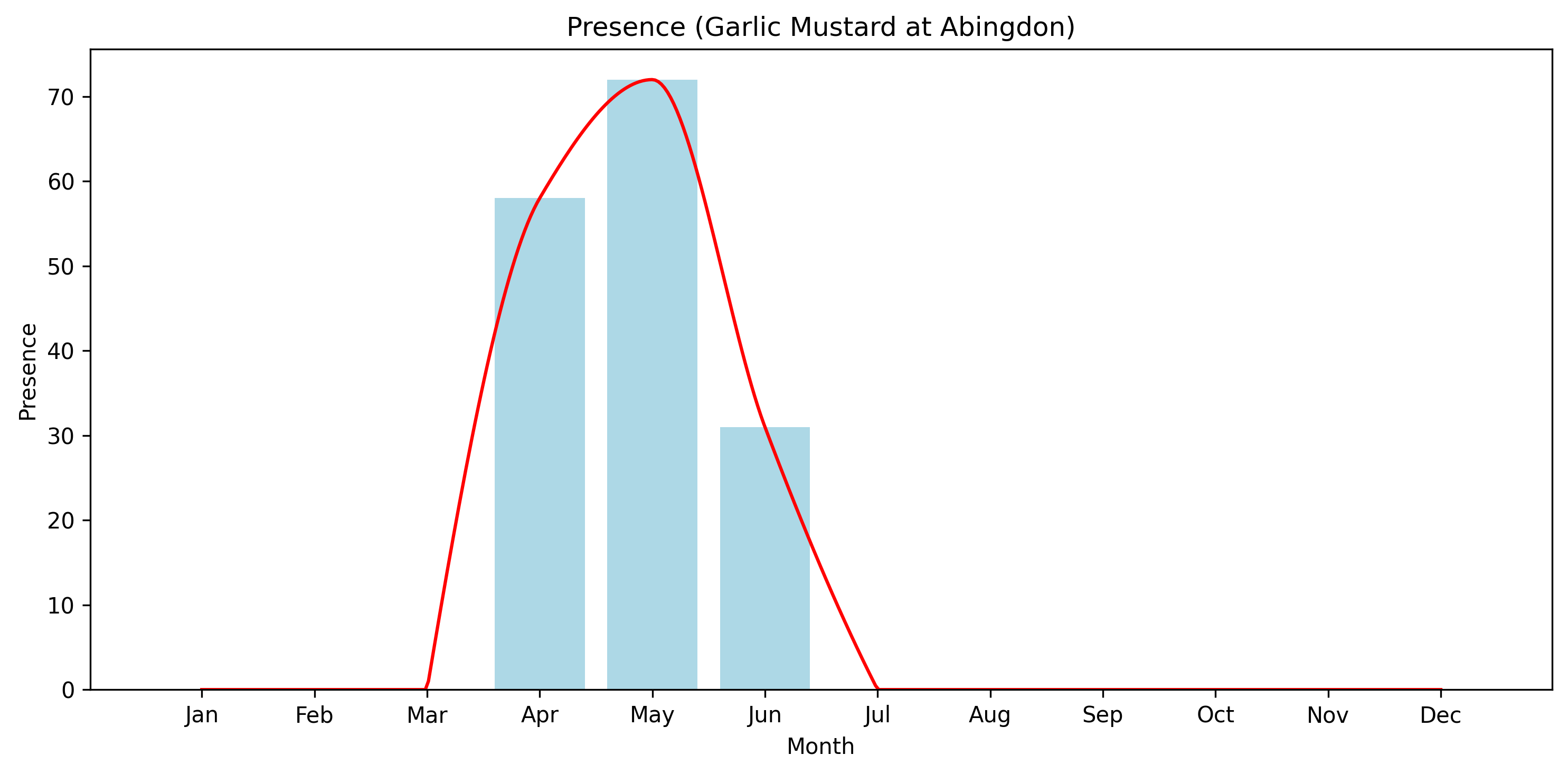
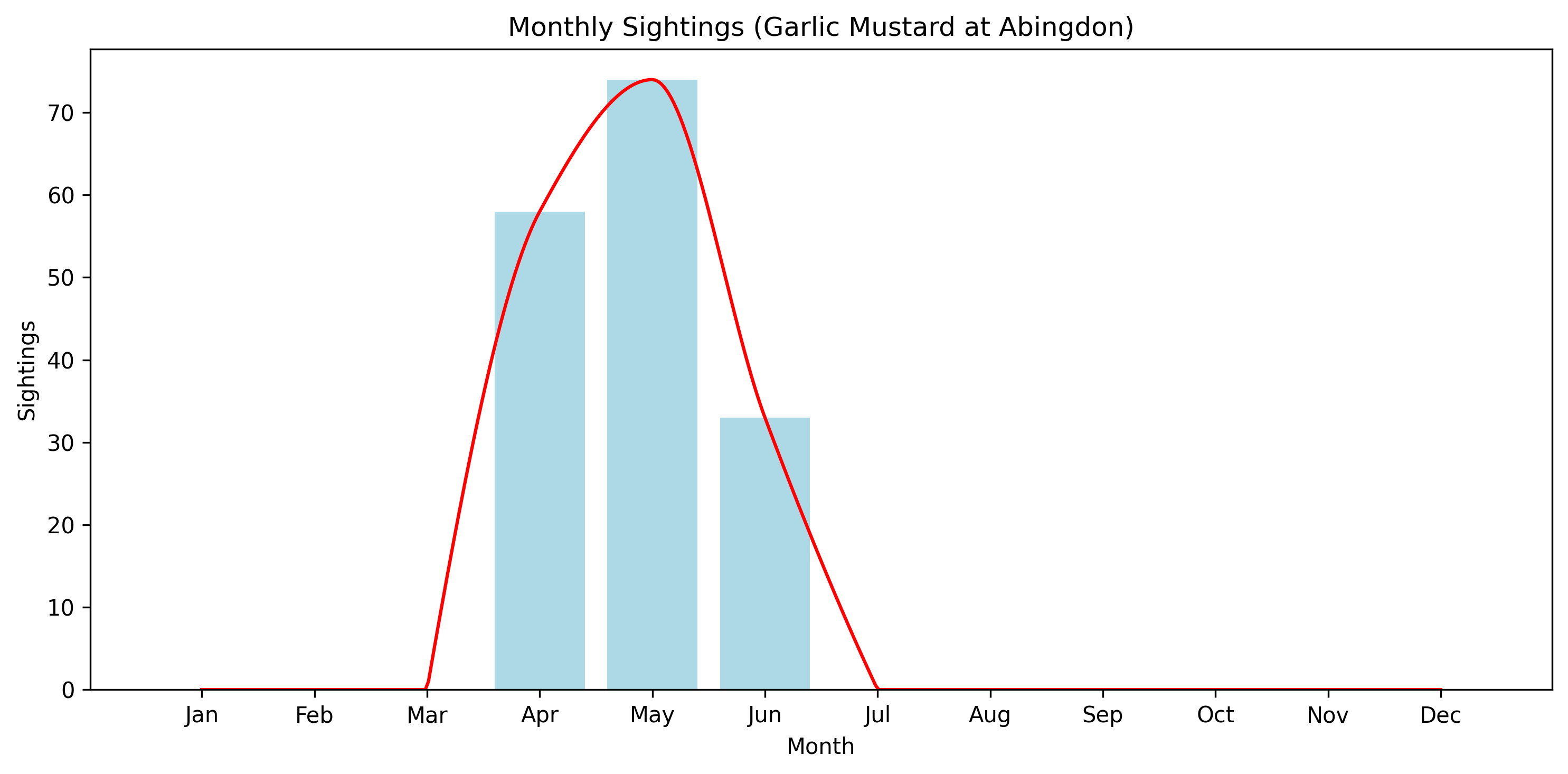
Garlic Mustard shows a well-defined flowering period centred on spring and extending into early summer.
Records rise through spring to a peak in late spring, with activity continuing into early summer before declining rapidly. Flowering is absent outside this seasonal window.
The overall pattern is that of a single flowering period with a moderate duration, longer than the earliest spring species but shorter than extended summer bloomers.
Interpretation
The flowering pattern of Garlic Mustard reflects a seasonal but not overly compressed flowering strategy.
Compared to tightly constrained species such as Bluebell, Garlic Mustard:
- Emerges slightly later in spring
- Builds to a clear peak over a broader window
- Persists briefly into early summer
This results in:
- A defined central peak (often May)
- A noticeable but limited extension beyond the peak
- A clear end to flowering by early summer
Unlike extended flowering species, it does not maintain activity across the full summer, and unlike very early species, it does not peak in the earliest part of spring.
Instead, it occupies a middle position in the seasonal sequence, contributing to the continuity of flowering between early spring specialists and longer-lasting summer species.
Overall, the pattern reflects a single, moderately extended flowering period characteristic of mid- to late-spring species.
Summary
| Aspect | Classification |
|---|---|
| Flowering period | Single flowering period (spring–early summer, moderate duration) |
Notes
These patterns are derived from long-term personal field records and should be read as descriptions of observed flowering rather than complete biological accounts.
For species such as Garlic Mustard, flowering occurs over a defined seasonal window that bridges early and late spring. The absence of records outside this period reflects the end of flowering rather than absence of the plant.