
Dunnock
Role in the year: Quiet winter companion and early spring singer
The Dunnock is a common but often overlooked resident in Abingdon, present throughout the year but most visible and distinctive in the colder months and early spring.
This page summarises how the species appears in the records: how it occupies the year.
Seasonal Pattern
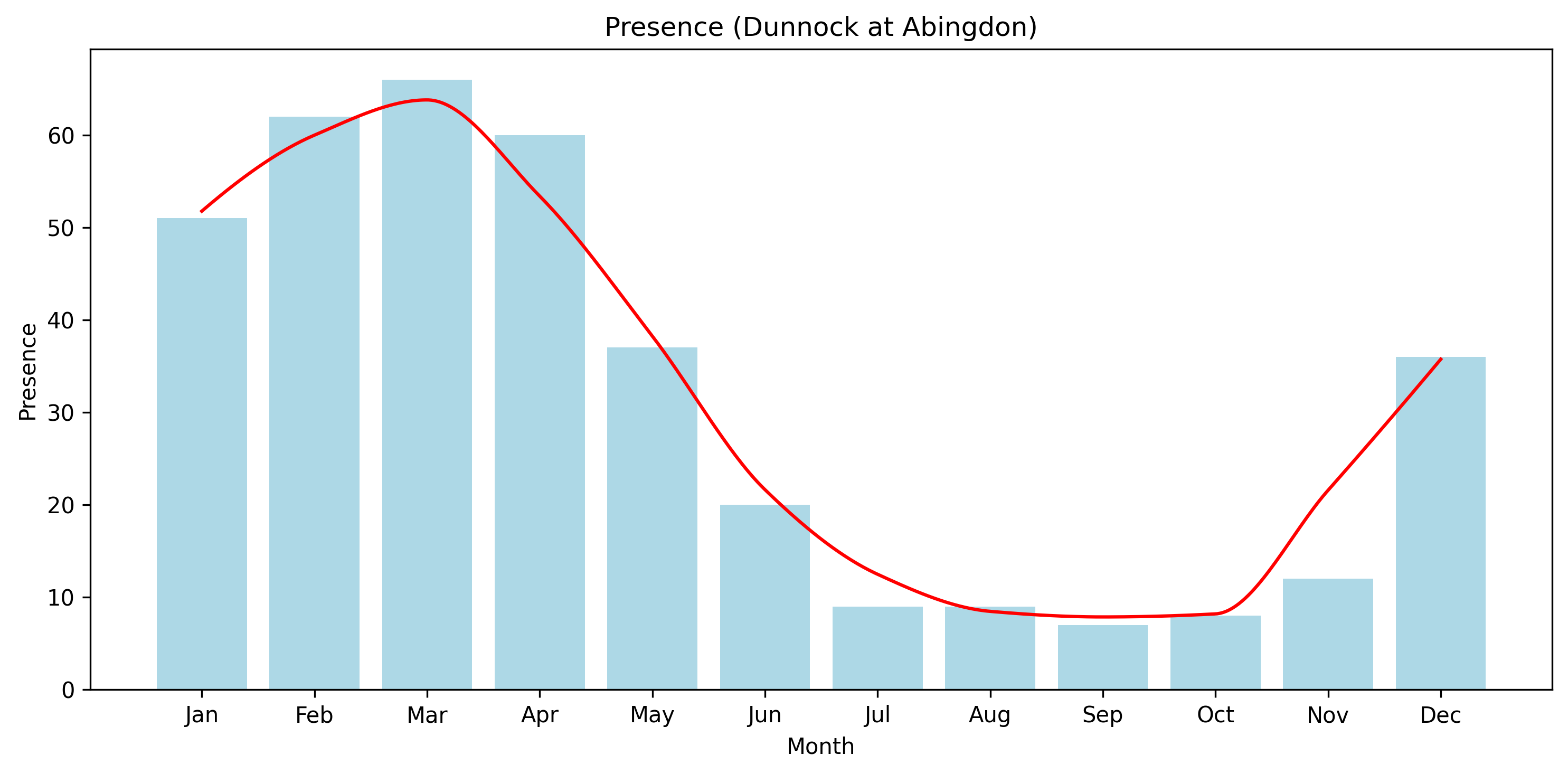
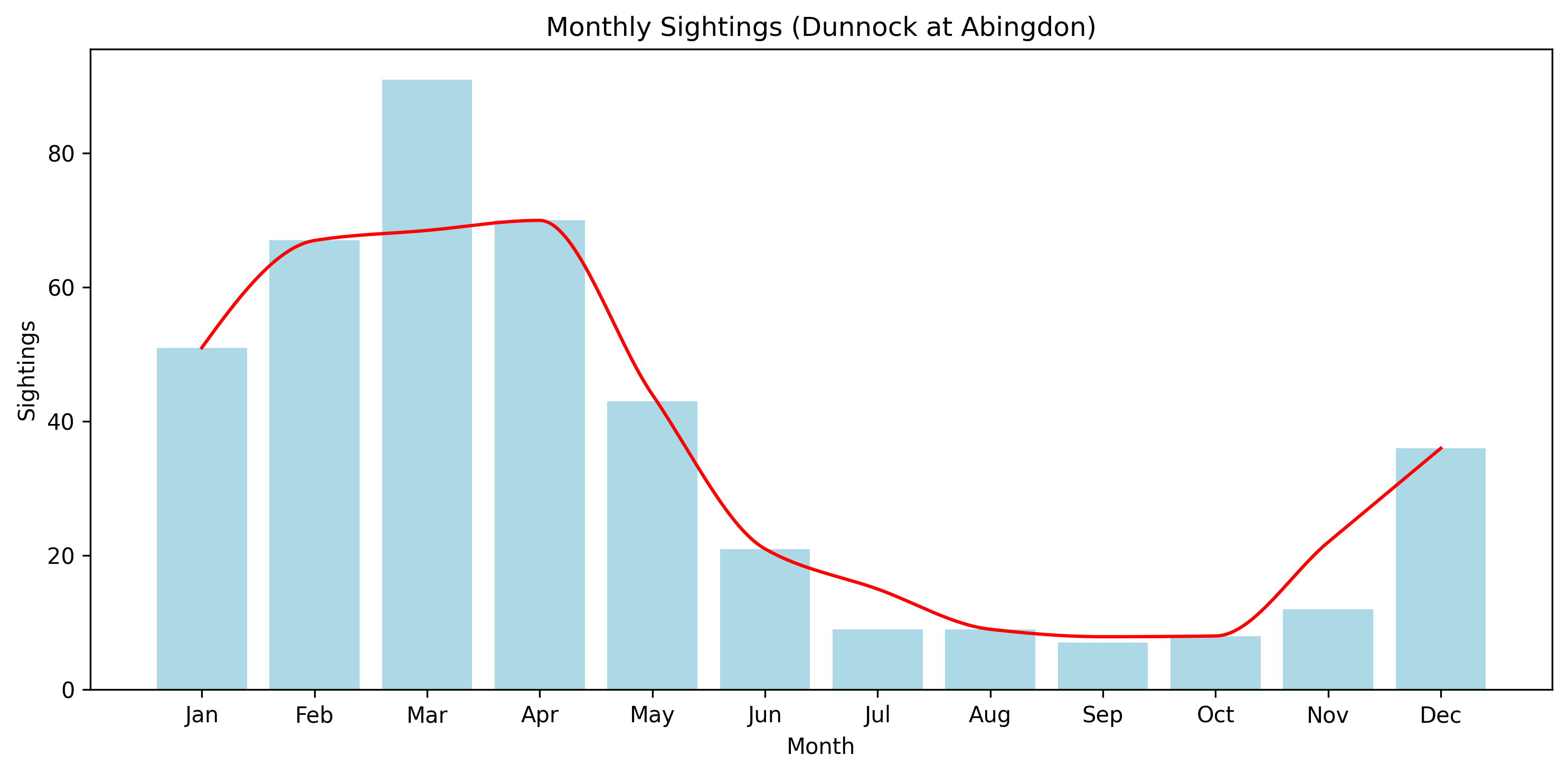
The Dunnock shows a clear seasonal pattern despite being present throughout the year.
Records are highest in late winter and early spring, with a broad peak from February through April. From this point, both presence and total sightings decline steadily into summer, reaching a minimum in July and August.
Through autumn, the signal begins to recover, with a noticeable increase into November and December.
The overall pattern is that of a resident species with strong winter–spring detectability, driven by behaviour and visibility rather than true absence.
Interpretation
The Dunnock’s seasonal pattern reflects its behaviour as a quiet, ground-dwelling bird whose visibility varies strongly through the year.
In winter and early spring, Dunnocks are far more conspicuous. Birds forage more openly and, in early spring, males begin to sing regularly. This combination of increased activity and vocalisation produces a strong peak in records.
As the breeding season progresses, the species becomes much less visible. Dunnocks spend more time low in dense vegetation, and vocal activity declines. Although birds remain present, they are far less frequently recorded.
This produces a pronounced summer trough in both presence and totals, even though the underlying population has not disappeared.
In autumn, visibility increases again as birds resume more open foraging behaviour. By winter, the Dunnock returns to being a familiar and regularly encountered species.
The pattern therefore reflects a resident species whose detectability is highest in winter and early spring, and lowest in high summer.
Summary
| Aspect | Classification |
|---|---|
| Seasonal pattern | Resident (winter–spring detectability peak) |
Notes
These patterns are derived from long-term personal field records and should be read as descriptions of observed behaviour rather than complete biological accounts.
Seasonal presence reflects when the species is encountered. For resident species such as Dunnock, variation in records is largely driven by behaviour and visibility rather than changes in population size.