Cuckoo-pint
Flowering period type: Single flowering period (spring, short and distinct)
Cuckoo-pint is a distinctive and somewhat unusual plant of woodland edges and hedgerows in Abingdon. Its hooded spathe and upright spadix make it unmistakable, though it is often encountered briefly within a narrow seasonal window.
This page summarises how the species appears in the records: the structure of its flowering period across the year.
Flowering Period
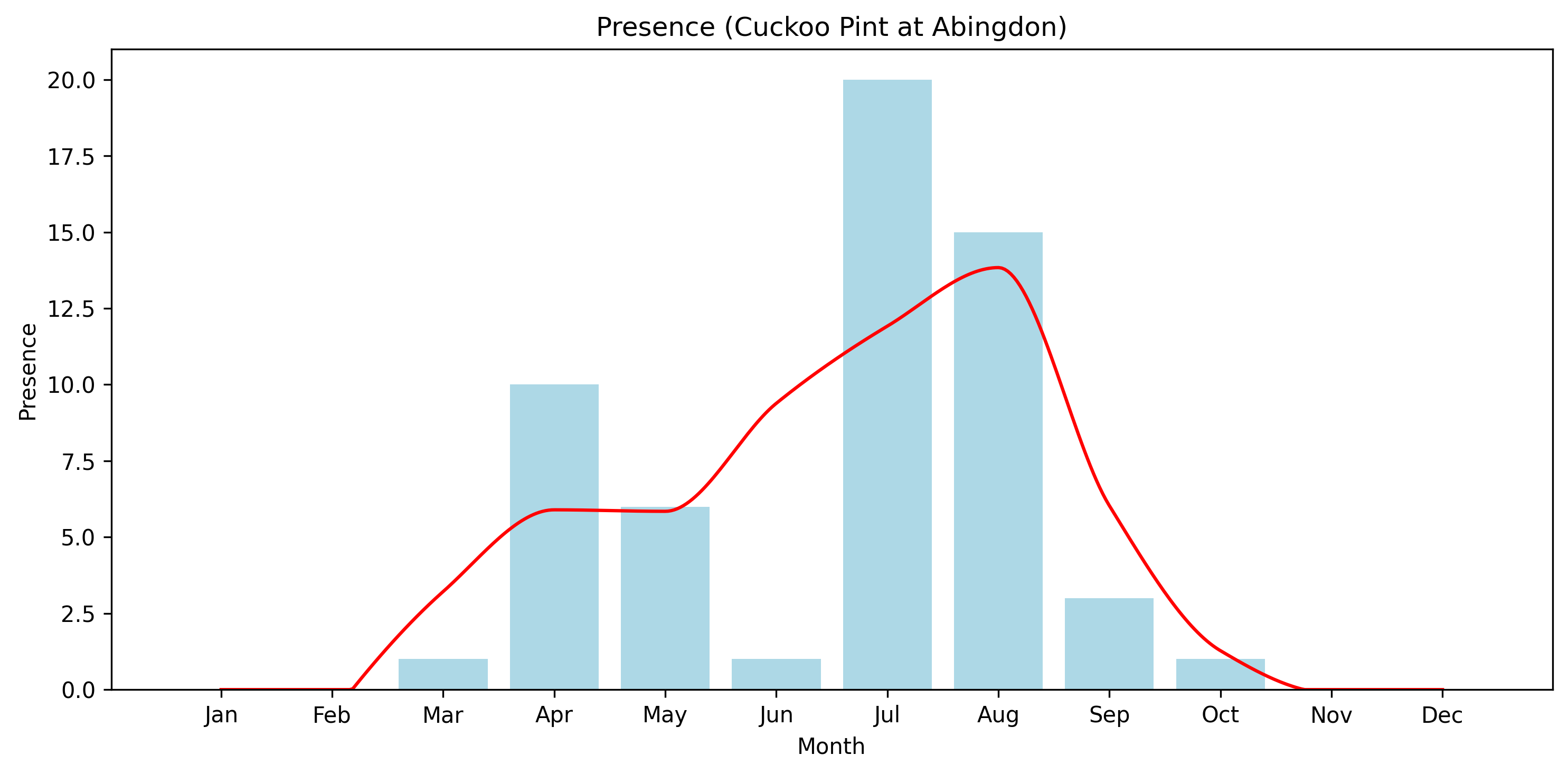
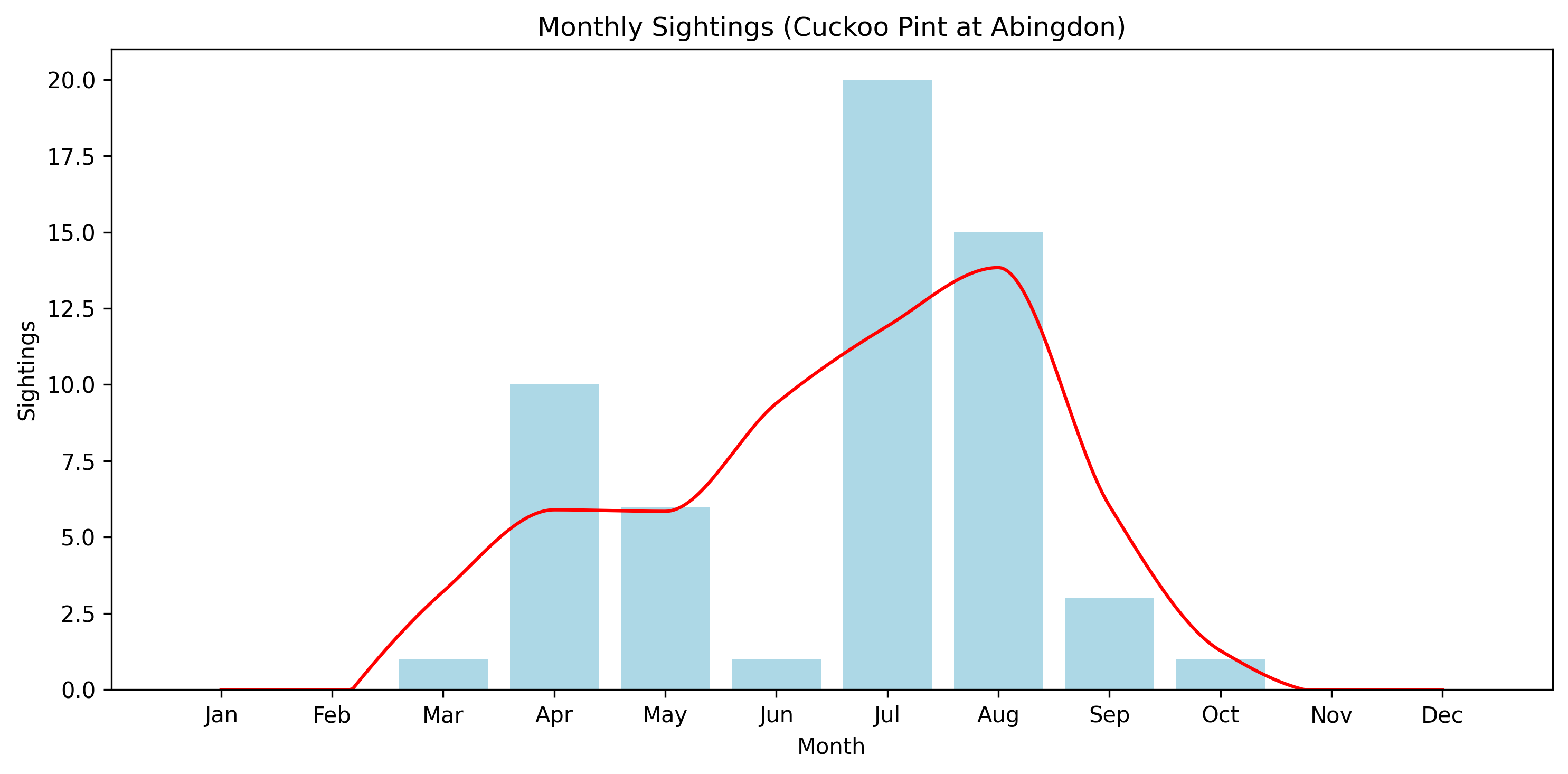
Cuckoo-pint shows a short and clearly defined flowering period in spring.
Records are confined to a narrow window, rising quickly to a peak before declining just as rapidly. Outside this period, there are no records of flowering.
The overall pattern is that of a brief, tightly bounded flowering event.
Interpretation
The flowering pattern of Cuckoo-pint reflects a highly constrained and short-lived phase within its annual cycle.
Flowering occurs over a limited period:
- Emergence is rapid once conditions are suitable
- The flowering structure is present for only a short time
- The plant transitions quickly to later stages (e.g. leaf and fruit development)
This results in:
- A narrow seasonal window
- A clear and often abrupt peak
- A rapid disappearance from the flowering record
Unlike more conspicuous or long-flowering species, Cuckoo-pint is:
- Easily missed outside its peak
- Structurally distinctive but temporally brief
- More of a moment in the season than a sustained presence
Overall, the pattern reflects a short, well-defined flowering period that contributes a brief but characteristic signal to the spring landscape.
Summary
| Aspect | Classification |
|---|---|
| Flowering period | Summer peak |
Notes
These patterns are derived from long-term personal field records and should be read as descriptions of observed flowering rather than complete biological accounts.
For species such as Cuckoo-pint, the flowering phase represents only one part of a broader seasonal cycle. The plant remains present in other forms (e.g. leaves, later fruiting structures), but these are not captured in the flowering record.