
Common Starling
Role in the year: Winter flocks and early summer dispersal
The Common Starling is a familiar but highly variable presence in Abingdon, shaped as much by social behaviour as by season. At some times of year it is abundant and conspicuous, while at others it is largely absent from the local record.
This page summarises how the species appears in the data: how it occupies the year, and how its breeding activity becomes visible.
Seasonal Pattern
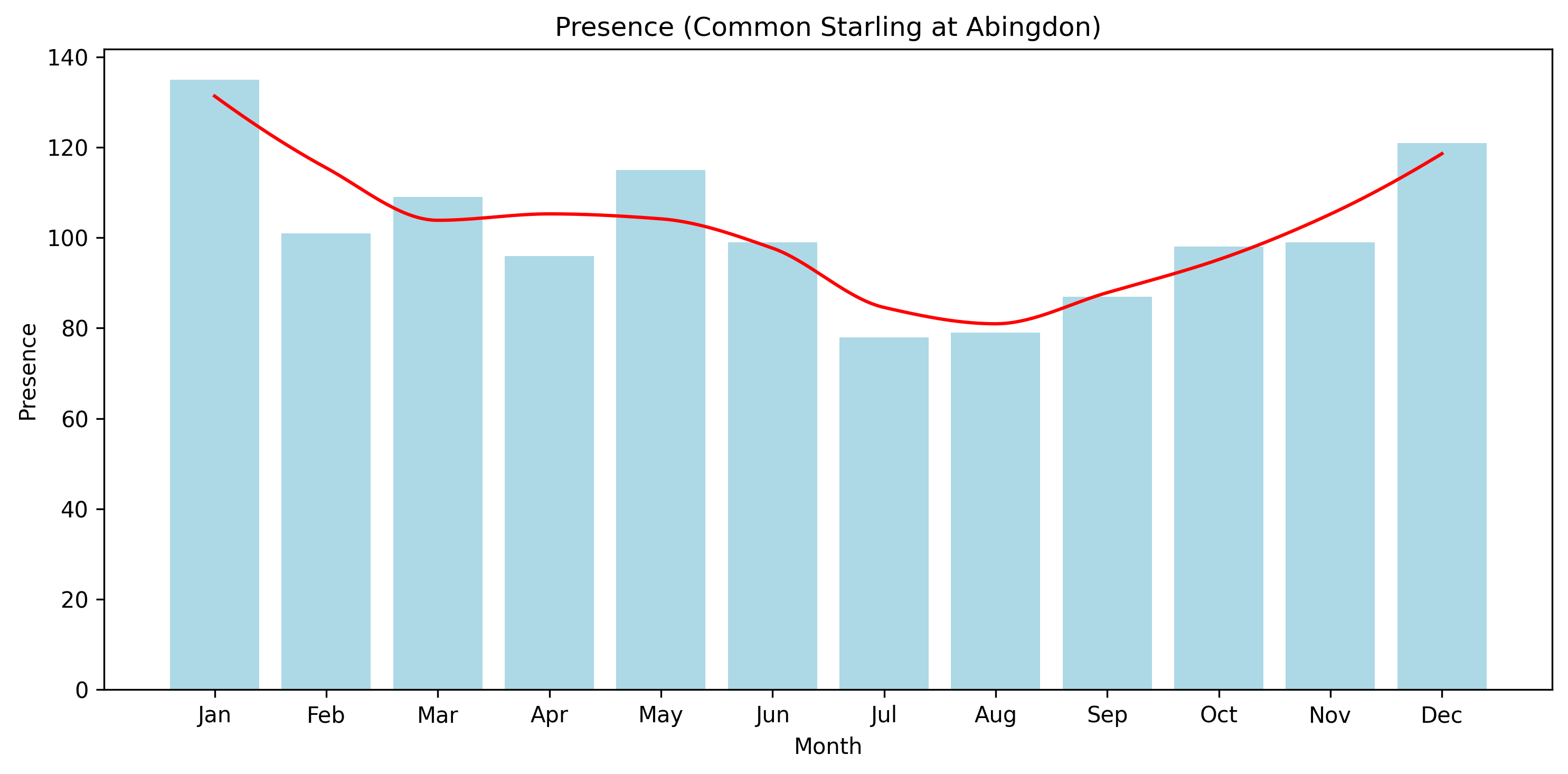
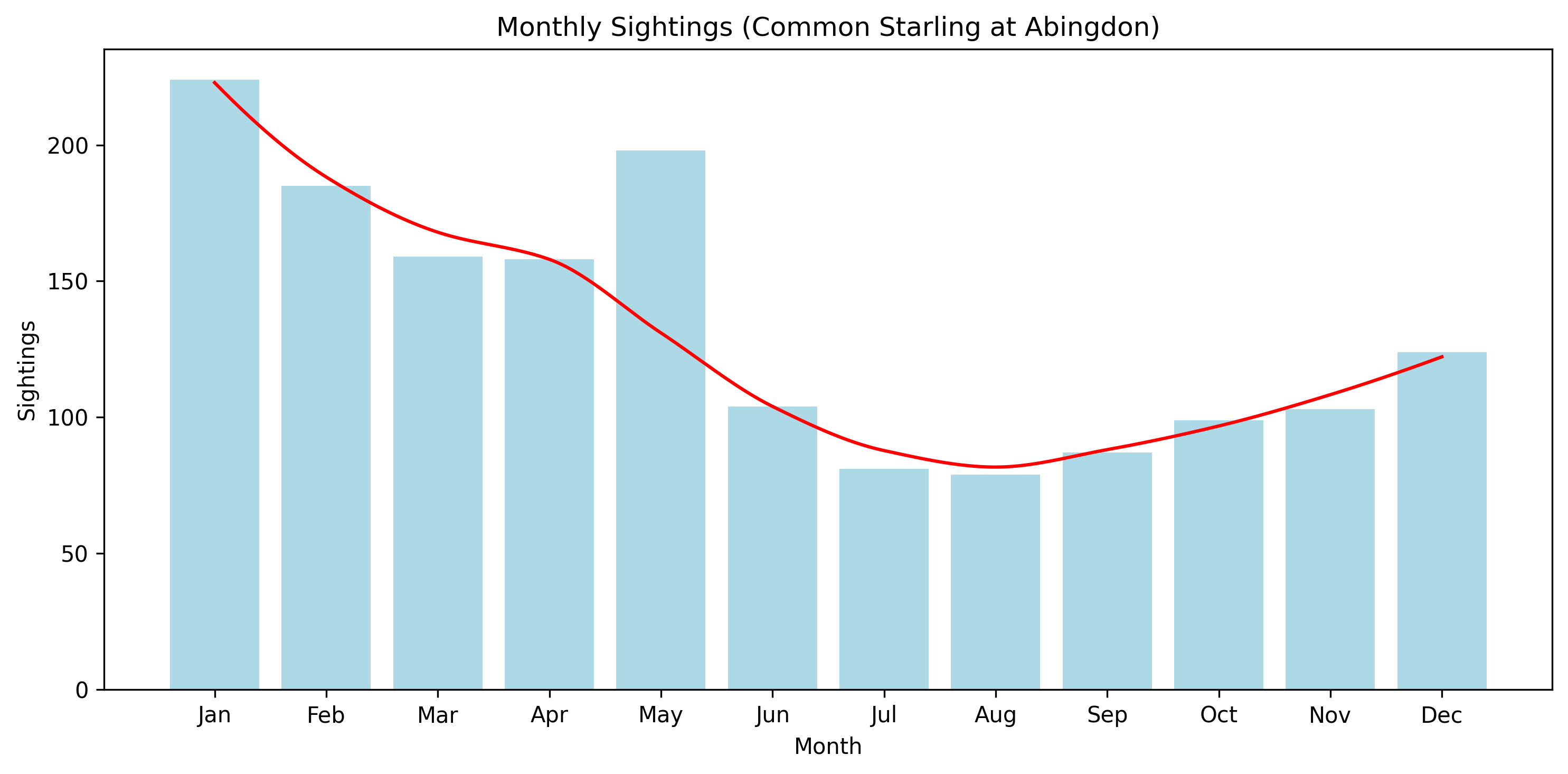
The Common Starling shows a strongly seasonal pattern, but one driven less by simple presence and absence than by changes in grouping behaviour.
Records are high through the winter months, reflecting the formation of flocks and the increased visibility of birds gathering and moving together. Through late winter and early spring, this signal begins to fragment as birds disperse into smaller groups and establish breeding territories.
During late spring and early summer, presence becomes more concentrated, reflecting breeding activity and the appearance of local birds and their young. By mid to late summer, the signal drops sharply, with relatively few records.
From early autumn onwards, presence begins to rise again, as birds regroup and flocking behaviour returns, building towards the higher winter values.
The overall pattern is one of an aggregation-driven resident: a species whose apparent abundance is shaped primarily by changes in social structure rather than true seasonal absence.
Observed Breeding Activity
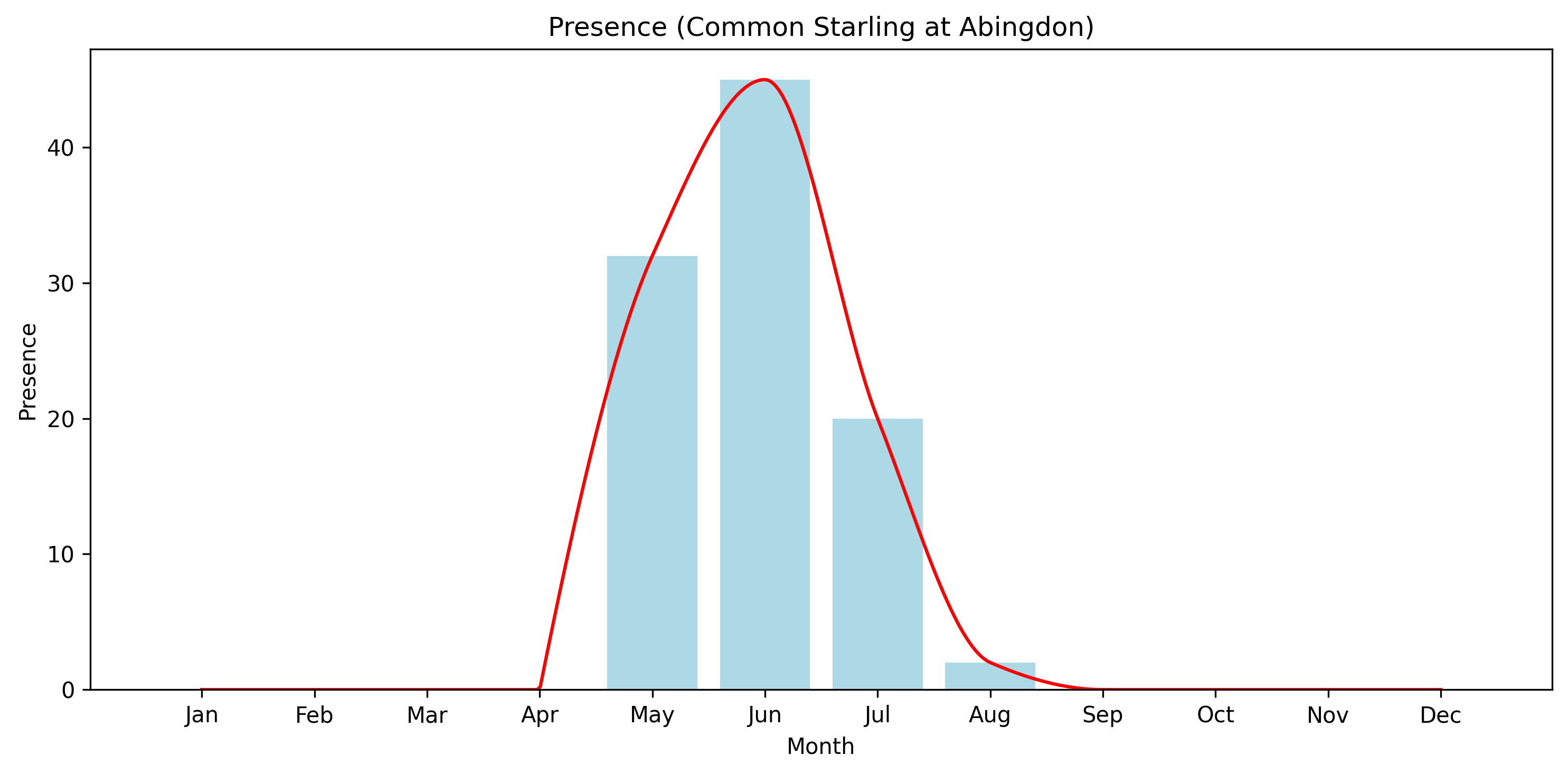
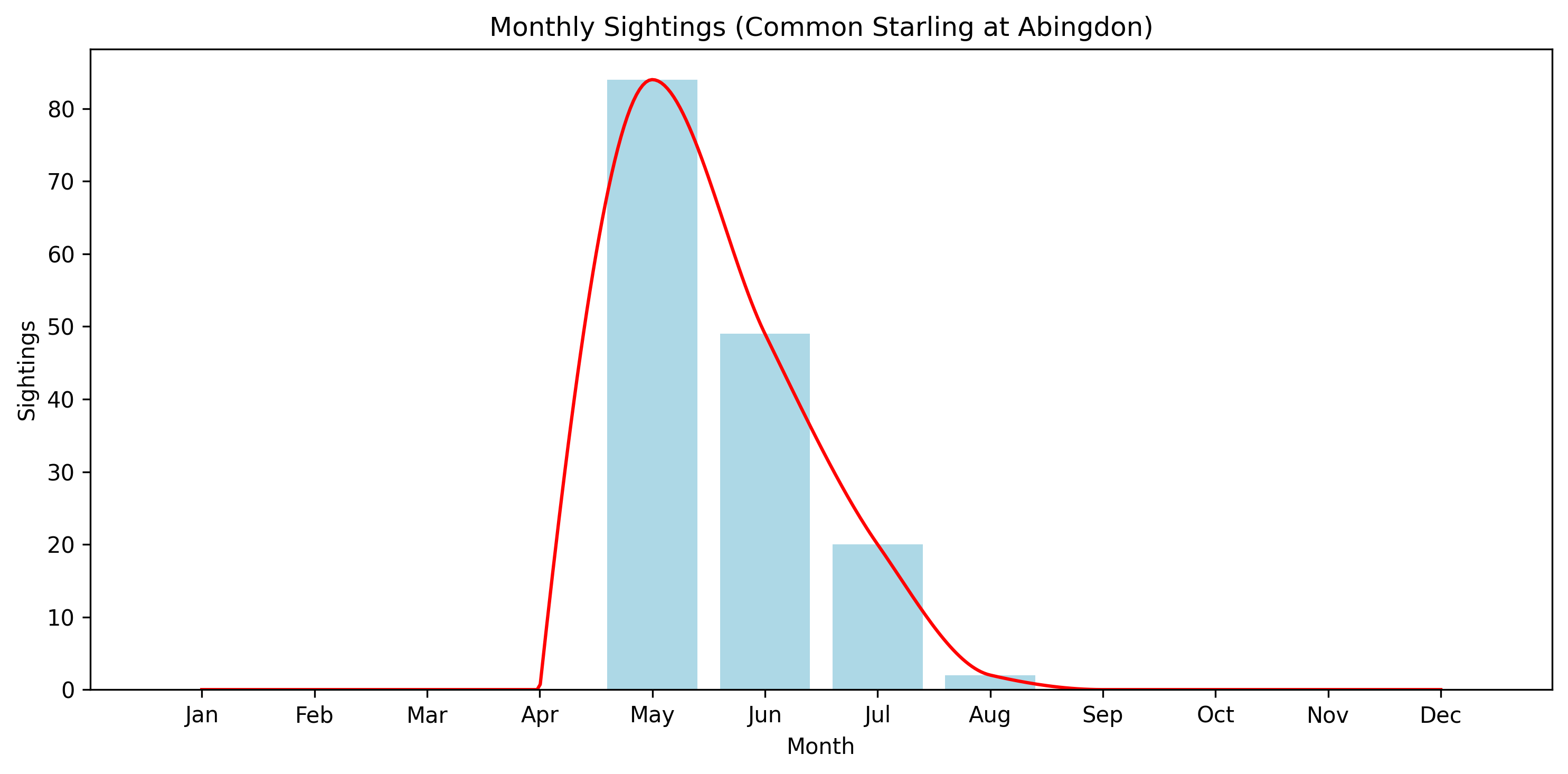
Records of Common Starling with dependent young form a clear seasonal signal.
Breeding activity becomes visible in May, peaks strongly in May and June, and declines through July, with little persistence beyond that point. The signal is broader than a very brief window, but does not extend far into late summer.
This pattern is consistent with a moderate breeding window: a recognisable seasonal period in which fledged young are encountered, without the prolonged tail seen in species where young remain associated with adults for extended periods.
Interpretation
Taken together, these patterns describe a species whose presence is defined by movement between two modes: aggregation and dispersion.
In winter, starlings are most visible as flocks. Their presence is amplified by number and behaviour — groups moving together, feeding together, and forming a conspicuous part of the landscape.
As spring approaches, this structure breaks down. Birds disperse into pairs and territories, and although still present, they become less obvious. The seasonal signal shifts from abundance to distribution.
Breeding activity then becomes visible in late spring. For a short period, local populations are reinforced by the appearance of newly fledged young, producing a clear but relatively contained peak.
By mid-summer, both breeding activity and overall presence decline sharply. Birds are more dispersed, less vocal, and less frequently encountered.
With the return of autumn, the cycle reverses. Small groups begin to form again, gradually building towards the large winter flocks that define the species at that time of year.
The result is a pattern that reflects not just season, but behaviour: a species that is always nearby, but only sometimes visible in number.
Summary
| Aspect | Classification |
|---|---|
| Seasonal pattern | Aggregation-driven resident |
| Breeding pattern | Moderate breeding window |
</div>
Notes
These patterns are derived from long-term personal field records and should be read as descriptions of observed behaviour rather than complete biological accounts.
Seasonal presence reflects when the species is encountered. Breeding activity reflects when dependent young are visible. Both are shaped by behaviour, detectability, and observer experience as much as by underlying biology.