Common Cleavers
Flowering period type: Extended flowering period (spring–summer, diffuse)
Common Cleavers is a widespread and often overlooked plant in Abingdon, found scrambling through hedgerows, along verges, and in disturbed ground. Its small, inconspicuous flowers contrast with its abundant and persistent presence.
This page summarises how the species appears in the records: the structure of its flowering period across the year.
Flowering Period
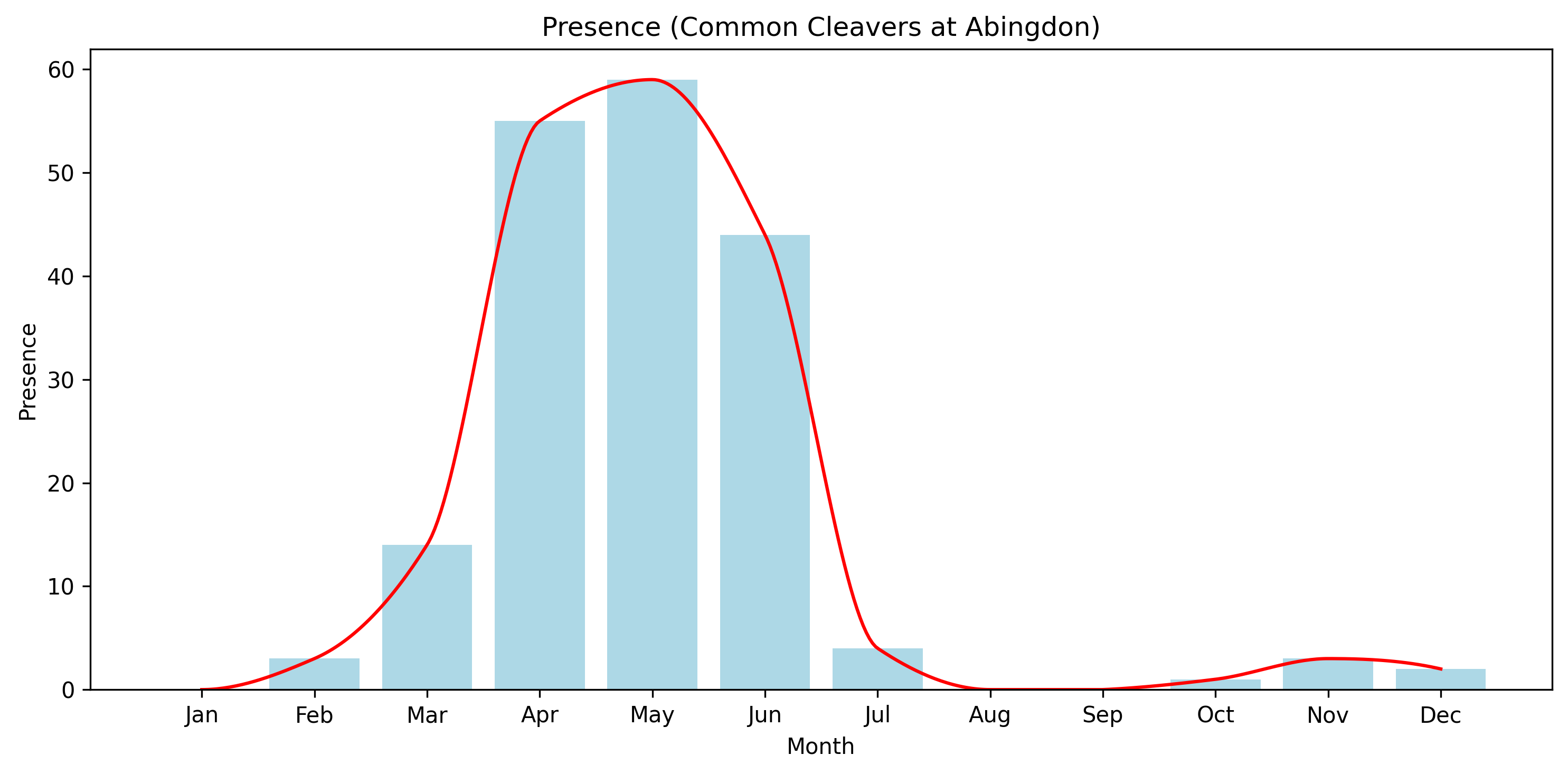
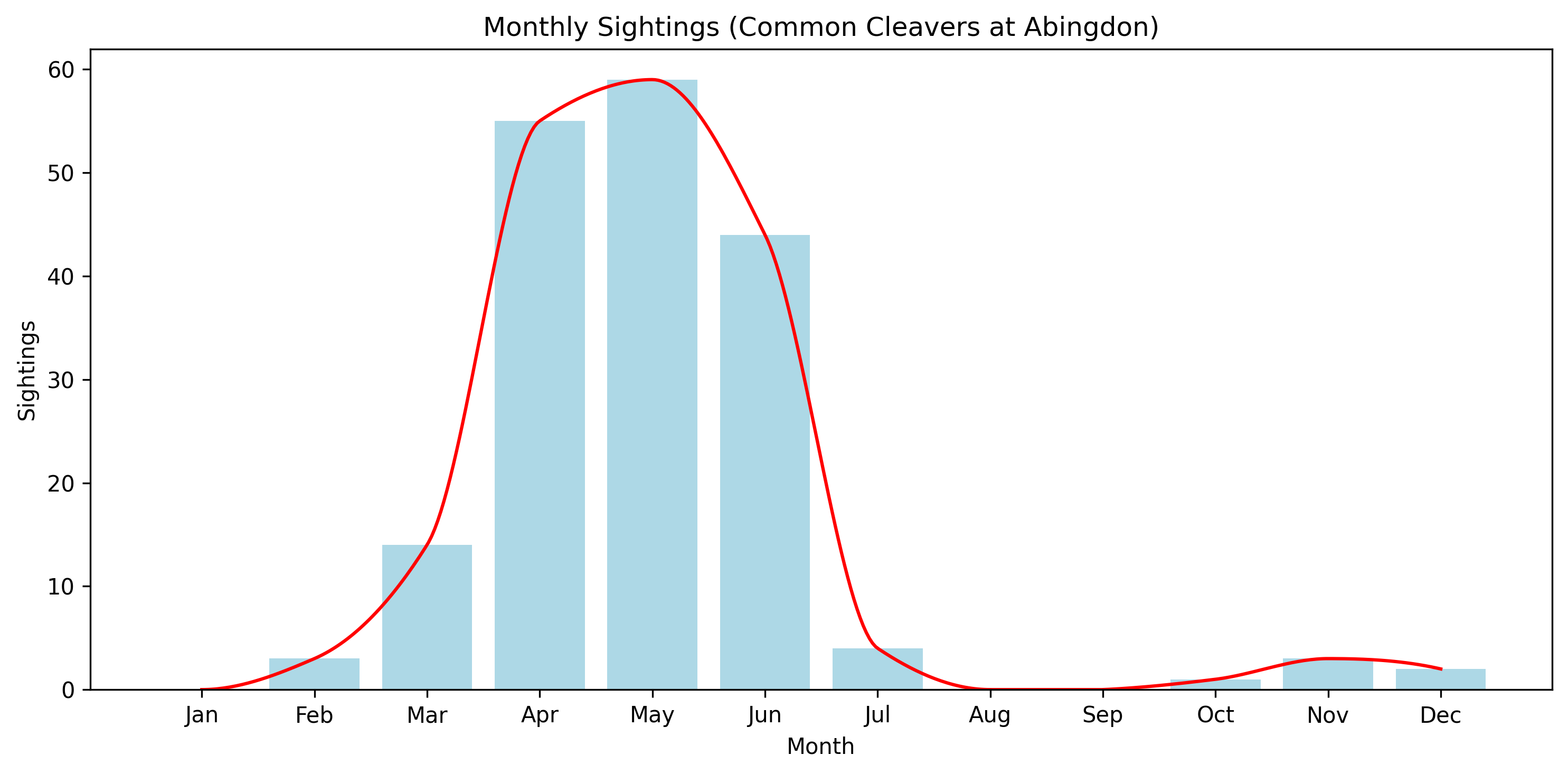
Common Cleavers shows a broad and extended flowering period across spring and summer.
Records begin in spring and continue steadily through the summer months, with no sharply defined peak. Activity is spread across the season, with gradual rises and falls rather than abrupt changes.
The overall pattern is that of a long, diffuse flowering period without a strong central peak.
Interpretation
The flowering pattern of Common Cleavers reflects a low-intensity but persistent seasonal presence.
Unlike species that produce a strong, concentrated display, Cleavers:
- Flowers over an extended period
- Produces relatively inconspicuous blooms
- Is often recorded opportunistically rather than as a focal observation
This results in:
- A relatively even distribution of records across the season
- A lack of a pronounced peak
- A “background” signal rather than a dominant seasonal event
The extended flowering window may also reflect:
- Variation in habitat conditions
- Continuous growth and flowering across the season
- The species’ ability to exploit disturbed or nutrient-rich environments
Overall, the pattern reflects a species that flowers steadily over time, contributing continuity rather than a distinct seasonal highlight.
Summary
| Aspect | Classification |
|---|---|
| Flowering period | Extended flowering period (spring–summer, diffuse) |
Notes
These patterns are derived from long-term personal field records and should be read as descriptions of observed flowering rather than complete biological accounts.
For species such as Common Cleavers, the flowering signal may be influenced by detectability and recording behaviour, as the flowers are small and often overlooked. As such, the observed pattern represents a combination of biological timing and observational emphasis.