
Bluebell
Flowering period type: Single flowering period (spring)
The Bluebell is one of the defining plants of spring in Abingdon, forming dense carpets in woodland and shaded habitats. Its brief but striking flowering period is a hallmark of the season.
This page summarises how the species appears in the records: the structure of its flowering period across the year.
Flowering Period
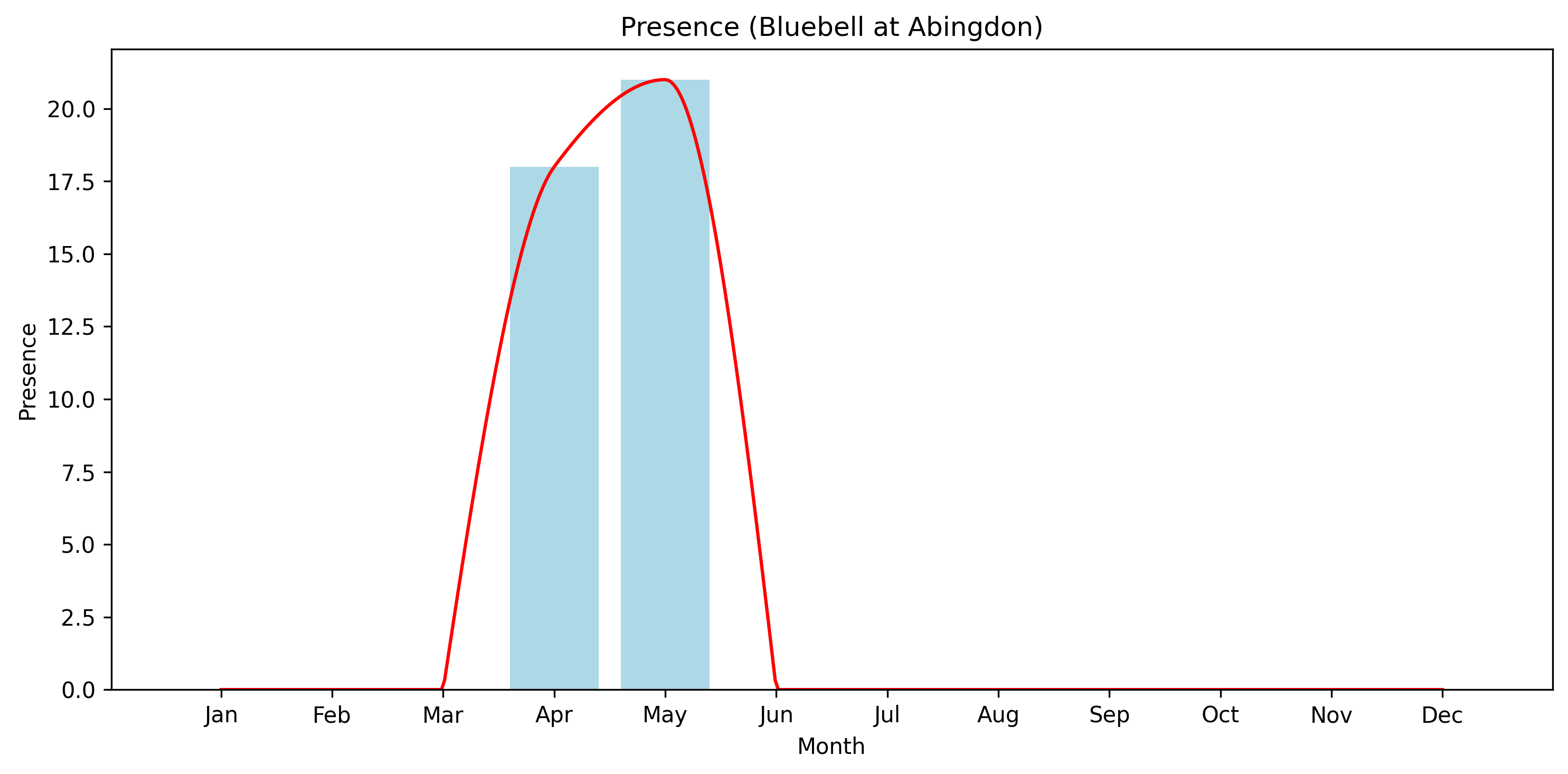
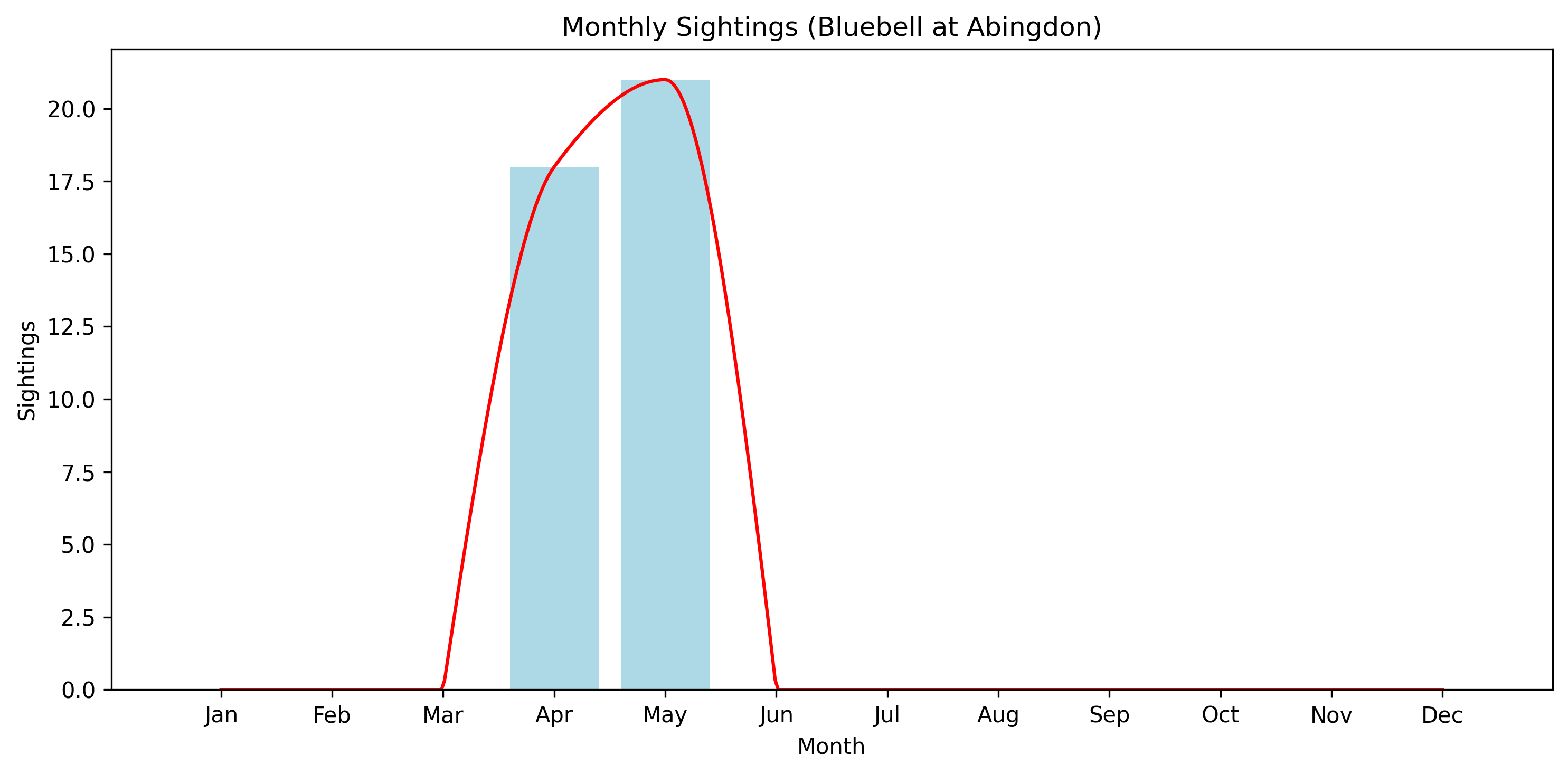
Bluebell shows a highly concentrated spring flowering period.
Records are confined to a short window in mid-spring, with activity rising rapidly to a peak before declining just as quickly. Outside this period, there are no records of flowering.
The overall pattern is that of a single, tightly defined flowering window.
Interpretation
The Bluebell’s flowering pattern reflects a synchronised seasonal event, closely tied to environmental conditions in early to mid-spring.
Flowering occurs within a narrow time frame:
- Emergence and flowering happen rapidly once conditions are suitable
- Peak flowering is short-lived
- The display fades quickly as the season progresses
This results in a strong, concentrated signal in the data, with little variation outside the main flowering window.
Unlike species with extended or repeated flowering, Bluebell exhibits:
- A single, clearly defined flowering period
- No secondary peaks
- No late-season activity
Overall, the pattern reflects a spring ephemeral strategy, where flowering is concentrated into a brief but highly visible period.
Summary
| Aspect | Classification |
|---|---|
| Flowering period | Single flowering period (spring) |
Notes
These patterns are derived from long-term personal field records and should be read as descriptions of observed flowering rather than complete biological accounts.
For plant species such as Bluebell, the flowering period represents a short-lived phase within a longer annual cycle. The absence of records outside this window reflects the absence of flowers rather than absence of the plant itself.