
Blackbird
Role in the year: Year-round presence with strong spring visibility
The Blackbird is one of the most familiar and consistently encountered birds in Abingdon, present throughout the year and forming a constant part of the local landscape. Its seasonal pattern is not defined by absence, but by changes in visibility and activity.
This page summarises how the species appears in the records: how it occupies the year.
Seasonal Pattern
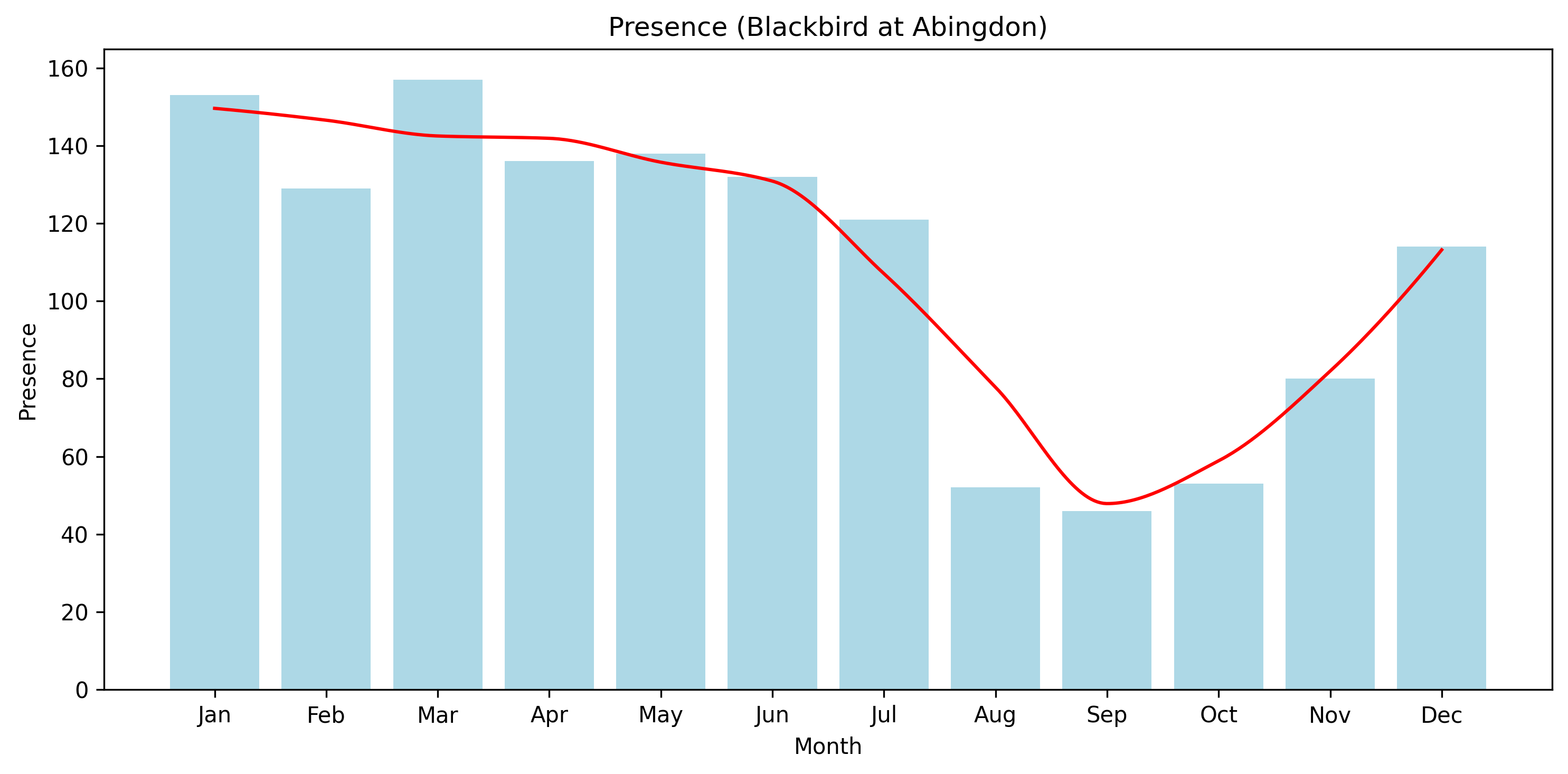
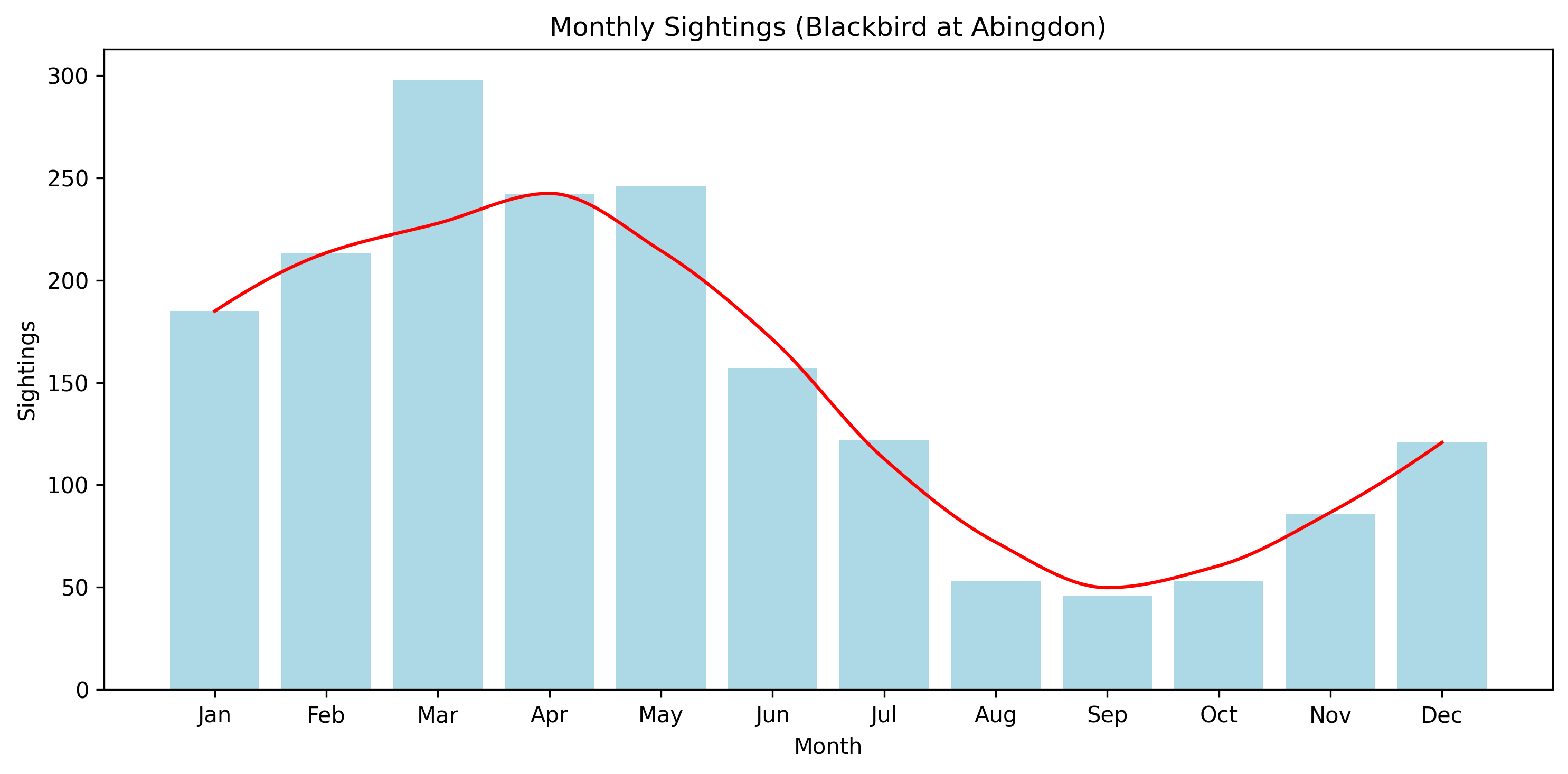
The Blackbird is recorded throughout the year, but with a clear seasonal structure.
Presence is high across winter and early spring, with a broad peak from late winter into spring. This reflects increased activity and detectability, particularly as birds become more vocal and territorial.
From late spring into summer, the signal declines steadily, reaching its lowest point in late summer. As with other resident species, this does not indicate absence, but a reduction in visibility as birds become quieter, more dispersed, and less frequently encountered.
Through autumn and into winter, presence rises again, returning to the higher levels seen at the start of the year.
The overall pattern is a clear example of a detectability-driven resident: a species that is present year-round, but whose visibility varies strongly with seasonal behaviour.
Interpretation
The Blackbird provides one of the clearest illustrations of how behaviour shapes the seasonal signal.
In winter, birds are widely distributed and frequently encountered, often feeding in open areas and gardens. Visibility is relatively high, even outside the breeding season.
As spring approaches, activity increases further. Territorial behaviour and especially song make Blackbirds highly conspicuous, producing a broad and sustained seasonal peak.
With the onset of breeding, this pattern changes. Although birds remain present, they become more secretive and less frequently observed. The presence curve declines steadily through summer, reflecting reduced detectability rather than reduced population.
By late summer, visibility reaches its lowest point. Birds are quiet, dispersed, and often overlooked.
As autumn progresses, this trend reverses. Activity increases, birds become more visible again, and the familiar winter pattern returns.
The result is a smooth, continuous cycle: a species that never disappears, but moves between periods of prominence and relative quiet.
Summary
| Aspect | Classification |
|---|---|
| Seasonal pattern | Detectability-driven resident |
Notes
These patterns are derived from long-term personal field records and should be read as descriptions of observed behaviour rather than complete biological accounts.
Seasonal presence reflects when the species is encountered. It is shaped by behaviour, detectability, and observer experience as much as by underlying biology.