
Field Notes Entry
Batty About Bats
An introduction to bats and bat detectors, originally written in 1999 and revisited here alongside a renewed interest in recording and analysing their calls.
This post was originally written in 1999 as a simple introduction to bats and bat detectors for the wildlife interest group I was a member of at the time but in the light of my previous post on analysing recordings of bats made through a detector, it seemed appropriate to ressurect it again here.
The content is still relevant and correct in its technical details today and it’s reproduced here in its original form, including the simplified diagrams, save with modified lists of suppliers and bat-related web-links to remove those that are no longer available.
Written at the time as an introduction for others, this article reflects the recording work I was engaged in and links to the previous post on analysing those recordings.
Bats are the only mammals capable of powered flight and there are nearly 1,000 species world-wide, divided into the Megachiroptera and Microchiroptera.
There are 16 species of bats in the UK, all belonging to the Microchiroptera and using echolocation to forage for their insect prey. Unfortunately, in the UK changing land use and human pressures has caused a loss of habitat, both feeding and roosting sites, and all but three of these species are in some way threatened.
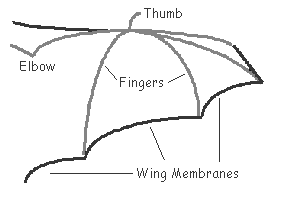
Bats fly using a modified hand and arm, as the following schematic of an outstretched wing shows. The position of the arm and fingers is shown with the outline of the wing membranes that are stretched between. The arm and elongated fingers are used to support very fine webs of skin that may be a matter of only thousandths of an inch thick. The thumb projects from the front of the wing and acts as a claw to aid clinging and climbing.
The most common British bat species is the pipistrelle, pipistrellus pipistrellus, which is also our smallest species. Pipistrelles are common garden visitors and can be seen twisting and diving a few metres above the ground as they home in on the small insects on which they feed, a single bat being capable of working its way through up to 3000 insects in just one night’s foraging!
Ultrasound
Bats use ultrasound to find their way around and hunt for insects in the dark but to understand ultrasound and echolocation it’s worthwhile looking more generally at sound waves and some of the terminology used when discussing bat calls.
Sound waves travel out from the source of a sound in all directions as a series of concentric spheres or wavefronts but for simplicity they’re most often depicted as a cross section through the wave, as shown in the following schematic:
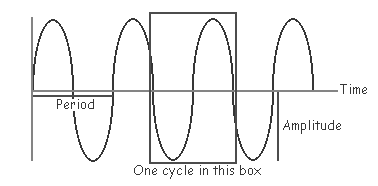
To understand what one cycle is, trace along the curve with your finger. Start from the origin on the left and go up to a peak, down past the centre line to the bottom of the curve and back up until you meet the centre line again.
At that point, your finger’s at the same level as the starting point and it’s also moving in the same direction - if you carry on, you head back up-hill towards the next peak. You’ve just traced out one cycle.
The wavelength is the distance occupied by one cycle. In other words, when you traced out the sound wave above it’s the distance along the centre line between the starting point and the point where your finger ended up at the end of the first cycle.
The amplitude is a measure of how far the tops of the peaks and bottoms of the troughs are from the centre line and the higher the amplitude the louder the sound is.
The period is the time it would take for one cycle to go past you if you were able to stand still and see the wave going by.
A related quantity, and one that we’ll use in the remainder of the discussion, is the frequency which is the number of complete cycles per second and is calculated as 1 divided by the period. Frequency is measured in Hertz, with the symbol Hz, where ‘1 cycle per second’ is equivalent to 1 Hz.
In discussions about bat echolocation, you’ll more frequently see the unit Kilohertz (kHz) where 1 kHz is 1,000 Hz or 1,000 cycles per second.
The ‘ultrasound’ that bats use for navigation is sound at such a high frequency that the human ear can’t pick it up (although dog and cat owners will know that their pets are able to hear some ultrasound). Since we can’t hear their calls unaided, if we’re going to listen in we need a bat detector to hear them.
Echolocation
Contrary to the popular myth, bats aren’t blind but they do hunt at night when their eyesight alone wouldn’t be enough to let them track down their prey.
To navigate successfully in the dark bats use a sophisticated system of echolocation - they send out a series of very loud, high-pitched (ultrasonic) sounds and listen for the echoes returning from nearby objects.
Using this system, bats build up a picture of their surroundings and are able to locate and hunt down insect prey.
Different bats have different call structures and use different frequencies and amplitudes, designed to give the maximum information to the bats based on their habitat and foraging strategy. A given bat may also modify its call structure depending on where it is and what it’s doing at the time.
Spectrograms and Bat Behaviour
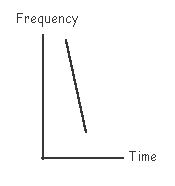
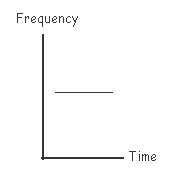
One way of depicting the echolocation calls of a bat is as a spectrogram. This plots the frequency emitted against time.
Echolocation calls are complex and the bat may begin with a high frequency and sweep down to lower frequencies (or vice versa) using what is termed frequency modulation, or FM, or it may use a constant frequency call.
Most calls are a combination of the two, maybe starting with a fast FM sweep from high to low frequency with a shallower FM or even constant frequency ‘tail’ to the call. Other bats use different combinations of the two.
FM and constant frequency spectrograms are illustrated below:
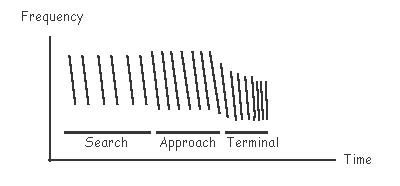
It is possible to relate a spectrogram to what a bat is doing at the time. The spectrogram shown below might be typical of a pipistrelle, using FM calls (with a near-constant frequency tail that isn’t shown). There are three distinct phases:
- During the search phase, the calls are regularly spaced and relatively widely separated and the bat is looking for but hasn’t found an insect.
- Once an insect is detected, the bat begins to home in on it and enters the approach phase where the calls are still regularly spaced but are closer together.
- As the bat closes in and, ultimately, captures the insect the start and end of each call comes down in frequency, the amplitude drops and the calls become very closely spaced as the bat increases its ‘sampling rate’ and homes in on the insect. Through the heterodyne bat detector this is heard as a ‘feeding buzz’.
Relating Bat Calls, Wing Shape and Habitat
The call structure can be related to the wing shape, the type of habitat the bat forages in and their time of emergence.
Bats that forage in open spaces have relatively long, thin wings that sacrifice manoeuvrability in favour of speed and allow them to escape predators. This, in turn, allows them to emerge earlier when other bats wouldn’t venture out because of the risk of predation. Their calls need to be able to travel large distances and the bats concentrate all the energy of their calls into a narrow band of relatively low frequencies.
Bats that forage along tree lines and the like need to be more manoeuvrable and need to gain a more detailed picture of their habitat so they can avoid collisions. Consequently, their wings are wider and shorter than those of bats that forage in the open. This gives them greater manoeuvrability at the expense of speed but this in turn means they emerge later to avoid predators. These bats will spread the energy of their call over a range of frequencies, typically having an FM sweep with a constant frequency “tail” to the call.
Bats that forage in closed environments, within the canopies of trees or low over water, need to be highly manoeuvrable and need a clear picture of their surroundings. Their wings are short and fat and their calls are steep FM sweeps over a wide range of frequencies.
| Habitat | Wing shape | Relative time of emergence | Call type |
|---|---|---|---|
| Open spaces | Long and thin | Early | CF |
| Tree-lines etc. | Shorter, fatter | Average | FM/CF |
| Within tree canopies, low over water etc. | Short, fat | Late | FM |
Bat Detectors
The calls emitted by a foraging bat are at too high a frequency for us to hear without the use of a bat detector.
The most common type is the heterodyne detector, so-called because it uses the heterodyne or mixing principle to convert the bat’s echolocation calls into something we can listen to.
The following schematic shows how a heterodyne bat detector works:
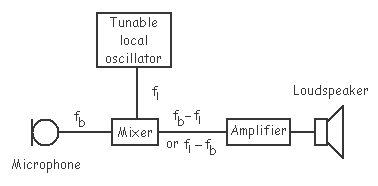
An ultrasonic microphone picks up the bat’s calls and passes it to a piece of electronics called a mixer.
The other input to the mixer comes from another piece of electronics, an oscillator, that can be tuned to produce a suitable output frequency, typically in the range 10 kHz to 120 kHz or something like that.
The mixer produces several outputs but the one we’re interested in is the difference between the bat’s call and the oscillator.
Suppose our bat is producing calls at around 50 kHz (which we can’t hear) and we use the tuning dial on the front of the detector to set the output of the oscillator to 45 kHz, the output from the mixer is 5 kHz, which we can hear. This is passed via an audio amplifier to either a loudspeaker or headphones.
A typical heterodyne bat detector, the Magenta Bat Mk II, is shown below. The microphone is in the ‘top-end’ of the box, pointing away from the camera. There are two controls on the front of the detector - a volume control to set the output level through the internal speaker and, to the right of this, a tuning dial calibrated in kHz. This sets the frequency of the local oscillator. The scruffy piece of paper attached below the dials is my own addition of a list of British bat species and their typical echolocating frequency ranges.
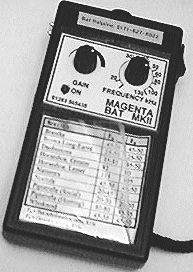
It’s available either as a kit 1, which is very easy to put together, or, if you’re not confident with a soldering iron, as a ready built unit. Either way, the unit’s very cheap and makes an ideal starting point. It’s also robust and the microphone seems pretty sensitive. The detector’s available from Magenta Electronics (details at the end of the article) 1.
Time Expansion
Heterodyning remains the most widely used method for bat detecting. Heterodyne bat detectors are cheap and effective and require no other specialised equipment to use.
However, they do suffer from one or two drawbacks:
- The bandwidth (i.e. the range of frequencies that are detected and converted simultaneously) is limited to about 8 to 10 kHz in a typical detector, making it more difficult to listen over the whole range of frequencies that a bat may be using in its call
- All the information about the original frequencies used by the bat is lost during the heterodyning process
One additional useful method that can be used to complement the information gained from a heterodyne detector is time expansion. The following schematic shows how the system works:
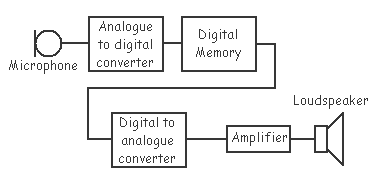
An ultrasonic microphone picks up the bat’s calls and passes it to a piece of electronics called an analogue to digital converter.
This converts the bat’s signal to digital form so it can be stored in digital memory, much like the memory found in a personal computer.
During this process, all the frequencies in use by the bat are captured and stored simultaneously, so the technique doesn’t suffer from the disadvantages discussed above.
Having stored the bat’s signal, the information is passed through a digital to analogue converter, that converts the digital information into a form that can be sent to an amplifier and on to a loudspeaker or headphones.
However, the playback rate is reduced, by something like 10 or 15 times in a typical detector, so the frequency of the output is also reduced by the same amount, making the signals audible to us.
For example, if one component of the bat’s call was at 50 kHz and the detector introduced a time expansion of x 10 then this would be heard through the loudspeaker at 5 kHz.
The disadvantage with time expansion detectors is that they are very expensive and to make best use of them requires either that the detector be plugged directly into a laptop PC in the field or that the output be recorded for subsequent playback and computer analysis at a later date.
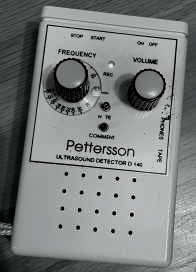
Above is a picture of a time-expansion detector, the D140 from Pettersson Elektronik. The detector stores just over 0.8 seconds of sound that is subsequently played back at a time expansion of x10, lasting just over 8 seconds. The D140 is available from Pettersson Elektronik or, in the UK, from Alana Ecology 2.
Bat Recordings
If you listen to a pipistrelle through a heterodyne detector, you can hear that the sound has what is often described as a ‘wet smack’ quality to it, often compared to someone clapping with cupped hands.
Each call consists of a fast, downward FM sweep with a small shallow FM or almost constant-frequency tail.
The steep FM portion of the call gives a ‘dry’ clicking sound in a heterodyne detector and the shallow FM/constant frequency tail gives rise to the ‘wet smack’.
The feeding buzz as the bat homes in on and takes an insect can clearly be heard.
The spectrogram shown below is a time-expanded recording of a pipstrelle bat, pipistrellus pipistrellus, taken during the summer of 1999 using the D140 detector and a simple tape recorder, connecting the detector output via the microphone output/input jacks.
It clearly shows the three phases as the bat detects, homes in on and captures an insect:
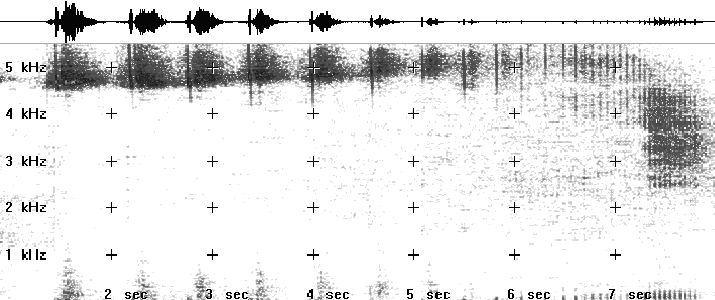
There are two sub-species, or phonotypes, of pipistrelle bat identified by the frequency at which their call bottoms-out in the shallow FM/constant frequency section. This happens at either 45 KHz or 55 KHz. The spectrogram shows that this was a 45 KHz phonotype pipistrelle.
How You Can Help
If you’re interesting in helping to conserve our bats here in the UK then please visit the Bat Conservation Trust web site at http://www.bats.org.uk/.
Their site has loads of interesting information about British Bat species and gives information on how you can help.
You could also get involved with your local bat group and, again, there are some links from the BCT web site.
Bats on The Web
- Bat Conservation International, http://www.batcon.org/
- The Bat Conservation Trust, http://www.bats.org.uk/
Further Reading
- “The Bats of Britain and Ireland: Echolocation Calls, Sound Analysis and Species Identification”, Jon Russ, ISBN 0 9536049 0 X. The discussion on the relationship between wing shape, time of emergence and call structure is based on material from this book. It’s available from Alana Ecology.
- “The Biology of Bats”, Gerhard Neuweiler, ISBN 0-19-509950-8; ISBN 0-19-509951-6
- ”Bats”, Phil Richardson, ISBN 0-905483-41-3
- ”A Field Guide to British Bats”, Frank Greenaway, A. M. Hutson, ISBN 1 872842 00 3
- “The Identification of British Bats”, D. W. Yalden, The Mammal Society, ISBN 0 906282 25 X
- “The Bat Detective”, Brian Biggs, David King, Rowena Varley
Equipment Suppliers
- Pettersson Elektronik, https://batsound.com
-
This was true when the article was originally written but I suspect the Magenta Bat Mk II is no longer available, though there are plenty of alternative detectors available today ↩ ↩2
-
This was true at the time when the article was originally written but that was around 1999 and the D-140 is no longer in production, though Pettersson still exist today and still supply bat detectors. Alana Ecology no longer seem to have a web presence, as far as I’ve been able to establish ↩