
Ernst Leitz Microscope Serial Number 149811 – Identification and Dating
Year of Manufacture
A list of Leitz microscope serial numbers and year of manufacture is available online:
Leitz Microscope Serial Numbers
The serial number of the instrument places it in one of the following years of manufacture:
| Year | Serial Number |
|---|---|
| 1911 | 138000 |
| 1912 | 150000 |
The German-language compilation of Leitz serial numbers referenced in the above link notes that:
“The numbers listed refer to the end of the respective year”
This indicates the instrument is a 1912 model, and somewhat late in that year.
The Stand
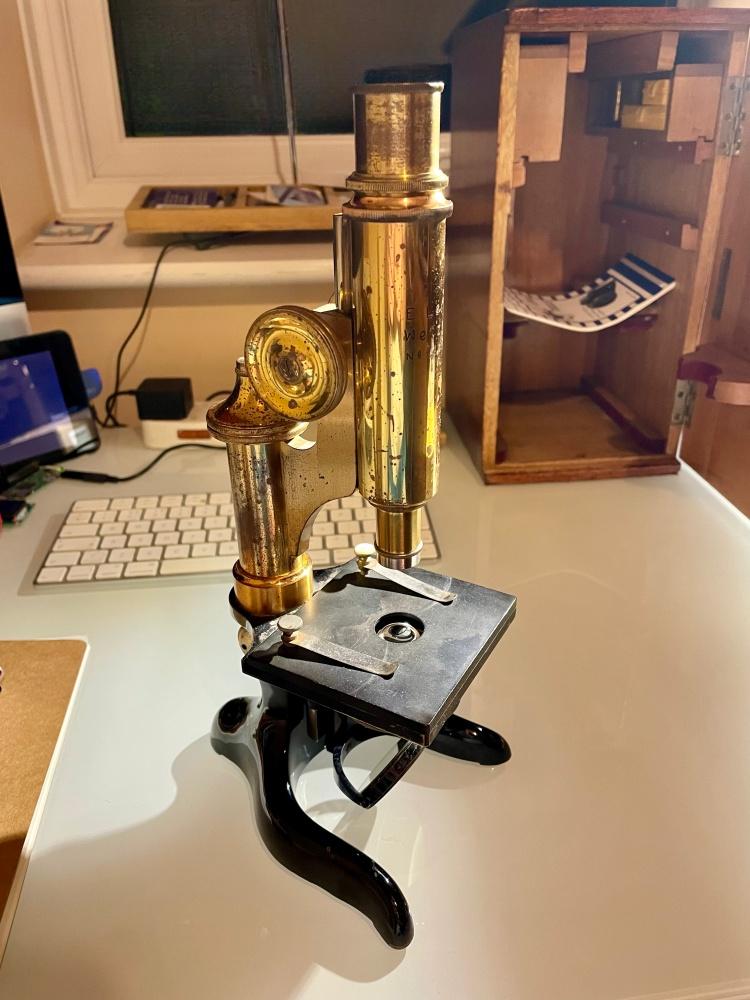
The stand has the following characteristics:
- Broad horseshoe foot
- Thick casting with substantial weight
- Deep gloss black enamel
- Swing-out mirror in a fork mount
The Stage
The instrument has a plain stage with clips.
Adjustment
The coarse adjustment is of rack and pinion type with large, exposed brass knobs.
Condenser
A fixed-aperture Abbe condenser is present and there is a swing mirror with plane/concave surfaces. The fixed aperture characteristic indicates the instrument was intended primarily for routine transmitted light work and was supplied as a solid, reliable, economical laboratory instrument.
Nosepiece and Objectives
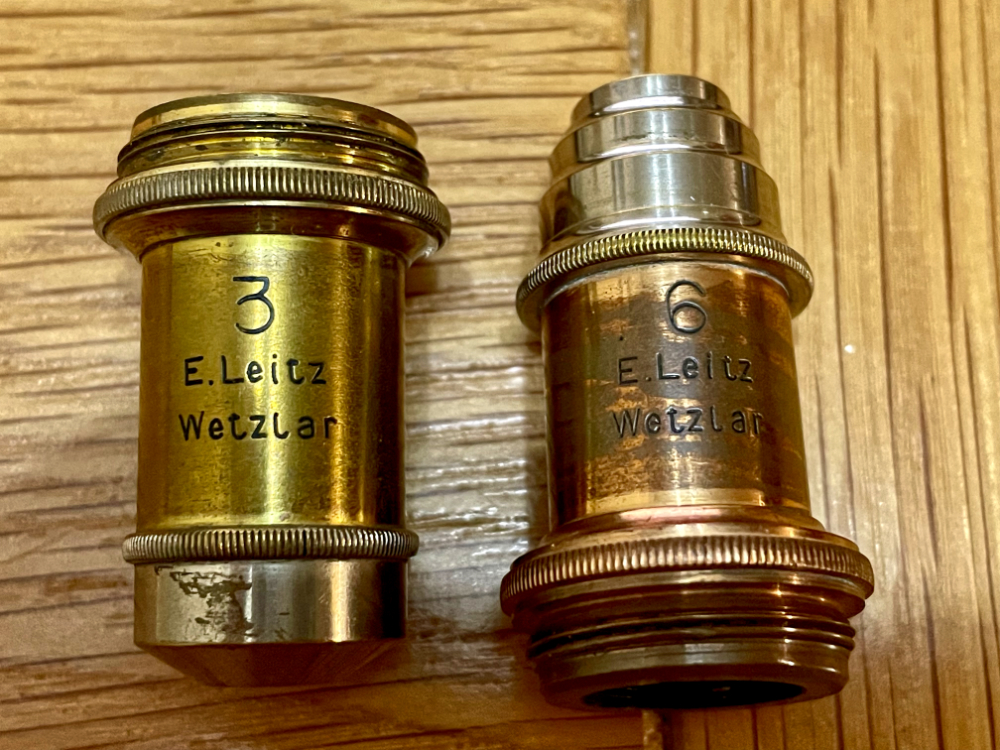
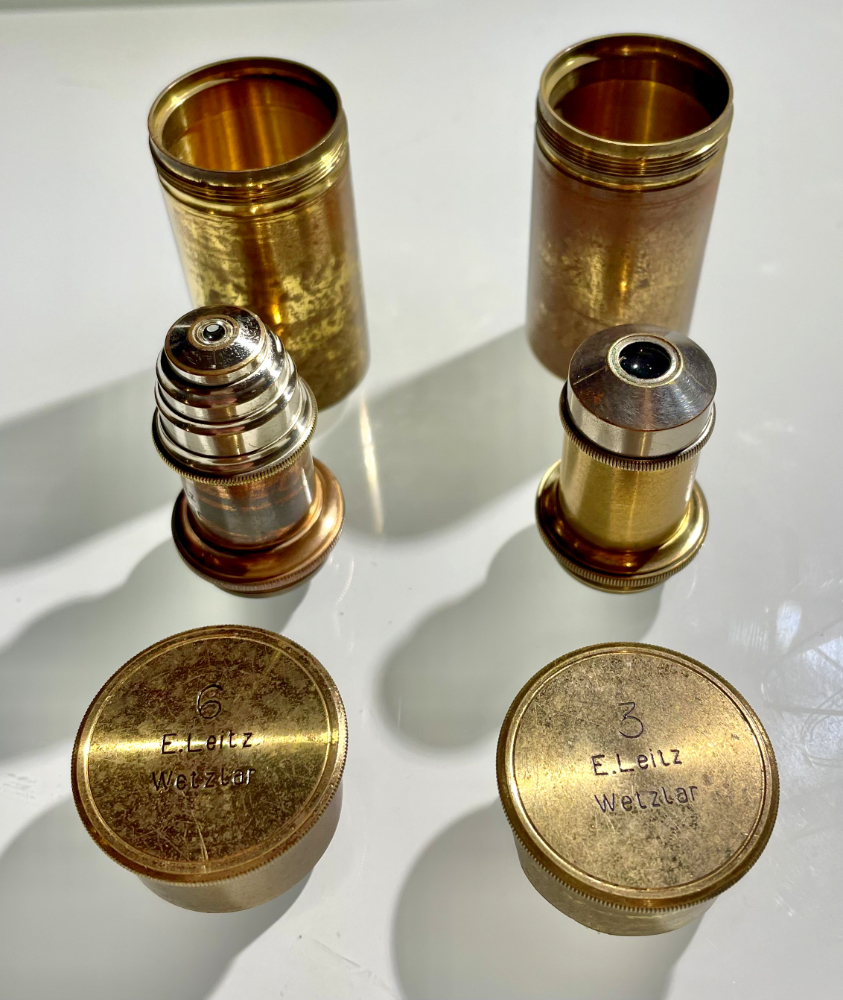
The nosepiece is a single objective mount with two objectives supplied, complete with original brass objective canisters. The first is a low-power option engraved number 3 and the second a high-power one engraved number 6, corresponding roughly to the following period-dependent characteristics 1:
| Leitz Number | Focal Length (mm) | NA | Likely Use |
|---|---|---|---|
| 3 | 18 | 0.28 | Low power scanning |
| 6 | 4.4 | 0.82 | High dry objective |
The font used in the engraving is clean, slightly rounded and is deeply hand-engraved.
The difference in orientation of the engraving on the two objectives is consistent with an early 20th century production in which objectives were assembled and engraved individually and not aligned to a cosmetic orientation relative to the mounting thread.
The omissions from the markings are significant. Later objectives, especially post-WWI, commonly included the numerical aperture, tube length and cover glass correction. Their omission suggests a ~1905-1915 production.
Eyepieces
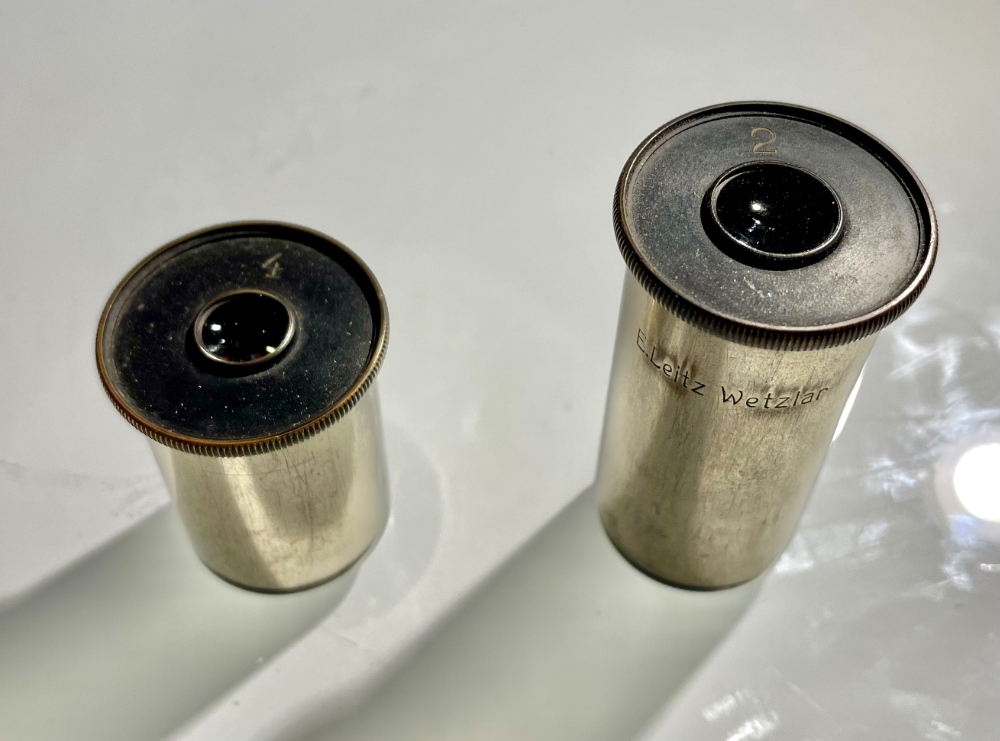
Two Huygens eyepieces are supplied, a low-power option labelled number 4 and a high-power option labelled number 2. The following eyepiece and objective combinations were likely used:
| Objective | Eyepiece | Use |
|---|---|---|
| No. 3 | No. 4 | Modest scanning magnification |
| No. 6 | No. 2 | High-power detail |
Manufacturing Quality
Pre-WWI Germany had strong materials supply chains, stable skilled labour and a pride in finish quality.
By 1912, Ernst Leitz Wetzlar was producing mechanically refined instruments, was financially stable and was working with high-quality brass and finishing materials. This resulted in instruments with thick, beautifully machined brass, deep lacquer tone, clean engraving, excellent silvering on mirrors and an absence of cost-saving shortcuts.
With the outbreak of war, brass became a strategically important material, being used in shell casings, and skilled labour and civilian production were redirected towards military objectives. Leitz began manufacturing rangefinders and other optics for wartime use.
While civilian scientific instruments were still manufactured, materials were rationed, finish quality was simplified and engraving became more utilitarian.
After the war, Germany faced economic crisis and export survival became critical. Industrial regularity, technical markings and systematic branding replaced the pre-war Edwardian craftsmanship. Further, to comply with the requirements of the 1891 McKinley Tariff Act in the USA, instruments and components intended for export were increasingly marked with the country of origin, “Germany” in this instance.
Instrument No. 149811 sits firmly in the pre-war camp.
Conclusion
This is a basic but very honest 1912 laboratory outfit.
The matched optics, period-consistent configuration and lack of later upgrades (such as a condenser swap) point to a coherent, intact set.
Typical contexts in which it would have been used are secondary schools, medical teaching laboratories, for botanical instruction and in small hospital laboratories. It would have been used for:
- Plant sections
- Pond protozoa
- Insect anatomy
- Histological slides
- Stained tissue
- Possibly basic bacteriology (but not high-end oil immersion work, as it lacks a suitable objective)
This is consistent with the intact nature of the set as research microscopes were often modified, this appears original.
-
Catalogue No. 40, Microscopes and Accessory Apparatus, Ernst Leitz, Wetzlar, 1903, Project Gitenberg, https://www.gutenberg.org/files/35842/35842-h/35842-h.htm ↩