Field Notes Journal Entry
A Copy of Selborne
A small 1842 edition of Selborne, found by chance in Oxford, becomes a thread linking observation across two centuries.
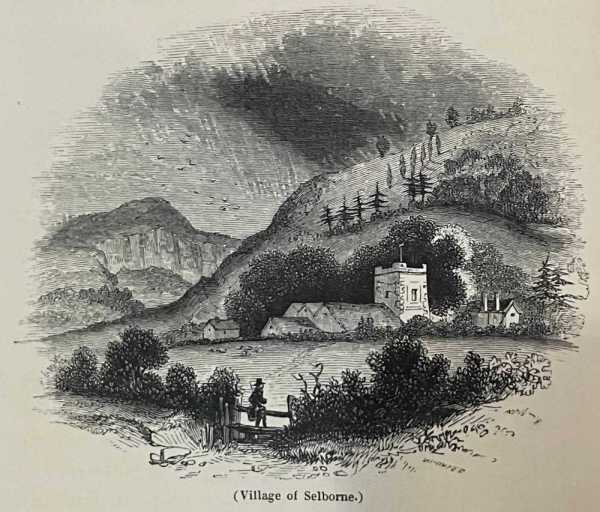
I picked this book up at Blackwell’s Bookshop, more or less by chance, about thirty years ago.
It wasn’t especially expensive — I think I paid around £60 — but there was something about it that stayed with me. A small, cloth-bound volume of The Natural History of Selborne, worn but intact, with a spine just beginning to give way. It appealed to me because it seemed to belong to the same world I’d attended to since my teenage years.
I’ve kept it ever since.
Recently, the outer spine — still present, but detached — finally needed attention. Repairing it meant looking more closely at the book than I had in years: the cloth, the paper, the way it had been put together. It is an 1842 printing, issued by the Society for Promoting Christian Knowledge, and described on the title page as “arranged for young persons.”
That phrase is more revealing than it first appears.
This is not simply a reprint of White’s original 18th-century text, but an adaptation — abridged and reorganised for a younger reader. That much is clear. But it is the dedication that fixes the moment more precisely.
Dated May 25, 1833, it is written in the voice of a mother addressing her son: encouraging him to work through the text for himself, to persist where it is difficult, and to learn by careful attention rather than simplification. Whether this voice reflects a real individual or an editorial device is not entirely clear. Bibliographic records attribute editions of this kind to an editor identified only as “G. Ellis”, about whom little is known. It is possible that the maternal voice is a persona adopted for the purpose; equally, it may reflect the circumstances in which the work was first prepared. In either case, the book carries the tone of instruction as something personal, domestic, and deliberate.
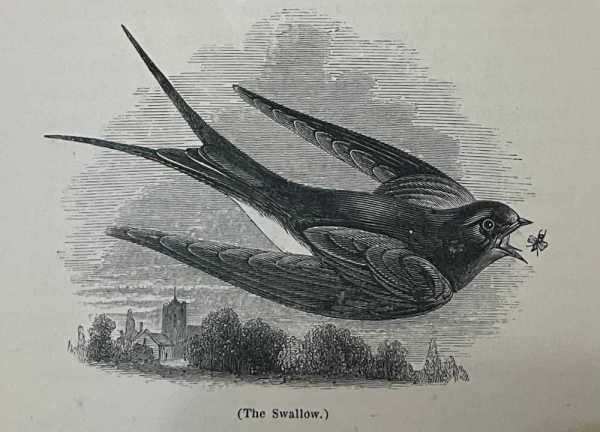
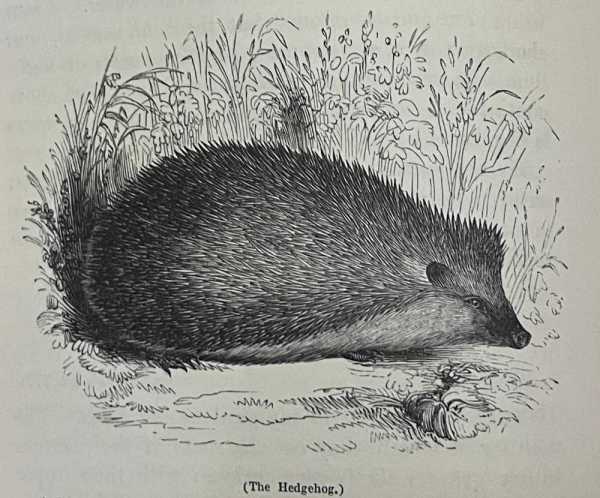
The illustrations are part of the same system.
Throughout the text are small wood engravings—hedgehog, rabbit, swallow, frog, bat — cut directly into the page. They are not plates, but working images, printed alongside the text. Their style places them firmly in the tradition established by Thomas Bewick: fine lines, careful shading, animals rendered clearly enough to be recognised and remembered. By the 1840s this had become the standard visual language of natural history, and these engravings were almost certainly produced by a professional London workshop, part of a wider network supplying educational publishers.
They are not exact, and not intended to be. They are clear.
At some point, the book was used as it was meant to be used. In the margins are pencil annotations — occasional, practical, unobtrusive. Someone read this not as a possession, but as a working text. The combination of printed illustration and handwritten note suggests a reader learning to look: matching what was seen on the page to what might be found outside it.
That, after all, is what Selborne is for.
It is difficult not to see a line running through the book: from White’s own observations, through this 19th-century adaptation, through the unnamed reader who added their notes, to the present. Not a straight line, but a continuity of attention. The methods change — letter, engraving, notebook, dataset — but the underlying act remains the same.
To notice. To record. To return.
The book now sits alongside my own records of place. Not as a reference in any formal sense, but as something closer to a companion. It was intended to teach a child how to observe the natural world. It was used. It survived. And, by chance, it found its way into another set of observations, made in a different century, in not entirely different surroundings.